| Author |
 Replies: 17 / Views: 13,285 Replies: 17 / Views: 13,285 |
|
Valued Member
United States
397 Posts |
I've got a good deal of junk gold I'd like to refine myself as just a experiment.
I understand that Aqua Regia can do it , however I'm curious if plain nitric acid can do it as I have some onhand.
|
|
|
|
Bedrock of the Community
Australia
21792 Posts |
You need concentrated nitric acid and concentrated hydrochloric acid for aqua regia.
In most cases, it is almost illegal or impossible to get concentrated nitric acid, because of it's obvious use in explosives manufacture.
You can endanger yourself as well as other people.
If you could, I guess that after dissolving the gold it could be electrolytically refined from an aqueous solution, an recovered off the anode, or as a sludge.
Too much effort, expense and danger. Take your gold to a refiner, if you have enough of it, or sell it as is.
|
|
Bedrock of the Community
United States
12437 Posts |
There is a very good reason why gold is classified as a nobel metal- aqua regia, mercury, and cyanide compounds are the only chemicals that will touch it. Aqua regia is definitely NOT for home experimentation.
|
|
Pillar of the Community
United States
1391 Posts |
I wouldn't do it if I were you. My dad used to pan gold and would use different things like mercury and nitric acid. He was very careful and followed all sorts of safty precautions. You already have the gold extracted right (in the form of rings or necklaces)? I'd just take it to a refiner, or sell it and buy some gold coins with it. Less time, money, effort and danger on your part.
|
|
Pillar of the Community
United States
6438 Posts |
I've chemically refined gold using aqua regia and it's not too complicated, but you need the acids and you really should have a fume hood to protect yourself from the fumes. You can also use concentrated hydrochloric acid plus sodium chlorate solution in combination to generate a corrosive chlorine mixture that dissolves gold, palladium, and platinum. If your gold is in very small pieces you can leach it with nitric acid alone; this will dissolve silver, copper, and other base metals without touching the gold. I don't expect this would work very well with solid gold jewelry but you could try it. Just be careful. Here's a 50-gram nugget of 24-carat gold I prepared using the aqua regia approach. 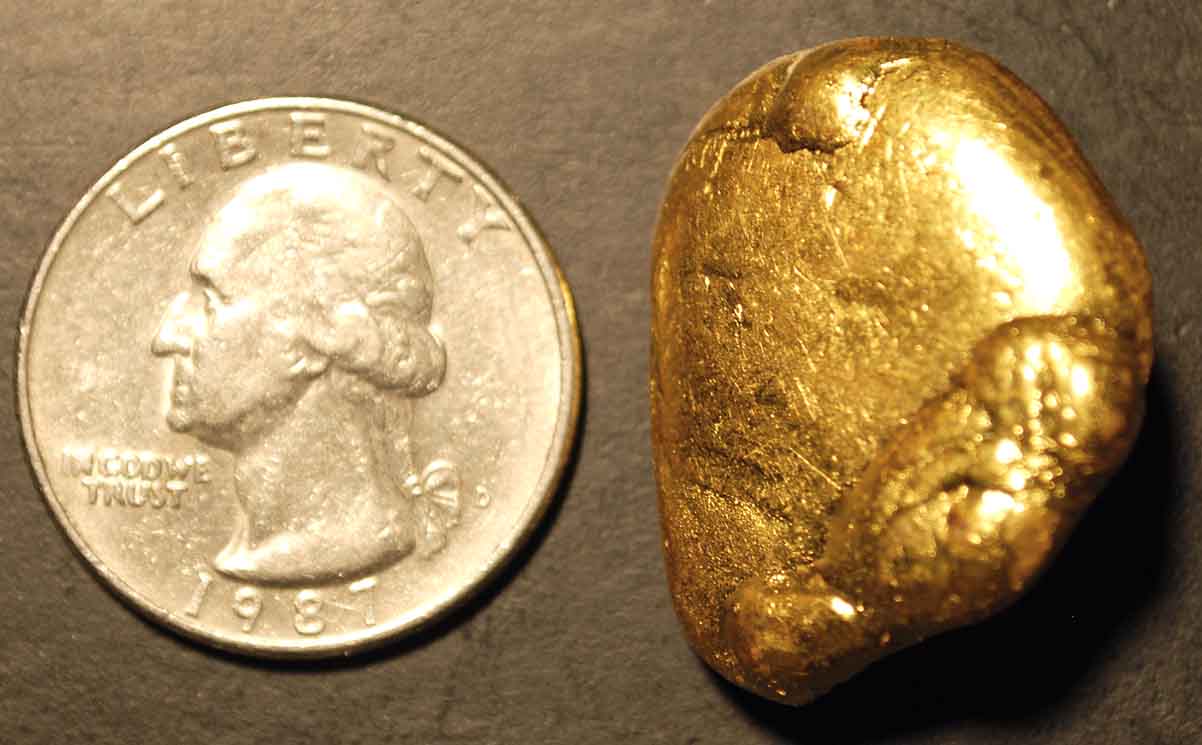 |
|
Pillar of the Community
United States
830 Posts |
Wow that's about a $2600 nugget...what was the source of the gold you reclaimed?
|
|
Pillar of the Community
United States
4008 Posts |
Quote:
I'm curious if plain nitric acid can do it as I have some onhand. Nope. Nitric acid will nicely clean a piece of gold jewelry but will not attack the gold at all. Aqua regia (royal water) attacks gold with concentrated hydrochloric acid in an oxidizing medium (concentrated nitric acid). Both are needed for the gold to be dissolved. Plus... what happens then? Well, you have gold dissolved in an acidic aqueous medium. You could probably neutralize the acids with baking soda and water but the gold itself might not precipitate out of the solution as a gold dust like material that could easily be filtered off, dried, and recovered. It could well come out as a gooey sludge of some kind that you would have a lot of trouble handling. Such a sludge might be recoverable via high temperature roasting to drive off the water and perhaps other impurities but the vapor coming off of there could be toxic or at the very least quite irritating. A chemist would do this in a muffle furnace inside a working hood. A ceramic crucible would be needed to hold the gold slurry / sludge. I agree with the others who suggest selling this to someone who does professional gold refining. |
|
Pillar of the Community
United States
6438 Posts |
My refining experience was with electronic scrap that included gold plating and monolithic capacitors containing gold, palladium, and platinum mixtures. Here's a synopsis of my method for you chemistry buffs! 1) Add excess aqua regia and heat to dissolve all the metals including base metals (copper, zinc, lead, aluminum, iron). 2) Filter out all the insoluble materials, rinse with deionized water to collect all the soluble metals, and boil the resulting liquid to drive off the residual free chlorine and concentrate the metals. 3) Dilute with 1% hydrochloric acid and then add sodium nitrite solution which specifically precipitates the gold and base metals. The gold comes out as a spongy mass with the base metals mixed in as oxides. The palladium and platinum form complexes with the nitrite ion which keeps them in solution for later recovery. 4) Filter and rinse the precipitate to remove all traces of chloride (left over from the hydrochloric acid), then boil the residue with dilute nitric acid. All the base metal oxides dissolve, leaving purified gold sponge. Repeat this process several times to ensure the base metals are all removed. 5) The gold sponge holds together very well and is easily handled. After drying in an oven the gold is ready to be melted to form nuggets or ingots. I used an ordinary Bernzomatic propane torch to form my nugget from sponge. Good times, good times!  |
|
Bedrock of the Community
Australia
21792 Posts |
The Incas had an interesting way increasing the purity of gold in the surface layer of a gold object.
If the object was say 50% gold copper alloy, the piece was immersed in an acid to leach out the copper, leaving the gold behind. The surface was then beaten to create the finished surface.
The alloyed gold is stronger and harder than pure gold, but the surface has a rich gold layer.
Which brings me to an interesting question:
can gold be refined by just using hydrochloric acid only?
For this situation, the gold would have to be reduced to a fine gold dust, before being immersed in a hydrochloric acid solution only. As I understand it, all chlorides are soluble in water.
After the reaction, the whole lot would be allowed to stand for some time, then the copper chloride solution decanted off, leaving a heavy gold sludge.
This sludge could then be filtered, several times, the gold being retained in the filter. Perhaps some sort of aqueous electrolytic process could follow, to further refine the gold.
I am definitely NO chemical engineer, it just seems reasonably logical to me.
Comments?
Edited by sel_69l
07/27/2011 02:30 am
|
|
Valued Member
Australia
193 Posts |
I refined some scrap jewelery to extract the gold using nitric acid some years ago. A metallurgist provided me with the knowledge and the nitric acid.
Co-incidentally it was only a few days ago I was thinking about the best way to get that refined gold officially assayed/certified as I'd like to sell or swap it.
Jaobler, whilst you know what you have is pure gold, what path would you take to give it 'creditentials' so someone else who can buy it as advertised?
This is the question I have with my little 'nugget'. Unlike a coin, I don't mind if someone cuts it in half so long as they say they will buy it if it is truly gold.
|
|
Pillar of the Community
United States
4008 Posts |
Quote:
can gold be refined by just using hydrochloric acid only? Well, the gold itself will not dissolve in HCl but most of the inorganic impurities that are contaminating the gold might very well dissolve into the HCl. If you are thinking about a multi-stage extraction process to remove the impurities, that would probably work to some extent. Not sure how pure the gold would become from this. It is doubtful that any of the platinum group metals would be soluble in HCl, so if these are part of the "impurities", then another purification method would likely be needed. Quote:
For this situation, the gold would have to be reduced to a fine gold dust This could be a considerable physical problem. Gold is quite soft as metals go, so it would be difficult to reduce it to a dust-like material. If a substance can be dissolved and then rapidly precipitated, a very fine dust-like material often results. Just as often, the rapidity of the precipitation occludes impurities within the particles of the material of interest. Not sure if gold could be ground to a powder without it smearing and flattening all over the grinding equipment, though. Quote:
As I understand it, all chlorides are soluble in water. With perhaps a few exotic exceptions, this is true. Not all elements form chlorides, though. Gold and platinum do not form compounds very easily at all. In many cases, the compounds that can be formed from them tend to be complexes with various other atoms or molecules. This is how cyanide dissolves gold... as an aqueous sodium cyano complex, like this: 4 Au + 8 NaCN + O2 + 2 H2O â†' 4 Na[Au(CN)2] + 4 NaOH While this is an effective gold leaching process, it is also extremely dangerous. Cyanide compounds are extremely toxic and can form airborne HCN gas if the solution pH is allowed to drop below about 10. The wastes from this process are also quite toxic and much chemical treatment is needed to neutralize their toxicity. Quote:
This sludge could then be filtered... I have filtered any number of sludges and every single one of them was a pain in the neck. They filter VERY slowly in most cases and vacuum is needed to filter them at all. The filter medium has to be sized correctly for that particular sludge or the pores in the filter will either plug very quickly or allow the bulk of the sludge to pass through it. This can sometimes be avoided via cooking the sludge in a muffle furnace for several hours at 600-700C and then doing additional purification steps on the resulting dry solid. I'm not a metallurgist or a mining engineer, so do not know a lot about the refining of gold. I can help a bit with the chemistry of some processes, though. The Internet is a great resource for learning about the various commercial processes for gold and silver recovery.  |
|
Bedrock of the Community
Australia
21792 Posts |
Ed_B
As my limited knowledge says to me, gold will combine with other elements as indicated by you. By the same reasoning, gold chlordide may not exist and therefore remains insoluble when soluble copper chloride is decanted off. That is how I figured it, anyway.
What I am not sure about is weather any of the gold double salts are soluble or not. In Western Australia, gold is mined in the mineral telluride, which is also a complex gold double salt in association with tellurium. Again, I do not know if this mineral is soluble or not. I guess that gold is recovered from telluride by the simple application of heat.
Again I guess that gold could be recovered in the process that I figured by the application of heat.
How fine must the gold alloy particles have to be? would have to be answered in any viable industrial chemical process. What triggered my reasoning off is the fact that hydrochloric acid must leach at least to some small depth in a surface enrichment process. Would very fine gold alloy filings suffice for this process?
The same surface enrichment process was used with British 50% fine silver coinage. In this case the alloy was 50% silver, 40% copper, 5% nickel, and 5% zinc. Before striking the planchets were blanched (acid washed, then rinsed), before planchet production. The acid preferentially attacked the copper nickel and zinc. I suppose pH management would control this preference.
The surface metal would have been spongy, but would have had an enriched silver surface after striking. The acid wash process was known as 'blanching'
So I am still not sure if my little piece of industrial chemical engineering is valid or not, at least in principle.
|
|
Rest in Peace
United States
9104 Posts |
Like posting 16mb pictures and cleaning coins, home gold refining strikes me as one of those "just because you can do it, doesn't mean you should do it" things.
|
|
Rest in Peace
United States
9104 Posts |
Quote:
Jaobler, whilst you know what you have is pure gold, what path would you take to give it 'creditentials' so someone else who can buy it as advertised? Realizing OZ is a big island, if you're near the gold fields, it should be simple to find an assayer. If not, a bench jeweler should be able to direct you to one. |
|
Moderator
 Australia
17000 Posts |
Quote:
can gold be refined by just using hydrochloric acid only?
For this situation, the gold would have to be reduced to a fine gold dust, before being immersed in a hydrochloric acid solution only. As I understand it, all chlorides are soluble in water. Silver chloride is one famous chloride salt that will not dissolve in water. So if your raw gold contains silver (something that I understand is common in Australian gold) then HCl won't pull that out. Platinum-group metals won't come out, either, which are also likely to be trace components of native gold. Don't say "infinitely" when you mean "very"; otherwise, you'll have no word left when you want to talk about something really infinite. - C. S. Lewis
|
|
Bedrock of the Community
Australia
21792 Posts |
I agree with Sap.
I was thinking more of refining (say) 9 or 14 ct. copper gold alloy, where there are only two metals involved.
If silver, and the platinum group metals involved, I guess that a sludge containing gold must result, and would require further refining, by industrial methods that would be dangerous to the back yard chemist. That would involve nasties, like mercury or cyanide!
I cannot think how you would remove silver chloride from a gold sludge, except by heating to melt temperatures, where the silver chloride would appear as dross. I would not like to manage that much heat, although it may not be beyond a good backyard operator with acetylene, but not my cup of tea. Besides some Australian gold nuggets have small amounts of arsenic in them. I don't want to breathe that vapour!
Copper and it's salts are poisonous enough as they are!
|
| |
Replies: 17 / Views: 13,285 |










 Posted 07/26/2011 10:57 am


