| Author |
 Replies: 29 / Views: 4,603 Replies: 29 / Views: 4,603 |
Page 2 of 2
|
|
|
|
Pillar of the Community
Philippines
1156 Posts |
the excel spreadsheet has helped me keep track of the coins I love to have and the direction to go for my collection. All the other unimportant coins, for me, they dont get listed at all
|
|
Bedrock of the Community
United States
17884 Posts |
Quote:
I think it's important to point out that most homeowner/renter insurance policies DON"T cover coins. You have to purchase a rider to get coverage. It is also important to note that riders on homeowners/renters policies tend to be VERY expensive compared to coverage from a firm that specializes in covering collectibles. Quote:
You need to track your cost basis when/if you sell since it's taxable. This can be very important if you have high value items. If you don't have records showing purchase price or when acquired you run the risk of the taxable gain being figured from the face value to the present market value. |
|
Pillar of the Community
United States
1179 Posts |
I keep one to prevent me from buying the same coin twice. Also, when I upgrade a coin, I have record of what I paid for the old one, might help my selling price etc. Mine is pretty simple, but very organized by denomination. A quick fiter on my cents tab and I can see exactly what I need to bring to the show to buy etc...very useful.
|
|
Pillar of the Community
Australia
585 Posts |
Definitions of numismatics:
the collection and study of money (and coins in particular)

Buying coins is stressful because I usually pay more then what I can afford,
a real fun is the research, study and cataloging.
I have following page for every coin, one in the computer and one printed in the folder.
 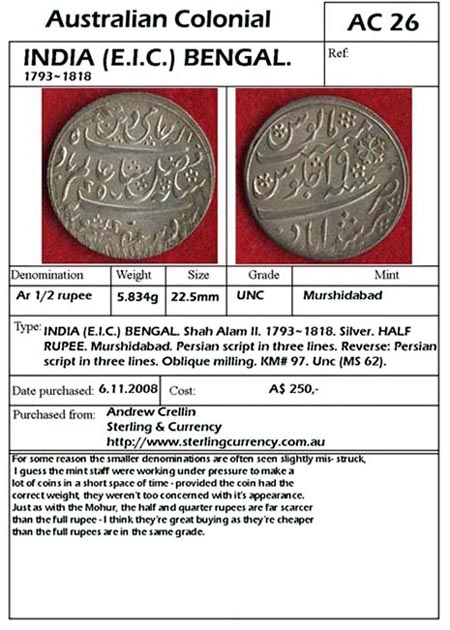
|
|
Valued Member
United States
429 Posts |
Inventory is a very personal list and should be put together the way that YOU want it. Some people may have it as simple as just the date with a check mark next to it while others seem to know the exact people on the Mint floor that day, if they were sick or not and what time of day it was created. However you do it, it is correct.
For me, I have different types of spreadsheets for the different types of coins I collect. My favorite coins are Lincolns and I go into a lot more detail with them:
1. A general checklist of every coin with the current grade it is in.
2. The second page has a list of what I have paid for the coin and color coordinated to show me coins that I want upgraded.
3. A color coordinated chart to show where my coin grades fall as a whole and what areas need to be improved on.
This list is a pain to keep up on but has come in handy more than once with buying the wrong thing. It hurts to spend your coin budget on one coin that you bought three different times within a week.
Most of my stuff is just a general list (date with a check mark, grade and maybe what I paid for it) and that is the only thing I need for them. If you do plan on selling them I would suggest putting something together though so it will be easier on you in the long end. The selling list is probably the hardest because I want to put a lot of detail into it and most of it really isn't needed at all.
Bottom line, do what you want and have fun with it.
|
|
Pillar of the Community
United States
8904 Posts |
Quote:
color coordinated to show me coins that I want upgraded That's a GREAT idea! I was trying to figure out a way to do that! Now I need to go through all my albums! |
|
Pillar of the Community
United States
1801 Posts |
You need some kind of record keeping. I never kept records when I was young and now I wish I did. The memory doesn't work quite as well now and I can't even remember where/when or how I acquired some of my coins. When my son was home from college summer of 2008 I had him start building me a digital record of all my "collector coins" (we didn't expand into the "bulk" coins like rolls of silver and wheat backs etc. and we are only doing the key dates in the Whitman and Dansco albums) It has been an ongoing project but the results so far are excellent. Now I can pull up a coin on my computer screen without going to the SDB at the bank and see right away what I have and in what condition. My goal when the digital record is complete is to go into the shoebox full of receipts and match the coins to the original receipt. One unexpected outcome of the digital file was the discovery of 2 altered coins in my collection (amazing what you can see on a 720dpi scan blown up to full screen size). I was able to track down the receipts, contact the dealers (we're talking 10 years after purchase) and get refunds on both.
|
|
Pillar of the Community
United States
1083 Posts |
Snitchard, one suggestion that would simplify your spreadsheet - drop the current price listing. You have to look that up each time and it is obsolete in a week. Who cares if you got a deal a year from now? I do include the price I paid, which gives me a rough idea of what I need to sell it for - pretty depressing really because I always lose money on resale.
|
|
Valued Member
 United States
422 Posts |
Hello, okie-colin, what do I do if I forgot what I paid for a coin and did not write it down? My totals will be off if I can't figure something out. I don't think I'll be selling any of my coins anytime soon but even if I do I know I will not even get what I paid for them because all of my coins are very common and available almost anywhere. I'm not as worried about deals as I used to be but still worried about overpaying. I have 3 "price" columns on my want list 2 are price guide prices and one is ebay's average price for the coins on the list updated before I buy. Today I went to a coin show and a dealer wanted $54 for a 1998 American Eagle Silver Proof. I took the average of the 2 price guide prices from my want list and made that my "highest willing to pay price." Well after I got home I realized I should have also included the ebay price. My original "highest willing to pay price" was $52. After adding the ebay price my "highest" went up to 55.25 (I always round to the nearest quarter to make things easier.) The average ebay price as of this morning was $61.50 and had I purchased that coin I do not think I would have overpaid. As long as my total "price paid" column is lower than my highest willing to pay" column I'm happy. If there is a coin I really want or need to complete my collection I'll go over my "highest" a little. Any suggestions on my problem of forgetting what I paid for those other coins? Thanks, Rich |
|
Pillar of the Community
United States
1083 Posts |
By all means list the price you paid for the coin, just forgo the price list info. Unless all this is part of the fun of collecting for you - have you ever considered that you might be a little compulsive about all this? Been there done that!
|
|
Valued Member
United States
422 Posts |
okie-colin, Yes of course I'm compulsive that is an unfortunate part of my nature. I think just Carl has a point too. Quote:just carl - As for myself, I just gave up a long time ago as the collection grew way to much in quantity. For example to just record each Mercury dime would take me forever. I've got over 3,000 of those alone. Over 100 Whitman Albums. Documenting all that STUFF would take up all my time. NO, I'd just rather look at what I've got and ignor attempting to document it all. I guess as long as I know I did not "overpay" what I paid shouldn't matter because as I said even if I sell a coin and I paid $40 in 2008 means I'd be lucky to get $35 in 2011 or anytime in the future anyway. Right? Thanks, Rich |
|
Pillar of the Community
United States
731 Posts |
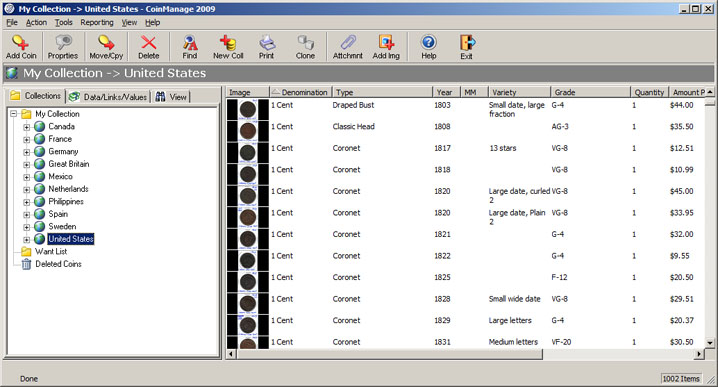
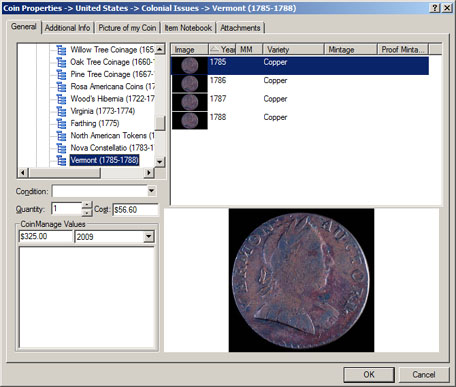
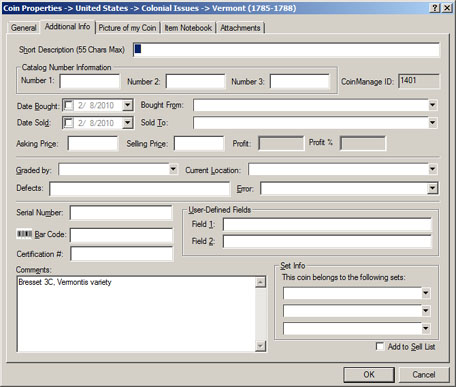
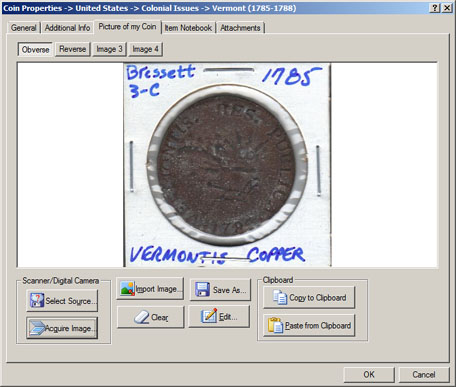
I'm surprised that no one has mentioned CoinManage software... IMO it's great software, inexpensive, and allows one to track as much or as little as they desire about their collection... including photos, RedBook values, price paid, grades, varieties, sources, links, countries, bar codes, serial numbers, etc. Once can do a google search on 'coinmanage software'. Liberty Street is the manufacturer. |
|
Bedrock of the Community
United States
20753 Posts |
Quote:
Here is my current problem I attended a couple of coin shows 3 or so months ago and bought some proof sets and commems and I didn't enter it in right away and can't remember what I paid or who I bought it from. That messes up my inventory if I'm keeping track of all of that. I'm not worried about theft because my collection isn't really worth a lot from a dollar point of view, from a sentimental point of view is another story. My homeowner's insurance only covers up to $2000 if my collection ever grows past that point then I'd be losing money in the long run if it ever got stolen. I also keep a pictorial inventory of all the coins I purchase.
Eventually your collection will grow to a point where all that documentation will take up your entire home. Imagine if you have thousands of coins and a piece of paper, receipt, for each one or two. Then mountains of information in a computer, which you will also make copies on a flash drive or CD. Then you may print most of it out. And you'll find all that STUFF cost money and you could have purchsed some nice coins for that. |
|
Pillar of the Community
United States
1083 Posts |
Here is what I do. If you start with a good online software, or just use Excel spreadsheets, you will always know what you have and what you have in it. This is important information for selling or upgrading down the line, and marks the difference between a hoard of coins, quickly forgotten and a true collection. It cost practically nothing, except the time to update it. You can customize it to store just the information you want and need. I have four parts to my coin collection link. One spreadsheet that keeps track of Dansco albums dedicated to one series, containing detailed info on the keys. A second part that tracks the Dansco 7070 Typeset. I copied this spreadsheet off a previous post. This is the most valuable part of my collection and keeps track of original TPG grading before cracking out the coins, upgrades, and cost to name a few. A third spreadsheet that contains a list of all the coins not in an album, i.e. Morgans, Peace dollars, Mint sets, and bullion coins, etc. This spreadsheet is organized by denomination and is very important to track all those slabbed coins I buy on impulse because I like them. It helps me avoid duplicate purchases and to track my buying preferences. Lately I have begun adding VAM info on the morgans and Peace dollars. Fourth is a picture album of all my albums and many of my more valuable key date coins, including old US gold coins. All of these coins were slabbed originally and I took pictures of both sides in the slabs before cracking them out, plus saving the labels. I also have pictures of all the coins that stayed in slabs, An easy way to do this is to just save the pictures the seller used in his listing. All this greatly enhances my enjoyment of coin collecting. The only real work was in entering all the data the first time. Maintenance is easy if you keep up with your buying and trading activity. One other thing, I keep all online purchase receipts in case I miss anything. I haven't found it necessary to store paper receipts provided I enter the data in my spreadsheets as soon as I buy the coin. It takes up no room, costs nothing and IMHO the more data you have about your valuable collection, the more you will enjoy it. Edited by okie-colin
02/07/2010 11:12 am
|
|
Pillar of the Community
United States
731 Posts |
|
|
Page 2 of 2
|
Replies: 29 / Views: 4,603 |
Page 2 of 2
|








 First Page


 Posted 01/29/2010 8:30 pm