Hi,
I can almost guarantee that in any major city one can easily find a coin shop or jewelry store that would analyze this potentially exceptional error coin using an x-ray fluorescence analyzer.
I personally had a rewarding experience involving a x-ray fluorescence analyzer last month.
Thinking that the local shop would not analyze my four suspect Alaskan gold nuggets for free using their x-ray fluorescence device, I also brought in about $ 40 worth of worn silver quarters to exchange for cash.
Upon my request the shop then happily pulled out their XRF x-ray fluorescence analyzer gun and determined that my four gold nuggets had a total aggregate amount of
8.42 grams of 21.4 karat AU (gold)
In summary since each nugget had a distinct gold weight and AU karat anatomy the shop gave me a free report for each nugget separately as well as a combined aggregate compositional report. All of the tests combined took them all of two to three minutes to complete.
I know that it seems to be overkill using this expensive machine but what if the '66 error dime in question contains neither of the expected compositions of:
a) for 1965 and subsequent years:
Metal Composition: 91.67% copper, 8.33% nickel
Total Weight: 2.268 grams
nor
b) for 1964 and previous years:
Metal Composition: 90% silver, 10% copper
Total Weight: 2.5 grams
If this 1966 dime turns out to contain neither of the above compositions, you could be the proud owner of an 'error of an error coin'(now that's a really BIG MISTAKE) and the sky could be the limit for what someone might pay out to own this coin!
Calculating specific gravity and weight only, for example, will never accurately portray the precise elemental makeup of this dime should it turn out not to be categorized within a) or b) previously described.
IMO
PS:
For the scientifically-minded viewers interested in drilling down in greater detail deeper into this subject I attached an excerpt,
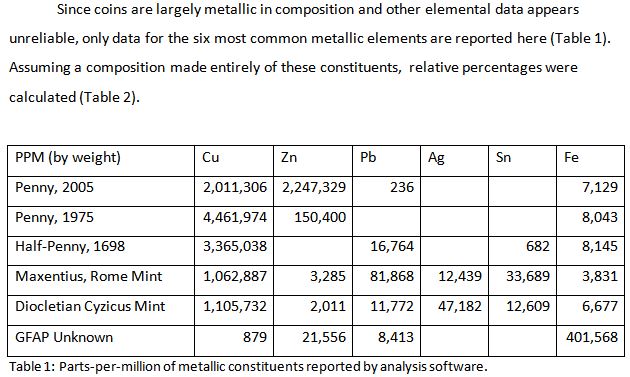
from an 18 page paper entitled,
'Study and Comparison of Coins by X-ray Diffraction (XRD);
Preliminary Findings' by Andrew Bearnot and Ashley Greene
http://www.google.com/url?sa=t&rct=...EcQFjAA&url=http://proteus.brown.edu/materialsscience/admin/download.html%3Fattachid=9759838&ei=z2J9UpTOLZHNsQTFqoL4AQ&usg=AFQjCNF8ChnHldwAzgSd7WcuZ60VTWvb7A&sig2=BUMOoQdmh42lWVHYEMAs4A
dedicated to analyzing various coins using x-ray fluorescence technology. This study addresses both XRF and XRD technologies.







 First Page
 Previous Page


 Posted 11/08/2013 10:50 am





