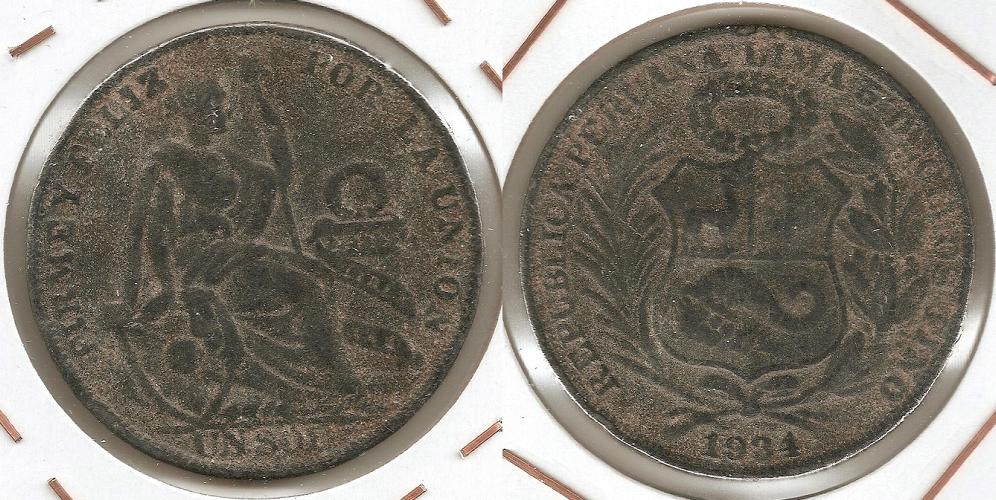
| Author |
 Replies: 97 / Views: 18,575 Replies: 97 / Views: 18,575 |
|
|
|
Valued Member
Uruguay
217 Posts |
bogdanjovi:The 1/2 Sol 1915 is made of 0.900 silver, It must be non-magnetic ! As for the other 1/2 Sol 1926 I think it goes into what is being discussed here. While this topic began with the coin 1 Sol 1933, I believe that what It is investigating here can apply to the entire minting of 1 Sol and 1/2 Sol from Peru between 1922-35. By law, this coinage should be 0.500 Silver, 0.400 Copper and 0.100 Nickel. With this alloy the coins should not be magnetic at all. However, reports of magnetic and non-magnetic coins have appeared here, this triggered the interest of all of us to know if the magnetic coins are authentic, with a higher proportion of Nickel than Copper by some minting reason, or are contemporary counterfeits or modern fakes. Swamperbob reported a coin that is a counterfeit made of copper-nickel, but I have found a coin that is 0.500 Silver without a doubt, whether it is authentic or not I do not know yet. Swamperbob says: Quote:
Now I have a comment for people who routinely use rare earth magnets instead of ferromagnetic magnets in coin authentication. If the rare earth magnet is so powerful that it detects the presence of 10% or 20% nickel - what actual value does it have? One way to test our magnets is first with a Jefferson nickel (25% Nickel, 75% Copper), should not be attracted by the magnet. After that, perform the test with the Peruvian coin in question, if It is attracted would enter into this discussion. Then perform a Specific Gravity test to determine if it is a Silver alloy 0.500 (SG = 9.64) or It falls directly into the fake category.
Edited by cara
12/20/2016 3:03 pm
|
|
Valued Member
Romania
86 Posts |
Quote: One way to test our magnets is first with a Jefferson nickel (25% Nickel, 75% Copper), should not be attracted by the magnet. After that, perform the test with the Peruvian coin in question, if It is attracted would enter into this discussion. Jefferson is not attracted. Unfortunately I cannot perform SG tests. |
|
Pillar of the Community
United States
5362 Posts |
ShadyDave You say in reference to my counterfeit: Quote:
His 1934 sol is a very obvious fake with the poor reeding, cast looking appearance and other poor details. None of my certified coins or raw Sol's look like a cast fake like that 1934. The 1934 counterfeit coin is not a cast fake. It may look like a cast in the pictures, but that is the fault of the pictures. In hand and under a microscope it looks far different. The coin was struck in collar using dies that picked up the very minor details of chipped lettering that I also see on your coin. The details are exceptionally sharp for a forgery totally unlike any type of cast coin I am familiar with. Look at the picture of the 3 on my coin. I do not believe that looks like a cast copy at all. The fine details are remarkably sharp at 30X. Until I get a new camera I will not be able to show more than that single picture. As I said earlier the 1934 coin does resemble the texture of the Micro-O Morgan dollars. They do not appear to be cast either but they are identified by very small details on the surface that transferred from the copied coin. There is no consensus yet on how the dies for the counterfeit Morgans were created. However, the date of creation of the Morgans is generally believed to be the 1930s. I think we are dealing with a forgery technique that was capable of copying the image of a coin onto a die capable of striking a near perfect copy. ShadyDave could you further this thread along by telling us if any of your magnetic coins are attracted to a standard ferro-magnet? Or only a rare earth magnet? This is critical because it is my opinion that the comment that started this discussion that there are both magnetic and non-magnetic sols is incorrect in a practical sense when dealing with authentication. If I am correct and you are using only a rare earth magnet to determine if a coin is magnetic or not - that is the problem. I do not use a rare earth element to authenticate coins because it is far too sensitive. The standard ferro-magnet is what should be used for forgery detection. Otherwise too many coins will respond to a magnet and the test itself gets called into question - just as it has here. It is a simple fact there are no 50% silver coins, sols or otherwise should respond to a ferro-magnet. Any that do are counterfeits or forgeries because they would need to contain 56% nickel. All of the "theories" needed to explain this apparent "magnetism" are unnecessary if my supposition is correct. Once again Occam's Razor would apply. The answer becomes very simple - do not use a rare earth element magnet for coin authentication.
|
|
Valued Member
United States
264 Posts |
Following up on my previous post on this topic I have obtained a neodymium magnet. I have two Peru 1 Sol. One is 1894TF and one 1926 1 Sol. The 1894TF is not within the scope of this discussion which is concerned wth Sols 1922 and later. However, I used this as a control for my little test. The 1894TF is a Lima issue Sol 24.95g 36.6mm x 2.7mm The 1926 Sol 24.95g 37.1mm x 2.7mm I've always struggled to differentiate the legend lettering size to determine which mint produced these (small letters for Philadelphia, large for Lima) without a second coin of the other mint for comparison. Perhaps someone in our community can identify which mint this 1926 Sol is from. The 1894 Sol is now in a PCGS holder and the 1926 Sol is raw. I tested each coin by placing a regular magnet and then neodymium magnet within 0-3mm of the surface (similar to the distance between OPs magnet and coin through plastic holder). All measurements and tests above were performed twice under controlled conditions to minimize error. Neither coin was attracted to regular magnet nor neodymium magnet. Below are photos of the 1926 1 Sol for reference:   |
|
Pillar of the Community
United States
5362 Posts |
The coin uses small letters which would mean it was made at Philadelphia. Note that on the small letter version the spacing between the A and M in LIMA is notably wider than on the large letter version. On the large letter version the letters are very close to being in contact. That said, I find it interesting that the 1926 US version does not respond to either type of magnet. It proves that an alloy with only 10% nickel is not responsive. It of course should not be magnetic because it has only 10% nickel by law. I still have not received a single response from a coin dealer who has or has ever seen a genuine magnetic Sol from the period of 1922 to 1935. There are multiple replies that magnetic sols exist but that in all cases those are counterfeit. So I am still basically waiting for some proof that: Magnetic Sols do exist and that such coins are genuine. The fact that these same magnetic coins may be encapsulated by TPG's is not proof of anything, except perhaps the failure of the methods of authentication currently used by the TPG's to work correctly. In the past 4 months I have expanded the number of Graded forgeries and counterfeits in my collection. The last 2 examples were both auctioned by Heritage unknowingly. Each was encapsulated and both are period counterfeits that were published as being counterfeit. One was published in Riddell's 1845 book and the other, more recently in a book published about 10 years ago. As long as collectors place their faith in TPGs without looking at the coins themselves there will be others. Buy the coin not the holder - is still great advise. If you can't tell the difference, then I would suggest you need more time to develop the prerequisite skills before spending your hard earned funds. |
|
Valued Member
Uruguay
217 Posts |
Hi guys, I have another theory about this issue. Does it make sense that in some coins the Nickel in the coin is Nickel-plated on the surface to comply with the law? According to my calculations, for a coin 1 Sol of 25gs, 10% of Nickel should be 2.5 grams, what is equivalent to a thickness of about 0.13 mm more on surface of the coin. This thickness would be sufficient to give a slight magnetism, compared to the mass of the coin, just like what I found in my 1/2 Sol 1923. I have reached that after I realized there is a strange crack in the coin, see the pictures. Has anyone ever heard of nickel-plated silver coins? I have never heard, so my theory is not very convincing, but what do you think? 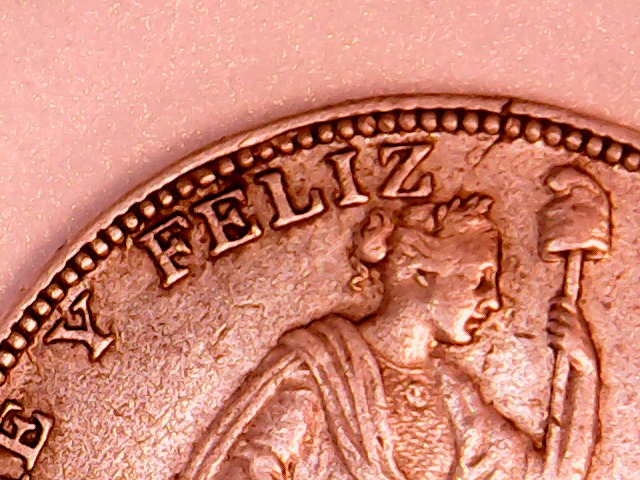 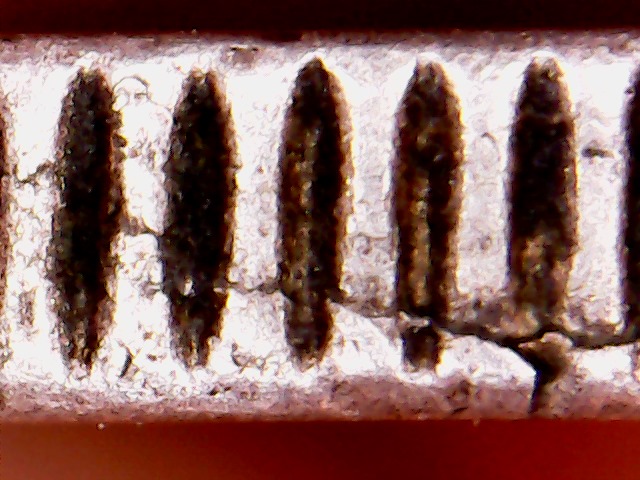 And this one: 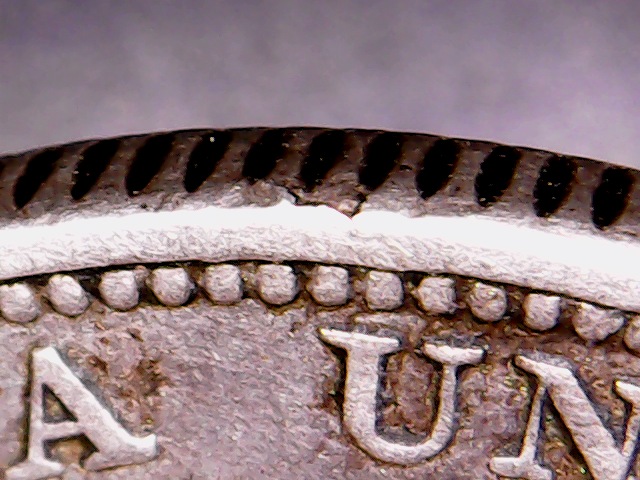 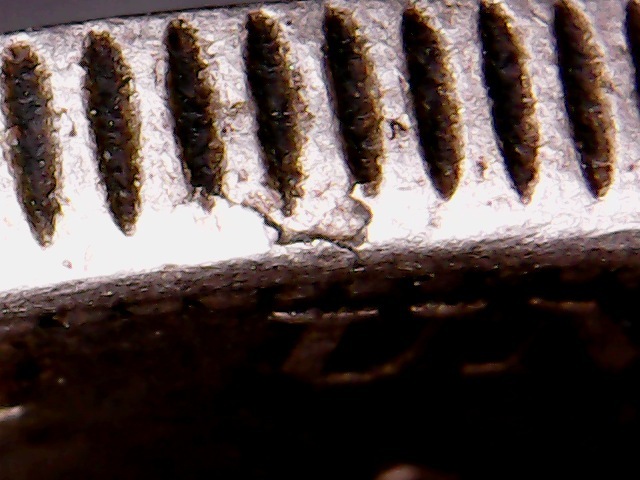 Edited by cara
12/27/2016 10:57 pm
|
|
Valued Member
United States
264 Posts |
While I applaud the original thinking regarding possible alternative explanations, the more I investigate this the less likely a viable authentic Sol becomes. A very thin plating of nickel is possible, but impractical. It would be more time consuming and expensive to apply a nickel plating to planchets or coins rather than to simply alloy them in the traditional manner. For that reason it seems an unlikely method of manufacture. Perhaps someone else can speak to the particulars of the coin photos you posted. Similar to your inquiry, at first I wondered if some Sols might have been made without nickel at the Philadelphia mint and perhaps the Lima issued Sols with nickel would be attracted to a rare earth magnet despite the limited amount of nickel they contain. However, some basic facts about magnetism and additional experiments changed my perspective. There are three classifications of magnetism. Ferromagnetic: Materials strongly attracted by magnet that can, themselves, also retain magnetism for some period of time. May lose magnetic properties at higher temperatures. Paramagnetic: Materials approximately 1 million times more weakly attracted to a magnet than ferromagnetic materials. Do not retain magnetism. Can become more magnetic at colder temperatures Diamagnetic: Materials weakly repelled by a magnet. When exposed to strong magnetic field they induce a weak magnetic field in opposite direction (repel). Some of these materials are used for levitation (such as mag lev trains). Magnetism involves a particular alignment of atoms within the material in question. What I discovered that was new to me is that a material's magnetic classification can change depending on quantity and interaction with other metals. For example, an individual copper atom is paramagnetic by nature. Pure copper objects are actually weakly diamagnetic. Stranger still, copper combined with small amounts of nickel (as little as less than 1% to as much as 30%) becomes non-magnetic. That is to say it is neither attracted to nor repelled by even a very strong magnet. When the proportion of nickel to copper exceeds approximately 30% nickel the alloy changes again to paramagnetic (and would be very, very weakly attracted to a magnet). Not until the nickel content exceeds approximately 60% will the alloy become ferromagnetic and attracted to a magnet. Another point of interest is that silver and silver-copper alloys are diamagnetic. That is, they are repelled by a very strong magnet (such as neodymium). To better comprehend this some empirical evidence is in order. I took a USA Washington quarter (25% nickel/75% copper layered clad around copper core), USA Roosevelt dime (25% nickel/75% copper layered clad around copper core), and USA Jefferson nickel (straight alloy of 75% copper, 25% nickel) and held a regular magnet and then a neodymium magnet in close proximity to each. None of these coins was in any way attracted to a regular magnet nor to a neodymium magnet. These coins contain 25% nickel in two forms (clad and straight alloy) and contain no silver and they are NOT attracted to regular or rare earth magnet. Next, I took a USA Walking Liberty half dollar coin and the Peru 1926 Sol I presented previously and placed them on a wooden table with no metal parts. I then moved a neodymium magnet a few millimeters above them without touching the coin or table in any way. Both the half dollar and then 1926 Sol slid along the table a few mm in the direction opposite of the motion of the neodymium magnet. These coins contain 90% silver and 50% silver respectively and they are REPELLED by strong magnet. How then could a coin with 50% silver, 40% copper, 10% nickel be attracted to any kind of magnet? As discussed above, the coin would need to be made of more than 30% nickel/70% copper to have even a very weak magnetic attraction. And that does not account for the silver content which would contribute to weakly repelling a magnet. As always, my mind is open to verifiable evidence to the contrary. However, until I am presented such evidence I consider magnetic Sols as non-authentic. |
|
Valued Member
Uruguay
217 Posts |
PetAr, thanks for your contribution to the discussion, what you say is very interesting, I want to give my point of view here: Quote:.....I took a USA Washington quarter (25% nickel/75% copper layered clad around copper core), USA Roosevelt dime (25% nickel/75% copper layered clad around copper core)......None of these coins was in any way attracted to a regular magnet nor to a neodymium magnet..... Because the clad is 25% Ni and 75% Cu, of course. If it were 100% Nickel would surely be attracted to the magnet as it is concentrated on surface. Quote:
....As discussed above, the coin would need to be made of more than 30% nickel/70% copper to have even a very weak magnetic attraction. And that does not account for the silver content which would contribute to weakly repelling a magnet.... Yes, more than 30% Nickel in a Niickel-Copper alloy, as you said, not Silver-Nickel or Silver-Nickel-Copper. Could be higher or lower because "The magnetic classification of the material can change depending on the amount and interaction with other metals," as you also said. While we have data on the Cu-Ni alloy, I found nothing yet on Ag-Ni-Cu alloys, but what does is true is that 10% of nickel would not be enough. Quote:
....As always, my mind is open to verifiable evidence to the contrary. However, until I am presented such evidence I consider magnetic Sols as non-authentic... Me too, at this point I have focused on understanding the composition of my magnetic coin (1/2 Sol 1923, flat top 3, LIMA mint), since I do not have any other for tests. The proven facts of this coin are these: -Weight: 12.35 gs -Diameter: 29.8 mm -Thickness: 2 mm -S.G. : 9.62 which would indicate an approximate alloy of 50% Silver and 50% of Copper-Nickel. -The coin is very weakly attracted to a common magnet and weakly attracted to a powerful magnet. "Weakly" means that if the magnet moves abruptly, the coin falls. Are two possible theories, from my point of view: 1-The coin does is authentic, and complies with the law in composition (50% Ag, 40% Cu, 10% Ni). So, the only explanation for this magnetic phenomenon is that the nickel is concentrated,on the surface for example. 2-The coin is not authentic, or may be authentic but does not comply with the law for some reason, and could have 20, 30, 40 or even 50% of Nickel, which could also explain the slight magnetic effect. These are the two theories that I come to mind for this coin, I suppose that only a spectroscopic analysis would tell the truth at this point but unfortunately it is out of my reach here. |
|
Pillar of the Community
United States
5362 Posts |
Cara - A couple points to consider - a plating of nickel on a silver copper alloy would simply NOT be magnetic. The diamagnetic effect on the core would be repulsion and any magnetic attraction by a 0.13 mm layer would be cancelled out.
You also said you had written to the Peruvian Numismatic Society. Have they responded to the existence of a magnetic sol?
Based on the science of the alloys the only answer for a "magnetic" sol appears to be a fraudulent coin. That is still the only answer I have received from any of the responding dealers 52 out of 57 replied. None has encountered a genuine Sol that is magnetic.
The only postulate left is that a nickel forgery (60% nickel and 40% copper) may have been made at the mint, However, given the ability for die duplication it would be difficult if not impossible to tell a struck forgery from a strike with genuine dies.
Finally a comment on malleability. Silver and copper are malleable metals the can be struck typically without cracking. An alloy of 50% silver, 40% copper and 10% nickel should be malleable. The crack appearing in the edge of the 1923 1/2 sol is an oddity that makes me believe it may actually be a forgery. Coins that are predominantly nickel will often show stress fractures at the perimeter. It is a common condition on 8R counterfeits of Cap and Ray types made in the late 1830s-1840s which were struck in various "white nickel" alloys (generic German Silver).
|
|
Pillar of the Community
United States
1962 Posts |
One wonders whether there are actually 57 coin dealers in the history of the entire universe who have put a magnet to a .500 Peru sol.
There has been a lot of speculation and deduction from people who frankly, I think, have little-to-no noteworthy experience with these coins - myself included. If there any collectors who are seriously familiar with these - long time collectors, have at least a few dozen of this type available to compare (1933 and surrounding .500 years... perhaps also the .500 1/2 sol coins)... are you out there?
Would seem this Peruvian Numismatic Society would be the place to start, at least in terms of simple practical experience with these pieces. Cara, get on them about this!
|
|
Pillar of the Community
United States
5362 Posts |
The 57 dealers I chose were not selected randomly. They are all world coin specialists and most had between 5 and 40 examples of 1930's sols in stock. All were asked to test their coins with a magnet. I offered a $50 payment for any date they believed to be genuine but which was magnetic.
There were no takers.
Of course I am awaiting the reply from the Peruvian NS to see if any illegal coins were released "officially".
One thing that this thread has proven is that no coin with the correct alloy is magnetic.
|
|
Pillar of the Community
United States
1962 Posts |
|
|
Valued Member
Uruguay
217 Posts |
Swamperbob, Quote:
.....a plating of nickel on a silver copper alloy would simply NOT be magnetic. The diamagnetic effect on the core would be repulsion and any magnetic attraction by a 0.13 mm layer would be cancelled out. ... I am not at all in agreement with that, because it is difficult to quantify since the silver-copper alloy is weakly repelled, while the Nickel is strongly attracted. I tested with a steel wire of 0.2 mm in diameter and this was attracted by a magnet through a 0.900 silver crown coin. So I tend to think that a layer of 0.13 mm of nickel on both sides of the coin (0.26 mm in total) versus about 2.6 mm thick on a silver 0.500 coin might present a slight magnetic attraction, like the phenomenon questioned here. Anyway, I accept that my theory of the coating of Nickel on the coin is unlikely and I have already dismissed it as impractical, as PatAR said. Quote:
.......Silver and copper are malleable metals the can be struck typically without cracking. An alloy of 50% silver, 40% copper and 10% nickel should be malleable. The crack appearing in the edge of the 1923 1/2 sol is an oddity that makes me believe it may actually be a forgery. Coins that are predominantly nickel will often show stress fractures at the perimeter. It is a common condition on 8R counterfeits of Cap and Ray types made in the late 1830s-1840s which were struck in various "white nickel" alloys... That's a good point, in the case of my coin the S.G. indicates a silver 0.500 alloy, but also may be a fake, of course. The other 50% can be predominantly Nickel, which would explain the little malleable alloy as you say and would explain the cracks. Quote:
........You also said you had written to the Peruvian Numismatic Society. Have they responded to the existence of a magnetic sol?...... I have not received an answer yet, I think they are taking research seriously. Keep in mind that this time of the year is complicated too. When I receive a reply I will inform you. realeswatcher, That is an interesting contemporary counterfeit made of lead. By the way .... happy new year for all of you! Edited by cara
12/30/2016 06:33 am
|
|
Pillar of the Community
United States
9395 Posts |
Quote:Next, I took a USA Walking Liberty half dollar coin and the Peru 1926 Sol I presented previously and placed them on a wooden table with no metal parts. I then moved a neodymium magnet a few millimeters above them without touching the coin or table in any way. Both the half dollar and then 1926 Sol slid along the table a few mm in the direction opposite of the motion of the neodymium magnet. I wonder if this repulsive force is actually caused by eddy currents induced in the coins as you move the strong magnet closer to the coin? Back some years ago, I did experiments with half dollars and dollars, strong magnets harvested from old 5-inch disks, and a milligram balance. The coins were placed on the scale, and a plastic box was positioned over the coin and scale to shield them from air currents. The magnet was placed on top of the plastic box, very close to the coin. The static repulsive force for these coins was only a few to several milligrams. However, as you moved the magnet towards the coins, the scales showed a very strong repulsive force (many milligrams). This would settle down to just a few to several milligrams after the magnet was in place. As you removed the magnet, a strong attractive force was shown by the scale. Also, most half dollars and dollars were repelled (by widely varying amounts) during these tests, but a couple were actually slightly attracted. Could tiny traces of ferromagnetic dirt on the coins overwhelm the weak diamagnetic forces? Maybe static electricity fouled up the measurements? |
|
Pillar of the Community
United States
5362 Posts |
I was at the FUN show last week and so I hunted for Peruvian sols to determine if any were magnetic. I started by asking the dealers about Peruvian coins and if they had ever heard of a "magnetic" 50% silver sol or half sol coin from the 1920s or 1930s. A few dealers actually started to lecture me about the existence of counterfeits because they said a magnetic coin was obviously a fake. After I explained what I was looking for they all said I was hunting for a counterfeit.
So I found NONE that had ever heard of a genuine magnetic 50% silver Sol or half Sol. Not too many had sols with them and the ones that did tended to bring MS graded examples if they had any. The earlier high silver sols were also far more common than the 50% silver coins.
I quickly realized that the bargain area was going to be the perhaps the only place where I would likely locate Peruvian 50% silver sols. They are low value coins.
I spoke to a minimum of 45 dealers in foreign coins. So my dealer sample is now over 100 different individuals.
I bought an iron magnet and a rare earth magnet to test them. I also had a couple "refrigerator" type magnets as well. Unfortunately I did not bring the magnets every day of the show including the last day when I found the largest group of the coins. I had to borrow a refrigerator type magnet to make the tests.
The last dealer I spoke to was an old friend from Peru who is a coin dealer. He brought over 600 examples of the 50% silver Peruvian Sol and they were loose in his display cases. These were all worn - no culls - with a condition range from VF to AU. He indicated they were taken from circulation some time ago.
He also indicated that ALL the coins were genuine and that he had never heard of a magnetic version.
I started by dividing the coins by date into piles. The majority were dated 1934. There were no 1933 examples. All dates from 1923 to 1935 were present in varying numbers roughly proportionate to the reported mintage for each date. The vast majority were made at Lima. I located only a small handful of US mint strikes (3 in all). The scarcer varieties (including the over dates) were not present.
After creating piles of about 50 coins each, I started by checked the piles looking only at the reeding with a 10X loupe. I was looking for typical counterfeit types that could be identified by the edge only. I found two that I believed to be counterfeit. In each case the coins were circulated and they showed the tell-tale signs of split reeds. I associate this look with coins that are edged with a ring die after they are cast or struck. Simply stated it means they were unlikely to have been made on a collared press.
I examined the two coins with split reeds and they were with no doubt struck types. These had bulges along the midline of the coin so that when they were driven through the ring die the centers were cut deeper than at edges.
Of the two coins only one was strongly magnetic. When I placed the standard magnet on top of each coin the magnet picked one up. The other was picked up by the magnet but could be shaken off rather easily. I believe that this proves that the counterfeits were contemporary and circulated alongside the 50% silver originals.
A third example with poor reeds was not magnetic and was rather heavily bag marked as well.
I tested each of 300 coins using two techniques. I tried to pick up each coin by placing the magnet on top of each coin. To test for para-magnetism I placed the coin on an angle and put the magnet onto the sloped surface. Genuine 50% silver coins showed a slight repulsion to the magnet. An angle of about 30% to horizontal was enough to observe the effect of para-magnetism. The repulsion tended to cause the coins to slip off the magnet very easily at the low angle.
Stronger magnets which I had at the motel room later confirmed that the coins were different alloys. The angle that could retain the magnet was different in each case. I concluded that more than one alloy was used to make counterfeits for circulation.
I also located a magnetic variety that at a quick look had no signs of being a counterfeit.
I plan to unpack tomorrow and I should be able to post pictures of the magnetic issues. I ended up buying a complete date set from 1923 to 1935 and of course I bought the fakes.
I think that my test proves that there were magnetic sol coins circulating along side the 50% silver sol but that these were just counterfeits made for circulation.
The second thing that this test proves is that even dealers very familiar with the sol coin do not notice that there are counterfeits in the mix. They are not detected easily.
|
| |
Replies: 97 / Views: 18,575 |
To participate in the forum you must log in or register.
 
- 1860 Wm Token Miller Ny-491A, George H. Lovett, PCGS MS-64
- 1969 S Lincoln Cent Mint Mark
- 1994-D 1¢ Poorly Aligned Mint Mark
- 1958 Lincoln Cent DDO?
- 1962-Mo Mexico Cinco De Mayo Centennial Gold Medal, PCGS MS-67
- 1952 3 Pence Coin, Or Necklace Charm?
- Commems Collection Classic: 1935-36 California-Pacific International Exposition - Historical Tidbits
- 1817/6 15 Star Large Cent.what?
- 1958 Roosevelt Dime Spike Head Die Crack And Mis-Aligned Die Clash(?)
- Most Humorous Counterfeit 1914-D Lincoln Cent On Ebay This Week
- 1974 Fiji 100 Dollars Gold Proof, King Cakobau, Elizabeth II
- 1961-D Toned Roosevelt Dime Fridb Around Mouth
- 1839 Braided Hair (Booby Head) Large Cent, CAC AU-58BN
- 1918 Illinois Centennial (Lincoln) Half Dollar Commemorative, PCGS MS-68+
- 1950-S Roosevelt Dime RPM
- 1966 Nickel Die Adjustment Strike?
- Will Our Coins Ever Be Valuable?
- 2026 Emerging Liberty Dime Spider Veins?
- Charles I Sixpence - Unattributed Sun Mintmark?
- Error Opinions, 1971-D DDO, 1955-D/S, 1996-P Quarter
Disclaimer: While a tremendous amount of effort goes into ensuring the accuracy of the information contained in this site, Coin Community assumes no liability for errors. Copyright 2005 - 2026 Coin Community Family- all rights reserved worldwide. Use of any images or content on this website without prior written permission of Coin Community or the original lender is strictly prohibited.
Contact Us | Advertise Here | Privacy Policy / Terms of Use
|
| Coin Community Forum |
© 2005 - 2026 Coin Community Forums |
| It took 0.69 seconds to rattle this change. |
 |
|








 First Page
 Previous Page


 Posted 12/21/2016 02:41 am