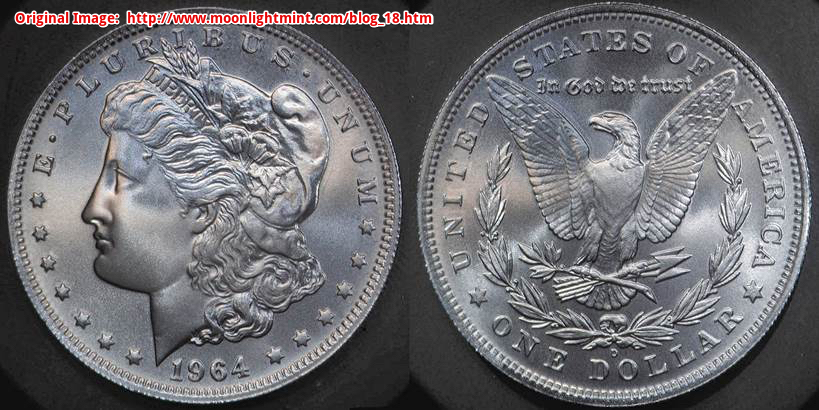
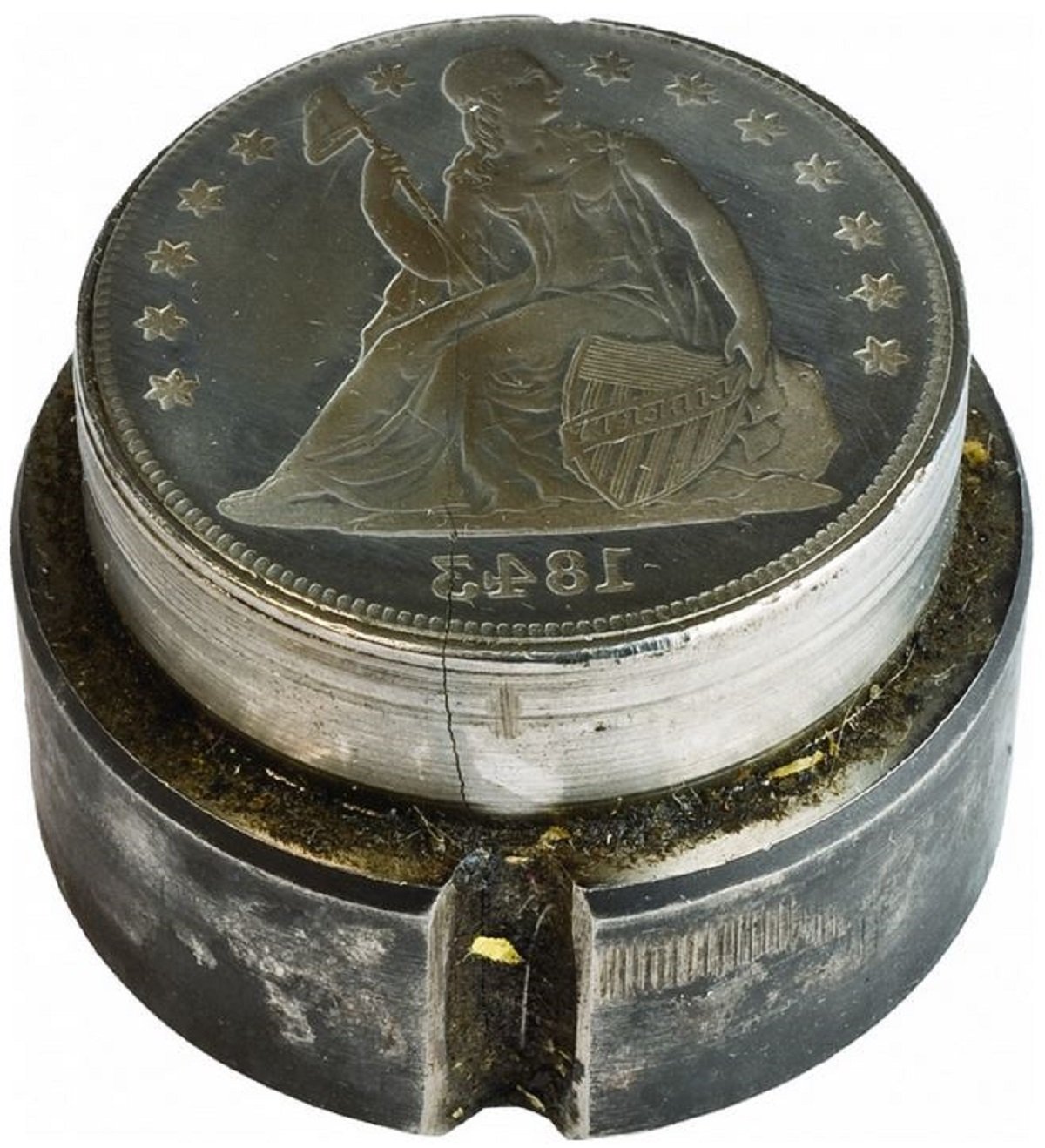
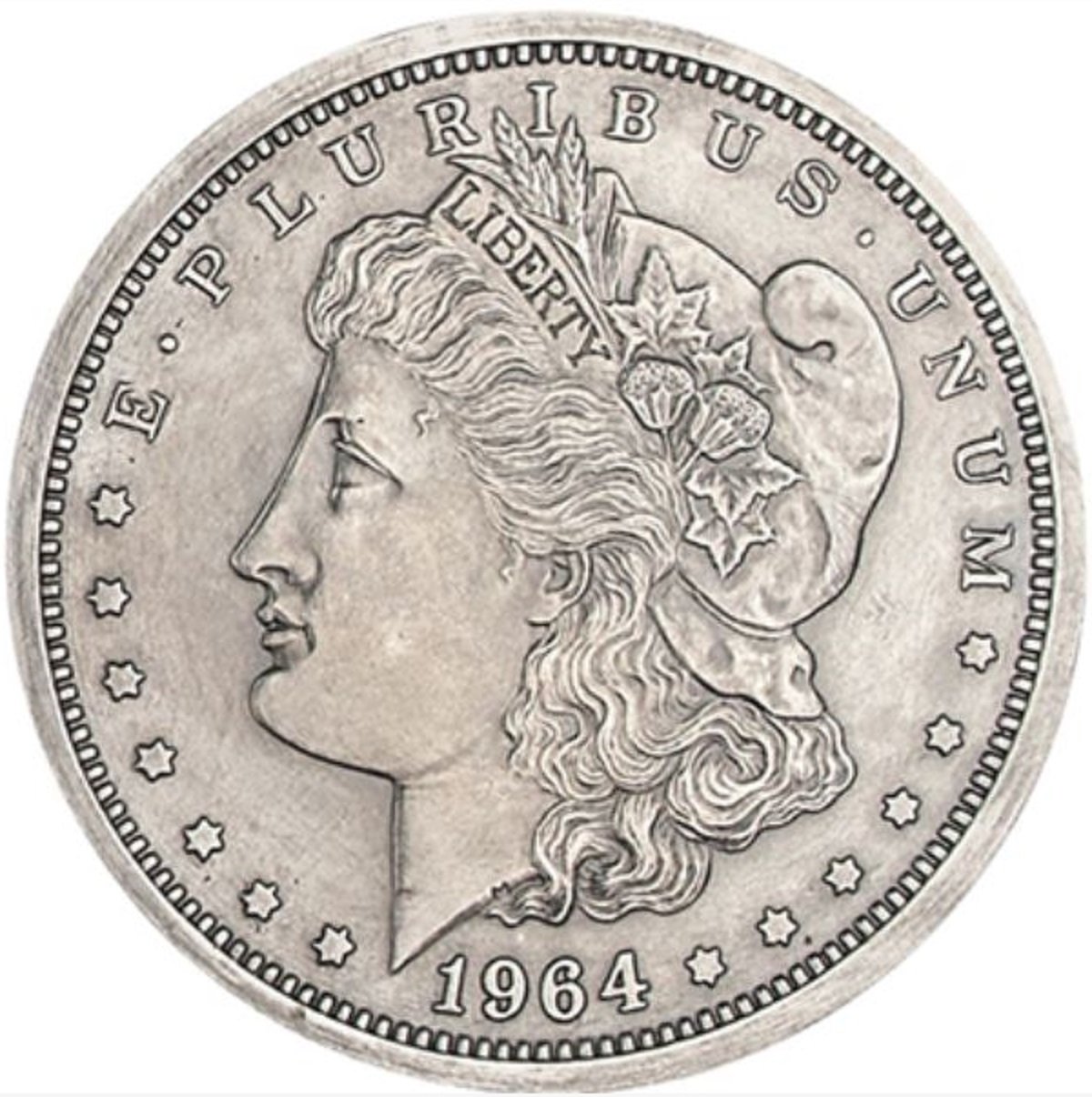
Found at the Philadelphia Mint and shown here is the master hub for creating dies for 1964
Morgan dollars — one of the most important discoveries in decades.
 Researchers at Philadelphia Mint uncover dies and hubs for 1964 Morgan dollar
Article by Paul Gilkes for
Coin WorldThe numismatic world was rocked in 2016 with the bombshell announcement by Whitman Publishing that researchers had uncovered the existence of hubs, master dies and other tooling at the Philadelphia Mint for the production of 1964
Morgan dollars.
The researchers' sleuthing, however, did not yield proof that 1964
Morgan dollars were struck.
The researchers also found hubs and master dies for the 1964
Peace dollar, trial strikes of which were produced at the Denver Mint in 1965.
The discoveries were actually made in July 2015 at the Philadelphia Mint during research conducted for the fifth edition of A Guide Book of
Morgan silver dollars, but not revealed until 2016 with promotion of the new edition.
In July 2015, four prominent numismatists visited the Philadelphia Mint: Dennis Tucker, publisher for Whitman Publishing LLC; prolific numismatic author Q. David Bowers, chairman emeritus of Stack's Bowers Galleries and numismatic director at Whitman; John Dannreuther, numismatic researcher, co-founder of Professional Coin Grading Service and owner of John Dannreuther Rare Coins in Tennessee; and David Sundman, president of Littleton Coin Company in New Hampshire.
Dannreuther and Sundman are also Whitman authors.
No trial strikes of either a 1964
Morgan dollar or a 1964
Peace dollar were discovered, though, and it remains uncertain whether any trial strikes were made of the 1964
Morgan dollar.
Any such theoretical production of a
Morgan dollar would have coincided with the Mint's consideration of what designs to use for the silver dollar, after Congress authorized resumption of silver dollar production for the first time since
Peace dollars were last struck in 1935.
Known experimentation included production of an estimated 322,394 1964-D
Peace dollars at the Denver Mint between May 13 and May 24, 1965, according to author Roger W. Burdette in A Guide Book of
Peace dollars.
All of the
Peace dollar trial strikes were reportedly melted, with none officially released into circulation. No examples are officially known extant.
During the July 2015 Philadelphia Mint visit, Tucker was photographing galvanos and plaster models of Philippine coins struck under U.S. sovereignty in the 1900s. For the then-in-progress A Guide Book of
Morgan silver dollars, Bowers and Sundman were jointly examining materials related to Eisenhower and Anthony dollars, and Dannreuther was randomly combing through a cabinet of trays.
when Dannreuther alerted the others that he had come across obverse and reverse galvanos for
Morgan dollars, he did not immediately note their date. Tucker interrupted his photography to see what Dannreuther had found.
Almost simultaneously, the two men's eyes focused on the date — 1964.
"Our excitement grew as all doubt was dispelled — these clearly were models for a 1964-dated
Morgan dollar, ..." according to Tucker. "Conventional numismatic wisdom held that in 1910 the Mint destroyed its dies, hubs, and other working materials relating to the
Morgan dollar, since there was no expectation the coin would ever be minted again.
"When it was brought back, for one final round of coinage in 1921, the dies used were from shallow, low-relief hubs recreated from an 1878 coin. A generation later, when Congress decided to issue a silver dollar again in 1964, the design the Mint used was that of the 1921 to 1935
Peace dollar, rather than the Morgan."
Another researcher, Roger Burdette, had reported in his Whitman book on
Peace dollars that Mint officials in the mid-1960s had debated whether to use the Morgan designs or Peace designs for the new silver dollars that Congress had ordered struck. However, Burdette's research had not uncovered evidence that the Mint got as far as creating galvanos, dies and hubs for 1964
Morgan dollars.
Dannreuther said the 1964
Morgan dollar galvano he discovered — a large metal model once used in the created of a master hub — was unlike any other galvano he has even seen, being smaller than any galvano he has seen before. Circular lines at the center on Liberty's face indicate it was probably used on the Janvier reduction lathe, he said, which routinely left such marks as the hubs were being created.
Tucker said the 1964
Morgan dollar tooling examined is more in line with the 1878 to 1904
Morgan dollar dies than with the shallower relief 1921 dies — "an interesting anomaly given that the original older materials were ordered destroyed by Mint Director Andrew in 1910."






 First Page
 Previous Page


 Posted 05/09/2018 09:58 am