| Author |
 Replies: 30 / Views: 2,072 Replies: 30 / Views: 2,072 |
|
Pillar of the Community
United States
1004 Posts |
It is now 2024, and coins from the mid 60's are commonly found in change. The last 90% silver coins were dated 1964 (even though some were minted in 1965 and 1966) and half dollars were changed to 40% silver clad for the years 1965 thru 1969, thereafter they too were the same copper-nickel clad as the dimes and quarters. Pennies and nickels from even earlier can still be found from time to time. Even seasoned coin collectors will often spend or cash in average condition pennies and nickels from the 50's and 60's. Due to the conversion from silver to clad dimes and quarters from 1965 and later are common, anything before that are silver and only occasionally pop up in change, usually due to someone cashing in a coin collection or long-lost coin jar. I often have thought about how such a scenario might have played out in past generations. For instance, in the early 1960's would it have been common to find 50-year-old coins in circulation? Let's look at the penny as it had been made of copper from the start, it wasn't until the 1980's that it was changed to the cheaper zinc composition they use today, although there was some nickel used in Flying Eagle and Indian Head pennies before and during the Civil War and of course steel was used in 1943. In 1964 the Lincoln Penny had been around for 55 years, and a few years before the reverse was changed to the Lincoln Memorial from the Wheat design. Due to the lack of real change to the common Wheat design for 50 years prior to the 1959 change it is likely that there were plenty of coins at 50 years old or more in common circulation. I remember in the later part of the 1960's buying a roll of 50 pennies with my allowance each week to look for old pennies and even found the occasional Indian Head penny. I probably had a dozen or so collected from this and change during the 60's and early 70's. I would toss back Wheats from the 40's and 50's as they were not yet old enough to keep. How about the nickel? It hadn't been redesigned since 1938 but in the 60's finding a well-worn Buffalo nickel was not unusual, I found a few of these over the years. "Dateless" Buffalos were the most common but even better condition ones were found from time to time. Of course I would keep the silver WW2 nickels I would find. Dimes and Quarters however were a different story. Due to the change from silver to clad most of the pre-1964 dated dimes and quarters were long gone by 1970. In the last 10 years I have found a couple each here and there in change. I have found more in CoinStar reject bins over this period as people cash in their coin jars and dead relative's coin collections. I suspect many of these came from stolen collections cashed in by ignorant thieves. My sister worked as a bank teller in the 1970's and would save any silver she found and buy it from her drawer at the end of the day. Her bank had a procedure that allowed that, and she was able to recover several coffee cans of silver coins in this way. I did not have such a job, but probably would have done the same if I had. Half Dollars were already pretty much gone from circulation by the 1970's due to both the silver situation and the Kennedy assassination. Due to the lack of use it was easier to find silver half's, be they 40% or 90$, including Franklins and the occasional Walking Liberty. While I could not afford to buy half dollars at the time (50 cents was my allowance for the entire week and I had pennies to search and candy to buy) my sister had bunches of them. 50-year-old halves were rare in the late 1960's for sure. I have to mention Silver Dollars; at the time they were long a novelty, occasionally being given as a gift from Grandma. They were never used in circulation when I was growing up, even less so that the Golden Dollars are now. I have read that they were used in casinos and sometimes in exotic places like Wyoming and Montana but by the time I was old enough to be able to gamble or travel to these places they were long gone. It is my opinion that 50-year-old coins are much more common today then 50 years ago, and many are tossed back with little regard for their age. The fact that they have little intrinsic value to the public has a lot to do with it. 50 years ago, the penny bought what a dime does today. You could buy a gallon of gas with a quarter, but that quarter was worth 10 times what it is today. Coins today have no real purchasing power by themselves, they are mostly used to make change for cash purchases. When is the last time you went into a store and used coins to buy something? When you do the cashier looks at you like to are a fool. I had a pocket full of quarters a while back and bought a bottle of water at a local quick-mart for just under $2.00, the gal looked at me and asked if I broke open the grand-kid's piggy bank. Most coins are received in change, tossed in a jar and when that jar gets filled are cashed in, rarely are they used to buy something. |
|
|
|
Bedrock of the Community
United Kingdom
18069 Posts |
Interesting observation. I certainly think nothing of getting 1965 quarters in change when I visit the USA.
I started collecting as a kid in England a few years before the changeover to decimal currency in 1971. At the time of the changeover, early George V pennies from 1911-1920 were still very common in circulation. Edward VII (1902-10) and Victorian Veiled Head (1895-1901) pennies weren't that common but weren't unusual to find, and smoothly-worn Bun Pennies of 1860-94 occasionally turned up. I still have an 1860 penny that I got in change in about 1970, so it was in circulation for 110 years! Of course, the old British penny was much larger and more durable than the American cent! Halfpennies were less durable - getting any with a 'Britannia' reverse (before 1937) was quite an event, and I never found any with a readable date earlier than 1895. The one Bun obverse halfpenny I got in change as a kid was virtually a flat bronze disc with almost no detail. I'm too young to remember farthings or silver threepences in circulation. Brass threepences were only introduced in 1937 and ones of that date were still very common in 1971.
Of the higher denominations, pre-1920 92.5% silver coins were very rare in circulation. Early George V 50% silver coins of 1920-27 were scarce and usually badly worn, often without clear dates. Shillings, florins and halfcrowns from 1928 onwards were fairly common, sixpences less so, probably because their smaller size and frequent use in slot machines meant that most of them wore out after about 30 years - I remember getting very worn examples from the early 1940s in change in the mid-1970s, when the old sixpence was still valid as two-and-a-half new pence. I must have got about four pre-1920 shillings and one sixpence in circulation while they were still circulating, none older than 1912.
Today in the UK it's not unusual to get 1971-dated 1p and 2p coins in change, and 20p coins from 1982 (first year of issue) are extremely common, but all other denominations have been resized or redesigned since 1990 so there aren't any oldies circulating!
|
|
Pillar of the Community
United States
2278 Posts |
Collector behavior has changed even more than the coins themselves. millions of people collected not only old Buffalo nickels and Mercury dimes back in 1964 but they also collected Jefferson nickels and Roosevelt dimes. Today there are many millions of coins like 1955 nickels and dimes in every grade from Gem to VF that have been set aside for many years. But nobody collected clads or even pennies and nickels from after 1964. They still don't collect them. Not only can you not find a 1968 dime in Gem but you'll have an even harder time finding a nice ch VF because the ones in circulation are heavily worn and beaten half to death. This, heavily worn and half beaten, is about the only way to find many of the post-1965 coinage and some of these are getting so scarce dure to attrition that even these are hard to find. Every year another 4% of the few 1968 dimes that survive in circulation are lost or destroyed. It's an odd situation where collectors look through old nickels hoping to find a VG 1939 and are putting back the scarcities like a nice F 1971. When you do finally find the 1939 it's more likely to be VF than VG and the 1971 is more likely to be beaten up G than anything nicer. Time don't fly, it bounds and leaps.
|
|
Pillar of the Community
 United States
4610 Posts |
The whole cycle has changed.
A coin used to be a working stiff - spent dozens of times before eventually ending up in the bank, rolled and sent back out to work. An urban nickel could be used a dozen times just in a single day.
Now it's one use...
The business gets the roll of coins, and breaks it open in the rare event of needing change. It goes in my pocket. Into the jar. Into the CoinStar. Rolled and sent back out.
-----Burton 50+ year / Life / Emeritus ANA member (joined 12/1/1973) Life member: Numismatics International, CONECA Member: TNA, FtWCC, NETCC, EveryCountry (online) coin club Owned by three cats and a wife of 40+ years (joined 1983) Author: 3rd Edition of the Sample Slabs book, https://www.sampleslabs.info/ |
|
Moderator
 United States
191500 Posts |
Very interesting analysis!  |
|
Pillar of the Community
United States
2278 Posts |
Quote:
The whole cycle has changed.
A coin used to be a working stiff - spent dozens of times before eventually ending up in the bank, rolled and sent back out to work. An urban nickel could be used a dozen times just in a single day.
Now it's one use...
The business gets the roll of coins, and breaks it open in the rare event of needing change. It goes in my pocket. Into the jar. Into the CoinStar. Rolled and sent back out. Excellent point. The way coins are used has probably changed the most. They now wear much more slowly and are much more scratched up than abraded away. A coin minted in 1969 received a great deal of wear until it was lost or destroyed after about 35 years on average. A quarter made today will likely be in an ugly scratched up VF when it is lost or destroyed in about 25 years. Time don't fly, it bounds and leaps.
|
|
Moderator
United States
100639 Posts |
This is an interesting topic. I don't have much to add, but it is a great topic on the life cycle of a business strike coin.
|
|
Pillar of the Community
United States
6666 Posts |
Let's agree to consider the 1964 silver-clad boundary as an artificial event. People stashing 90% and 40% silver has essentially zero to do with collecting and everything to do with the relative commodity value of silver. The coins with the greatest cool factor will get collected. Buffalo nickels are still in demand. Steel cent trios and short sets of War Nickels are in demand. Where is the cool factor on Lincoln cents, Jefferson nickels, clad Washington quarters with eagle reverse? LWC/LMC has had the same design for 115 years. Also, I'd like to ask a more basic question. How do you guys know that modern coins aren't being collected? The mintages are in the tens or hundreds of millions. People don't need to resort to ebay to fill an album, they can do it right from circulation or pop-pop's old change jars. I would like to offer a premise: more people casually collect today than ever, as an absolute number vs. a population percent. I would speculate that Whitman and its competitors sell more cheap coin albums today than ever. If I'm wrong—and it is very likely that I am to some degree—I'd like to see the numbers to prove it. To support my theory, I would point out the absolutely huge number of non-collectors who purchased and filled the 50 states albums. When something comes along to capture people's imagination, they collect it. Many, many, many people still have coffee cans of Ike dollars and bicentennial halves and quarters. In two years, people will stash another huge hoard of coins, assuming the 250th design is something that people can get behind. |
|
Pillar of the Community
United States
3535 Posts |
Good Post! It brings to mind, a friend of mine here in Colorado who is an amazing jewelry Artist. He has horded Buffalo nickels since his childhood in the 60's. I have seen two 5 gallon buckets full of Buffalos. Granted they are mostly without a visible date but he and his brother have been making Southwest style jewelry and horse riding type embellishments for saddles, clothing, cowboy hats etc. for 60 years using these worn Buffalo nickels. They say they got quite a few of these nickels from circulation/at family owned retail shops in the 60's and 70's. The rest they bought at shows by the pound. I haven't seen a Buffalo nickel in change since the early 70's. |
|
Moderator
United States
191500 Posts |
Quote:
people still have coffee cans of Ike dollars I told you that in confidence!   |
|
Pillar of the Community
United States
6666 Posts |
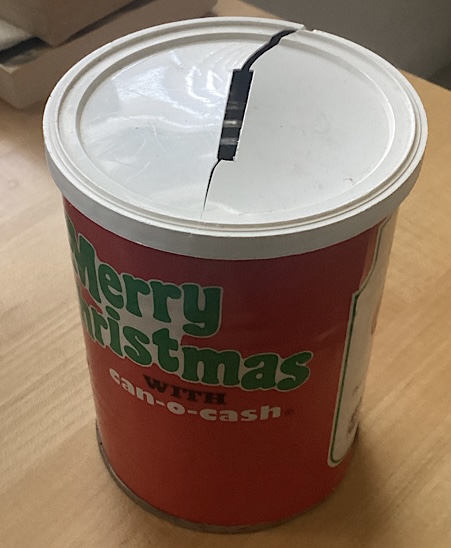 Not only is Jbuck the Ike Can Club president, he is also a secret client! My coin can was modified by my young self to accommodate Eisenhowers without peeling off the lid. =) |
|
Moderator
United States
191500 Posts |
Quote:
Not only is Jbuck the Ike Can Club president, he is also a secret client!  Quote:
My coin can was modified by my young self to accommodate Eisenhowers without peeling off the lid. =)  |
|
Bedrock of the Community
United States
94367 Posts |
Couple of die breaks there, Brand.
|
|
Pillar of the Community
United States
4085 Posts |
Quote:
Brandmeister: people still have coffee cans of Ike dollars and @jbuck: Quote:
I told you that in confidence! But truth be told, we all already knew  |
|
Moderator
United States
191500 Posts |
Quote:But truth be told, we all already knew Yeah, probably a worse kept secret than kayfabe. |
|
Moderator
Australia
16904 Posts |
Quote:
I often have thought about how such a scenario might have played out in past generations. For instance, in the early 1960's would it have been common to find 50-year-old coins in circulation? Of course. Ask any of those old-timer collectors who started collecting as a kid in the 1960s (though those veterans are sadly starting to get hard to find these days). Many of them will tell you they had a paper route or some such, and "got the collecting spark" when they were given an old "classic" coin like an Indian cent or Liberty nickel in payment. Quote:
It is my opinion that 50-year-old coins are much more common today then 50 years ago, and many are tossed back with little regard for their age. The fact that they have little intrinsic value to the public has a lot to do with it. 50 years ago, the penny bought what a dime does today. You could buy a gallon of gas with a quarter, but that quarter was worth 10 times what it is today.
Another core aspect of "old coins being rarer back then" was that silver is a fairly soft metal, in comparison to cupronickel clad. This, combined with the fact that coins were actually used much more back then, means that old silver coins simply wore out after less than 50 years in circulation. If a silver coin became so worn that it was underweight, the banks were supposed to withdraw them and send them back to the mint for remelting. This would have happened more readily in big city banks, which had a ready supply of fresh coinage coming in. A small rural bank wouldn't have bothered. Today, the US Mint has completely rescinded its role in coinage recycling. If a coin becomes so well worn / damaged that it falls below the minimum weight and so is technically no longer legal tender, that's your problem, not the Mint's. The number of countries where coins over 50 years old can even theoretically still be found in circulation is very small; most countries have either had a government change or otherwise completely reformed their coinage in the intervening period. Only three countries are still using the same currency system that they were using prior to World War II: The USA, Canada, and Switzerland. Switzerland is a special case: they haven't had a coinage reform since 1859; while the compositions have changed the designs have remained the same. Australia has probably the fourth-oldest currency, having commenced in 1966. It's still common to find 1966 coins in change here. No silver, of course; only one of the new decimal coins had any silver (the "round 50 cents"), and that coin disappeared from circulation completely even before the cupronickel replacement was issued in 1969. I've found just one silver coin in change in my entire collecting life (since 1980), and have heard of only a handful of other such finds. We stopped issuing 1c and 2c coins in 1991, and there's been grumblings for over a decade about reforming the coinage along the lines of what New Zealand did in 2006, to make them smaller and cheaper to manufacture. Don't say "infinitely" when you mean "very"; otherwise, you'll have no word left when you want to talk about something really infinite. - C. S. Lewis
|
| |
Replies: 30 / Views: 2,072 |








 Posted 08/14/2024 09:05 am


