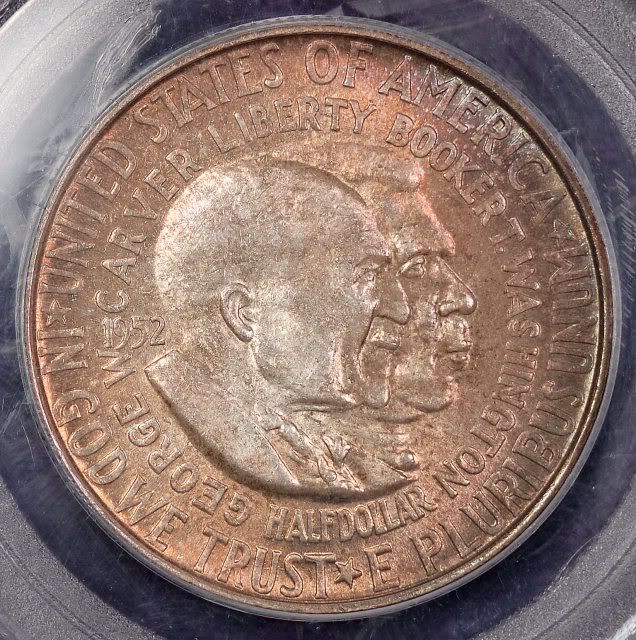
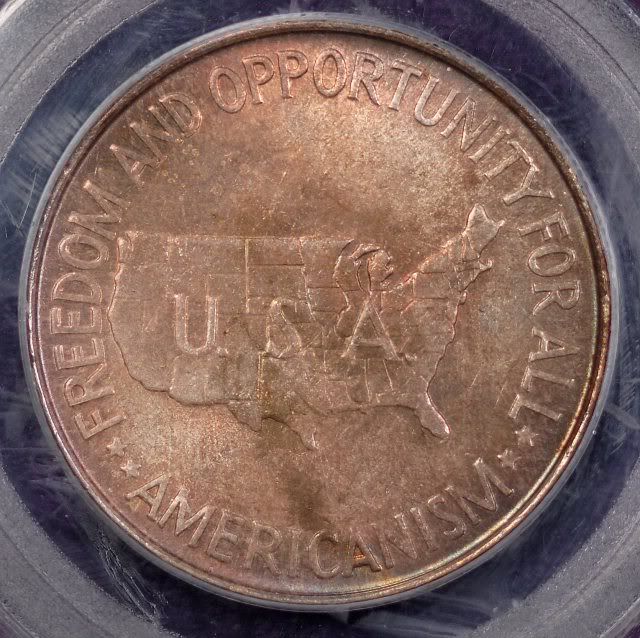
Alas yes ..... both the Booker T Washington (BTW) and Washington-Carver (WC) series are noted for their weak strike and resultant planchet marks remaining on the high points of the design of the finished coins.
This is not a result of year of mintage as you suggest ..... the unfortunate fact is that it occurred in all the years these coins were struck ... BTW 1946-1951 and W-C 1951-1954.
There are many details of the coinage process for which I am still learning ...... but ...... in the spirit of sharing what I have learned ...... following is my understanding of what was going on with these two commemorative series at the Mint ....
These coins were struck on a standard US Mint silver planchet comprised of an alloy of 90% silver and 10% copper weighing a nominal 12.5 grams. The tolerance on weight was +- 1.5% ...... so an 'overweight' planchet of 12.69 grams was the upper end of 'acceptable' by US Mint standards.
One of the many adjustments available to mint employees who operate the coinage press is the final spacing between the dies when fully extended ...... and it was common knowledge that if the die spacing were set for a 'nominal' 12.5 gram planchet then the occasional 'overweight' planchet causes problems as a result of the excess metal flowing out of the die and causing rapid
Die Deterioration leading to breakage ........
Sooooo ... the expedient solution to reduce work replacing/polishing dies was to set the die spacing targeted for the higher end of the allowable planchet weight ....... whereby most of the coins passing through the coinage press did not contain enough metal to fully fill the design at the high points (the deepest recessed areas of the die) ........
Soooo .... today we have a pile of BTW and WC coins that are in general weakly struck with original planchet marks on the high points of the design. Not to mention the general disregard the Mint employees took handling these coins ....... so .... in general most of these left the US Mint on Day 1 of life as poorly struck with bag marks!
All that said ..... this unfortunate situation presents a golden opportunity for the informed collector who has the patience to cherry pick.Refer to my logic above ...... the die spacing was set to accommodate as fully-struck only the few top-end 'overweight' planchets ..... and there were for sure some of those which passed through the coinage press.
Sooooo ....

.... there exist out there fully-struck BTW and W-C coins that are lovely in all respects and well below the radar screen of those who only look at technical grade (MS this-or-that) for their coin purchases.
I am proud that my personal growing collection of Classic US Silver Commemorative contains lovely examples of each of these ..... a fully-struck Blast White MS-66 1950-S BTW and a fully-struck Blast White MS-65 1954 W-C.
You need the discipline (and knowledge) to look for awhile ..... but they are out there for the same price as a weak ugly example.
Geepers ..... long reply to a short question ..... forgive me for that.

David
Edit ..... I humbly admit to still learning ..... will appreciate any expert views on my feeble attempt to describe the over-weight planchet relationship to poorly struck coins.










 Posted 05/18/2010 9:25 pm