| Author |
 Replies: 10 / Views: 2,646 Replies: 10 / Views: 2,646 |
|
|
Pillar of the Community
United States
2605 Posts |
Most maundy coins have Arabic numerals for denomination. I have 1686 maundy fourpence of James II with the denomination in Roman style. 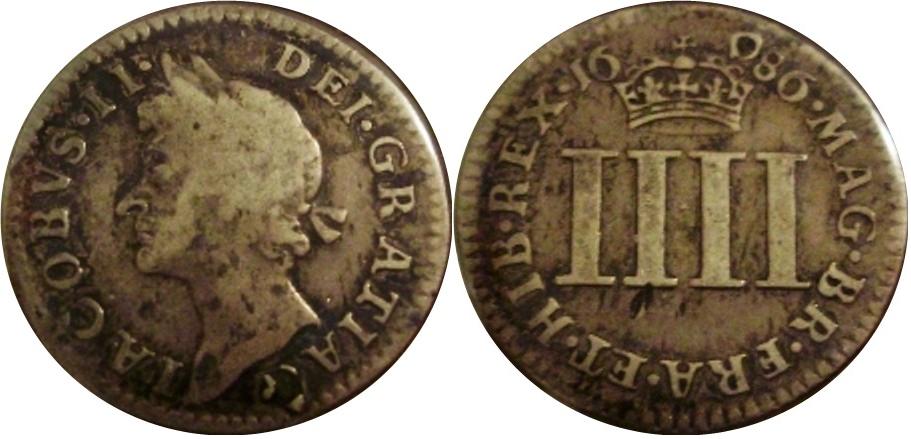 I found it interesting and decided to investigate. The designer of the set John Roettier also designed James' predecessor, Charles II's, maundy as well. And he used initials of the monarch on the reverse to express the denomination, single "C" for a penny, two interlinked "C"s for twopence, etc. 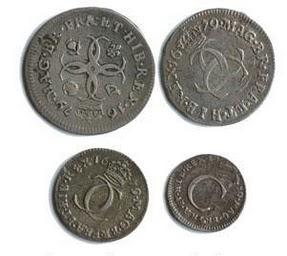 So he continued that tradition of signifying the denomination with the corresponding number of the monarch's initials, "I" in case of James (Iacobus) After James II all maundy fourpence had Arabic 4. |
|
|
|
Pillar of the Community
3660 Posts |
An absolutely awesome coin svslav.....I really like that one very much....  |
|
Moderator
 United States
23731 Posts |
|
|
Valued Member
United Kingdom
60 Posts |
Although lumped together under the generic term Maundy they are not technically maundy coins and were not issued as maundy sets until the second half of the reign of George III.
At the time of Charles and James it is thought that the only coinage issued as maundy handouts would have been silver pennies.
|
|
Pillar of the Community
 United States
2605 Posts |
That is correct, at the time this coin was struck for general circulation. It has a flaw - some wise guy was trying to make a hole, by "86" on the reverse, under the king's bust on the obverse. Luckily it doesn't take away too much from the general coin appeal.
By the way, the coin is currently up for trade.
|
|
Valued Member
United Kingdom
114 Posts |
As has been pointed out, the Charles II coins show, by a quantity of "C" initial letter of the King's name, the denomination of the coins.
Now look again at those of James II and you will see that the same applies! The legend on these coins is in Latin, and JAMES becomes IACOBVS - the Latin for "J" is written "I", just as the "U" appears as "V".
As to these being Maundy coins, they are in fact circulation coins which happened to be used for the Maundy Ceremony over the years. True "Maundy Money" commences with the 1822 issues; previous to this, they were, quoting a few words from the 1816 Act relating to recoinage "... Shillings, and Sixpences, or Pieces of a lower Denomination ..."
The first legal reference to "Maundy monies" that I can find is in the Royal Proclamation by H.M. King George IV issued on 21 March 1821. This Proclamation includes the wording (which quotes the intent of the Act) "... crowns or five shilling pieces, shillings, sixpences, and other small silver monies, usually denominated Maundy monies, namely, fourpenny, threepenny, twopenny, and penny pieces (in addition to the other denominations of silver monies), ... ... ". At last the word "Maundy" appears in an official document relating to coins.
It is interesting that the coins of 1817, 1818 and 1820 (produced under the 1816 Act as "lower Denomination") are not legal tender today, whereas the next issue of 1822 (produced under the Proclamation as "Maundy monies") are legal tender. Maundy coins have been produced continuously since 1822 and all are legal tender today.
Two more interesting facts - the circulation coins of the same design are "considered as Maundy" because it would be impossible to distinguish them from legitimate Maundy ones which are worn, and also at decimalisation the number of pre-decimal pence became the same number of decimal pence, thus the face value increased overnight by a factor of 2.4.
The "acorn" and "shield" versions of the 3d, being a circulation-only type were demonetised 31 Aug 1971. The 1½d coins of similar design to the Maundy ones have never been involved in the Maundy ceremony and as they were produced only for Colonial use, they were never legal tender in Britain.
If anyone can quote any earlier legal reference to "Maundy monies" than the proclamation of 21 March 1821, I shall be glad to hear from them.
Bill.
|
|
Pillar of the Community
Australia
2830 Posts |
I collect by year. I put together a circulation set, including Maundies, for 1820.
I had read that the distribution of Maundy by the Sovereign only dated back to the Victorian era, and that in earlier times, the Maundy was distributed by some delegate "on behalf of" the Sovereign.
So, I checked the London Times for 1820. On Maundy Thursday, the King was in Brighton, and his gifts were distributed by a Bishop: can't recall the details. Specifically, I can't recall whether the word "Maundy" was used. But that might be an avenue for research.
|
|
Valued Member
United Kingdom
114 Posts |
Thanks Peter. My real question is about the LEGAL NAME of the coins used. For 1821 and earlier years,it appears to me that the coins distributed at the ceremony were not specifically called Maundy Money, although they might even have been specially struck as Proofs. There is no doubt that the ceremonies took place. There is a good website http://www.maundymoney.info/26064/index.html which again only lists coin details from 1822. I believe that is the first year of the specific title of Maundy Money, which still has LEGAL effect TODAY. Bear in mind that around the time in question the general everyday coinage of pennies, half-pennies and farthings was the Cartwheel type, plus the 1806-1808 copper ones. Also, many of the older silver coins were being withdrawn to be recycled as the new "1816" type coinage. Again, any further thoughts are welcome. Bill. |
|
Pillar of the Community
Australia
2830 Posts |
I have a Thorburn's "Coins of GB & I", 4th edition, 1905.
At p 76, it says that in the reign of Charles II, the 4d, 3d, 2d, & 1d, were minted exclusively for use in the maundy ceremony.
He also records at p79 that a "very fine" hammered Maundy set had recently (1905) sold for L1.2s.6d
|
|
Valued Member
United Kingdom
114 Posts |
Information appreciated. Again, no doubt, the writer does not quote any source for the coins being specific Maundy Money rather than coins that were distributed at the Maundy Ceremony.
I have today posted the question in the discussion area of the Maundy site which I mentioned above. I wonder if anyone there has any more detailed information.
Bill.
|
|
Valued Member
United Kingdom
114 Posts |
In my message of 8th June 2011, I suggested that the coins dated 1817, 1818 and 1820 are not legal tender today. I have confirmation from The Royal Mint that they are! Therefore, all "number type" 4d, 3d, 2d and 1d from the 1816 Recoinage Act are still legal tender, at the number of present decimal pence shown on them. The "Acorn" type of George V and "Shield" type of George VI were circulation coins only and have been demonetised. The same applies to the "Britannia" type 4d. The 1½d coin was never legal tender in Britain. Bill. |
| |
Replies: 10 / Views: 2,646 |
|




 Posted 11/20/2010 4:13 pm





