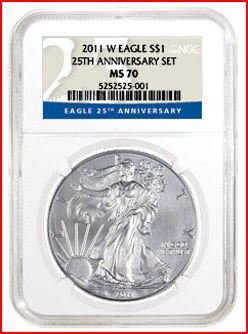
This whole notion of perfection, something only really applicable to modern coins of the past few decades, is so heavily dependent on the definition of perfection being applied to the specific coin type by the specific graded at the specific company that there are bound to be differences between the companies. To discover if there is truly a difference between the companies (and not simply a perception of difference), one would need to perform a fairly complicated study without either the knowledge or consent of the companies involved. It would be difficult to execute, require stealth and secrecy, be expensive, and be of huge value to the collecting public. Unfortunately, finding people willing to fund such a study who are also capable of keeping the secret, may be difficult. In the absence of such data, impressions of the standards of the various grading companies (mine included) will remain highly subjective and charged with emotion. ANACS, which began its life as the official grading service for the
ANA, has been, in my view (again based on my perception of the wallet ballot), and remains highly respected in its grading of a number of classic coins, especially gold coins.
I have only sent a single coin in for grading (and the grade was of no interest to me, really) and that was my 2009 silver proof Northern Mariana Islands quarter, and I only did that because I wanted it tagged as a significant error (including establishing a point in time at which it was known) and protected by the slab. Unfortunately, the additional $36 that PCGS charges to authenticate and grade error coins turned out to pay for nothing more than a special label, which I did not even get because the grader stated that the mint meant to make my coin like that and that no error had occurred. I have no desire to have the coins in my collection "professionally" graded or slabbed, and, aside from mint direct purchases or the purchase of "mint original" items from the secondary market, I use available imaging if I am not holding the coin I am considering for purchase and make my own determination as to whether or not it is worth the asking price, deserves a counter offer, should be walked away from, or what my max price on an auction should be. The grade, stated or guesstimated, is unimportant. What is important is what I am willing to pay for what I see and can I get for that price or better. Even in the realm of the "perfect" 70 grade, there is significant variation from one coin to another and with what is sometimes a ten to one price jump from 69 to 70, deciding what a particular coin is really worth to me is not an easy task. For me, to blindly pay the asking price for such a coin, or to believe that all "perfect" coins of any given type, evaluated by the same grader, at the same
TPG are worth a single price is a risky tack at best. With such a significant difference in price between grades, there are certainly many coins from both sides that are worth somewhere in between the two extremes. Also, it is important to remember that "professional" grading takes place in a matter of seconds, whereas I normally spend several minutes examining a coin before assigning a value. I too, feel that I can tell the difference between a 69 and a 70, but what causes that difference is different for each coin type and not all perfect coins of a given type are of equal value. For me, when deciding whether a coin deserves a perfect score is largely a matter of not finding any reason to downgrade it during a detailed evaluation. That is a very different process than the one used to assign any grade at or below a 69. Also, for me (as I believe is the case for most people), to be considered perfect requires more than the lack of detectable defects.
Of course, all of my rant so far is mainly concerned with coins entering my collection. When talking about having coins graded and slabbed for the sole purpose of preparing them for sale the ideals of numismatics fall by the wayside and market forces dominate. Do I send my coins to the company who's 70s people appear to be paying the most for or do I go with a company that I perceive hands out the grade to a larger percentage of coins to get more of them even though the average per coin selling price seems lower. Is my buyer going to base their decision on what to pay based on the opinion of a
TPG and a set of price charts or will they act like me and arrive at their own subjective decision of what each individual coin is worth to them. Buying any coin sight unseen is risky business and buying a coin graded 70 is even more so because of the drastic premium granted so often that grade. This notion of perfection doesn't even exist in classic coins, the first appearance of the grade in the PCGS price charts is 1960 for cents, dimes, and quarters, 1963 for nickels, and 1968 for halves. The grade has been handed out to modern commemoratives and Eagles since the inception of those series (in 1982 and 1986 respectively).
I guess what my rant really boils down to is caveat emptor. Educate yourself both as a buyer and a seller, and put as little faith as is possible in third party grades and grading companies. Use TPGs sparingly and carefully, their services are not cheap and not always what they appear to be. Make sure that what you are paying for is what you really want when using their services and understand what their labels are really telling you as a buyer. As a member of the
ANA, I think I would have a problem selling coins with these FS, ER, or FDOI labels without explaining what they do and do not really mean to a potential buyer without violating my interpretation of my contract with that organization. Of course, not every member interprets the contract as strictly as I do (and that's OK) and
ANA members are a fairly small percentage of coin buyers and sellers, so be careful out there and try to enjoy coin collecting and trading as much as a hobby as a business.
EDIT: GR58, with your order marked as shipped this early in the day, it will definitely ship this afternoon. You probably won't get any meaningful tracking info until the wee hours of tomorrow morning but sometime after 3:30PM ET UPS should at least recognize the tracking number but you will get your coins sometime tomorrow.








 First Page
 Previous Page


 Posted 11/14/2011 09:55 am