| Author |
 Replies: 35 / Views: 9,433 Replies: 35 / Views: 9,433 |
Page 3 of 3
|
|
|
|
Pillar of the Community
 United States
3644 Posts |
Kind of amazing how it was taken out of the dryer as soon as it reached exactly the 5 gram weight mark no?
|
|
Pillar of the Community
United States
3644 Posts |
And would anyone agree if this coin was in the dryer so long for this to happen and be reduced to exactly 5 grams is quite a bit-wouldn't there be a lot more wear on this coin?
|
|
Moderator
 United States
23522 Posts |
This would be a good time to slow down a bit - you're coming across as argumentative and unwilling to listen, whether that's actually the case or not. The reason this isn't struck on a nickel planchet is because of the existing rim structure. Had it been on nickel stock - individual planchets having already been through the upsetting mill - the larger die of the Quarter would have flattened the rim where it made contact. Your coin looks to have a full rim on each face, proving it's not off-planchet. A Quarter struck perfectly-centered on a Nickel planchet (and yours is perfectly centered) would have zero rim. That's simple, inarguable fact not subject to your "belief." The simplest explanation for what's visible here is a dryer. Yes, a Dryer Coin raises a rim on what ends up looking like a coin of the wrong diameter. Yes, that rim would be perfectly centered. Yes, dryer activity can wear weight off the coin. Yes, a dryer can add a copper-colored appearance to the rim, depending on the composition of the tub. Yes, such a coin can end up at exactly 5 grams; that seems about right considering how much of the original 6.3g Quarter is missing. And I call it "missing" because there's insufficient rim for it to have all rolled there. Most importantly, Occam's Razor says that a dryer is the likely explanation. We see hundreds of Dryer Coins here - it's spectacular to the uninitiated but a daily thing for a collector. I'm not saying this *is* a Dryer Coin - other processes could have caused what you see - but I am saying this is almost certainly a "normal" quarter which suffered some sort of post-Mint activity. |
|
Pillar of the Community
Canada
2632 Posts |
Quote:
-wouldn't there be a lot more wear on this coin? Could there really be much more wear? It didn't come from the mint like that..my vote is totally PMD |
|
Bedrock of the Community
United States
62064 Posts |
Last time I checked a nickel doesn't have a copper core showing. On your coin you can see that it is a clad coin. Just because it is lower in weight it doesn't mean it wasn't removed. The coin was not struck that way. It was altered. Whether it was intentional or not, it is PMD. |
|
Pillar of the Community
United States
8533 Posts |
Let us know as soon as you get the results from NCS.
Oregon coin geek.....*** GO BEAVS ! ! ! ***
|
|
Valued Member
United States
355 Posts |
If it were on a nickel planchet, the coin would be much thinner than a normal quarter. I'm thinking 5 grams is only coincidental.
|
|
Pillar of the Community
United States
3644 Posts |
Ok it will and thanks guys-and yes I know a nickel planchet does not have a copper core I thought by some odd rare chance it may have been a double error where wrong stock was used for the nickel planchet and then the quAryer was struck-I'm sure this is a remote possibility but thought the coin dealer who submitted it for me would of known if it was altered but then again I guess not necessarily-either way it was worth a shot as it was my daughters find and she's recently gotten very involved with coin collecting with me lately and she was excited but it won't be the end of the world either lol-appreciate the feedback and I'm also getting an ike '72 type 2 coin graded and a type 1 so there is still some excitement left!
|
|
Bedrock of the Community
United States
62064 Posts |
There was a wrong stock quarter error in 1970-D where they used dime stock. The devices could not be fully struck as the planchets were to thin. 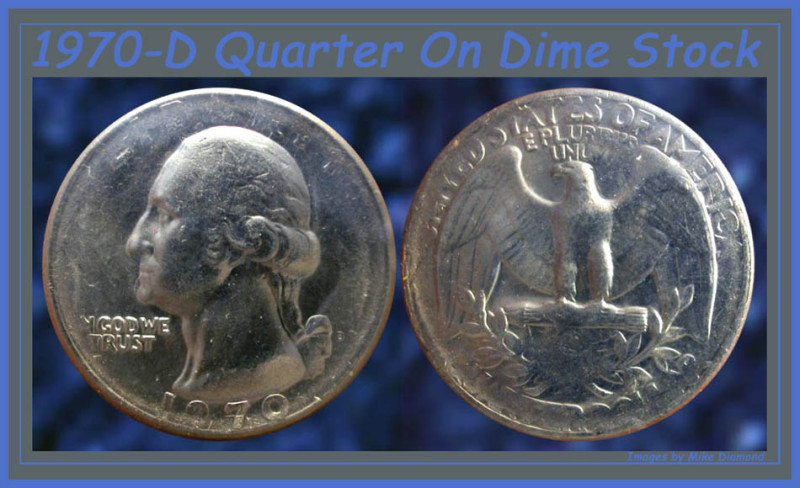 |
|
Bedrock of the Community
United States
17884 Posts |
Ssuperdave has covered everything well except for one error, the quarter weight is 5.67 grams not 6.3 grams. I would question the weight. When you said it was exactly 5 grams was it 5 grams or 5.00 grams? Precision is important.
The coin appears heavily worn which could account for some of the weight loss, and if it started slightly underweight from the mint as well I could see it being 5 grams.
|
|
Bedrock of the Community
United States
10065 Posts |
I do not want to contradict people who know more than me. But I would like to throw in my 2 cents on this one. I am fairly acquainted with Dryer Coins: https://goccf.com/t/143863What puzzles me about this quarter is that on the Dryer Coins I have (only half shown in the pics), all of them have the rim built up so it curls up over the edge of the coin. I do not see this on the one in question - especially on the pic where Siamnbass shows the edge. Even Dryer Coins that I have that have only been slightly tumbled have a ridge sticking up all around the rim. I suppose the dryer-made rim could have somehow been taken off of his, but it also was done in a very uniform, and nice looking way. Take a look at the look I posted to some of the quarters I have. As quarters tumble/roll, it seems the edge around the rim just gets higher and higher. Something else is weird about the dryer quarters I posted. They do not have OBV and REV details wear on them like some of the other denomination Dryer Coins and the one Siamnbass posted. It is obvious the dyer quarters had to be in the machine for a long time since they are so thick. I am not sure why. |
|
Pillar of the Community
United States
2750 Posts |
There can be no doubt that this is a normal quarter that was altered/damaged outside the Mint. The damage removed enough metal that its weight approximates that of a nickel. But the close match is merely coincidental.
Error coin writer and researcher.
|
|
Bedrock of the Community
United States
10065 Posts |
A thought just hit me... I bet your quarter is one one of those electrically altered/shrunken coins done by massive capacitor discharge? http://teslamania.delete.org/frames...gallery.htmlThis likely explains the apparent uniform thickness from side to side. Although in their gallery it shows "shrinkage marks" on the face of the coin, it might be, for whatever reason, yours does not have them. From the one gallery where they compare sizes of them made by increasing the power used, it seems you could backwards extrapolate the results and yours was made with less power - this might also explain the lack of shrinkage marks: 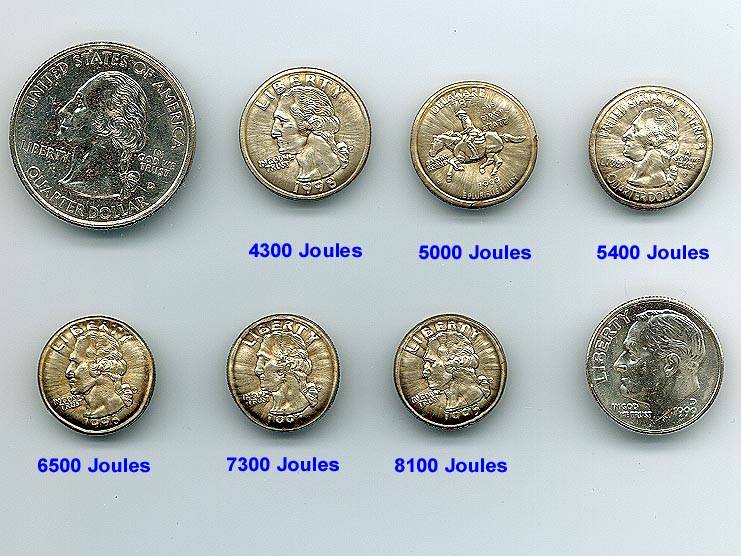 Just a thought  |
|
Bedrock of the Community
United States
62064 Posts |
Have you seen the thickness on the shrunken quarters? The weight is the same, the thickness increases.
|
|
Bedrock of the Community
United States
10065 Posts |
The uniform thickness of his is what sparked my memory about the shrunken coins. Tumbling in a dryer cannot increase the thickness of the coin uniformly across the diameter. A Dryer Coin's center will retain the original thickness it had when it left the mint (or will actually have a loss of thickness due to wear - not a gain). Although doing a bit more reading on the site where they shrink these, I see the shrunken examples posted all retain the milled edge. His does not have a milled edge  Multi-step PMD? ...shrunk then the milling was removed? |
|
Page 3 of 3
|
Replies: 35 / Views: 9,433 |
Page 3 of 3
|







 First Page
 Previous Page

 Posted 03/24/2014 01:38 am





