| Author |
 Replies: 18 / Views: 3,685 Replies: 18 / Views: 3,685 |
Page 2 of 2
|
|
|
|
Rest in Peace
10197 Posts |
Definitely a Post Strike Damaged coin, that just DON'T happen at the mint. Now what caused it...since only one side is affected, it has been ground or sanded down. Dryer Coins will alter BOTH surfaces, and usually so will being caught in any other mechanism. This was held down secure and worked on only the one side. Here's how it's done: 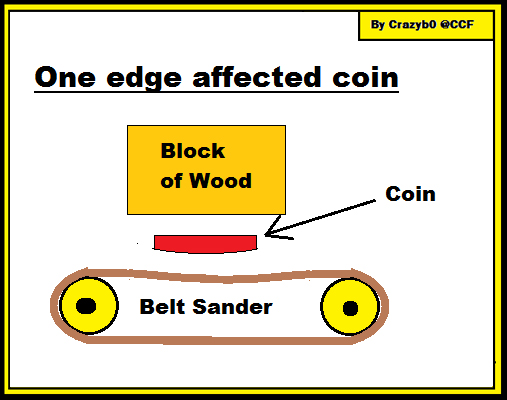  Edited by Crazyb0
08/26/2018 3:10 pm
|
|
Bedrock of the Community
Canada
21943 Posts |
Not an error. It's PMD. Done intentionally after it left the mint. Somebody has ground it down, possibly to fit in a betzel or some other form of holder for jewellery. Crazyb0- You beat me by a minute. Glad we both agree. Edited by JimmyD
08/26/2018 3:00 pm
|
|
New Member
 United States
16 Posts |
Thanks. I appreciate the good info.
|
|
Pillar of the Community
United States
4707 Posts |
Could also have had 1 side exposed to acid.
|
|
Moderator
 United States
34567 Posts |
Quote:
Could also have had 1 side exposed to acid. Possibly, but I agree with @crazyb0 that a belt sander seems much more likely based on the pattern of damage. In the end I guess that it doesn't much matter--this clad dime is a spender. "If you climb a good tree, you get a push."
-----Ghanaian proverb
"The danger we all now face is distinguishing between what is authentic and what is performed."
-----King Adz
|
|
Pillar of the Community
United States
940 Posts |
There are circularly-radiating scratch lines, like it was held against a rotating wire brush.
|
|
Bedrock of the Community
United States
94367 Posts |
Agree, good theory.  to the CCF! |
|
Pillar of the Community
United States
3402 Posts |
I would agree more with a wire brush or file (more control and not as dangerous) than the belt sander.
KK
|
|
Bedrock of the Community
 United States
12931 Posts |
I think both theories are plausible. There are stationary belt sanders that this could be done on. I can see this type of this damage happening via either a stationary belt sander or a bench grinder.
Is it shellacked too? The obverse looks glossy.
|
|
Bedrock of the Community
United States
79991 Posts |
No matter what happened to it, it's Post Strike Damage (it happened after it left the U.S. Mint). It's worth face value unfortunately.
Errers and Varietys.
|
|
Bedrock of the Community
United States
20753 Posts |
Always makes me wonder why anyone spends time doing that.
|
|
Bedrock of the Community
United States
17884 Posts |
To do it that evenly on just the one side I say mounted in a lathe and then the edge ground off. Much better control.
|
|
Pillar of the Community
United States
8537 Posts |
I have to admit that it looks pretty cool. Going with Conders theory. A belt sander would be unwieldy.
Oregon coin geek.....*** GO BEAVS ! ! ! ***
|
|
Bedrock of the Community
United States
12931 Posts |
Quote:
A belt sander would be unwieldy. Yes, the traditional handheld belt sanders that most people think of when they hear "belt sander" would certainly be unwieldy for such an application. But again, there are stationary belt sanders and disc sanders where in this case you would bring the coin to the tool, not the tool to the coin. For instance: 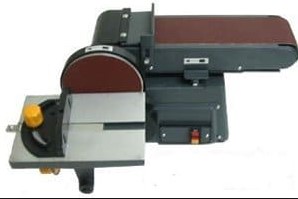 Now that I think about it, I like the disc sander with a low grit based on the wear markings on the face. Machining it on a lathe should give a much smoother surface. |
|
Bedrock of the Community
United States
17884 Posts |
Machining on a lathe yes, but what about just spinning up the coin and using a file or a sanding block to grind down the edge. The problem with a grinding wheel or fixed belt sander is holding onto the dime and getting the ground surface smooth and even. that isn't a problem with a lathe.
|
|
Page 2 of 2
|
Replies: 18 / Views: 3,685 |
Page 2 of 2
|





 First Page


 Posted 08/26/2018 2:57 pm


