| Author |
 Replies: 35 / Views: 6,264 Replies: 35 / Views: 6,264 |
Page 3 of 3
|
|
|
|
Pillar of the Community
United States
5362 Posts |
jgenn Good point I had not considered.
I saw the break on the left side of the doorway but really never thought about the change in the outline of the castle.
I like your pictures of the Matrix block. Where are they from? Do they show all sides of the block?
|
|
Pillar of the Community
 United States
1156 Posts |
|
|
Pillar of the Community
United States
5362 Posts |
jgenn Thanks for that lead.
|
|
Pillar of the Community
United States
1156 Posts |
I understand that the item from Sedwick's auction was a copy of a part of the matrix block for 4 reales and not the actual matrix.
Edited by jgenn
05/20/2020 10:12 pm
|
|
Pillar of the Community
United States
5362 Posts |
According to a good source, now retired, the Mexican mint vault still contains the colonial matrix blocks for all denominations, but the authorities do not allow photographs. It is too bad that clear pictures are not available for study.
|
|
Pillar of the Community
United States
1962 Posts |
A Cayon auction auction from 2006 contained numerous matrices and punches (I believe that's where the 4R Sedwick example came from): https://www.acsearch.info/search.ht...ot=1&order=2¤cy=usd&company=26&auction=553&lot= Bob, do you have the pic of that copper core piece digitized to post? What year is it? Any other pics of the strong suspects handy? The broken castle being a marker idea still is dubious, though... because clearly a decent number of coins WITH those markers are of sufficient silver content. So if SOME broken castles are debased - but ENOUGH so that those in the know will avoid them - virtually 100% of non-broken castles have to be proper alloy. Do you think that's the case? Have you looked at enough examples where even just visually, you can see a clear trend of ONLY broken castles ever showing hints of debasement? Regarding appearance being a tell of alloy... Pretty much EVERY type of a low-silver alloy tips its hand fairly quickly once a decent amount of wear occurs. The Peru 1930s Soles, British .500, Austrian mid-1800s increasingly debased 10/20 Kreuzers, debased Cap & Rays... and of course low-Ag "normal" contemporary counterfeits. ------ Jgenn, that IS an interesting observation... but the corner simply could have broken off, no? Also... if you're thinking it's something along the lines of what you suggested earlier, somehow copy the coin and fashion punches from that (which seems tecnnologically difficult for this time and place to do convincingly) - why not just use a complete castle from the lower right quadrant? Edited by realeswatcher
05/20/2020 11:44 pm
|
|
Pillar of the Community
United States
1156 Posts |
Quote:
why not just use a complete castle from the lower right quadrant? If your goal is to replicate a genuine punch then I surmise you would copy from the best mint state example, from the earliest die state that you could acquire that was also as fully struck as possible. I have a few mint state Potosi examples but typically one castle is better struck than the other. For instance, the one in my photo is not so well struck that you would want to copy from it. So maybe the best example available was the top castle. Edited by jgenn
05/21/2020 12:18 pm
|
|
Pillar of the Community
United States
1962 Posts |
Whoever would be making these coins would have access to any examples they needed, I would think (I'm working under the premise that any examples came from someone connected to the regal operation).
Again, though... I don't think that would have been technologically feasible for this era within the Potosi circulation area.
-----------
I'm starting to study dates. 1777, for example, has at least THREE visibly different "states", I guess you'd call it, of castle. There's an "unbroken" castle with full feet, then the broken one we're discussing - with right foot always angle cut as you pointed out... but then also a castle with no crack but part of the LEFT foot nicked off.
I took a brief run through 1782 before backtracking to 1777. The one definite trend you notice for the cracked/broken R foot castle is that the dies it appears on are noticeably cruder overall, which is not the case for back in 1777. The placement (alignment) and actual stamping in of the punches is simply sloppier. Also seemed from quick observation like there's variation in some of the other punches on the reverse - again, with the cracked castle pieces' design elements skewing cruder. That said, the product is reasonably close enough to the "better" pieces in overall "fabric" to not necessarily think they emanated from completely different sources.
One other thing to look at... more field space seems to be present overall on the reverses of the neater 1782 w/non-cracked castles. Haven't studied closely enough yet to tell if they're bigger planchets or the combo of sloppy punchsetting and possibly different punches is the cause... but if the former, perhaps there's a connection to fluctuating alloy content in the planchets.
I'm wondering if there weren't two different hands making coins within the mint by 1782... lower man being made to use crummier/more worn down punches. Again, the 1782 execution varies... but not enough where I think they were straight up contemp. ctfeits. from some random group not connected to the mint. I don't think counterfeiting was good enough yet to produce these.
|
|
Pillar of the Community
United States
1156 Posts |
Turns out I have two examples from 1775 with a very early broken castle. 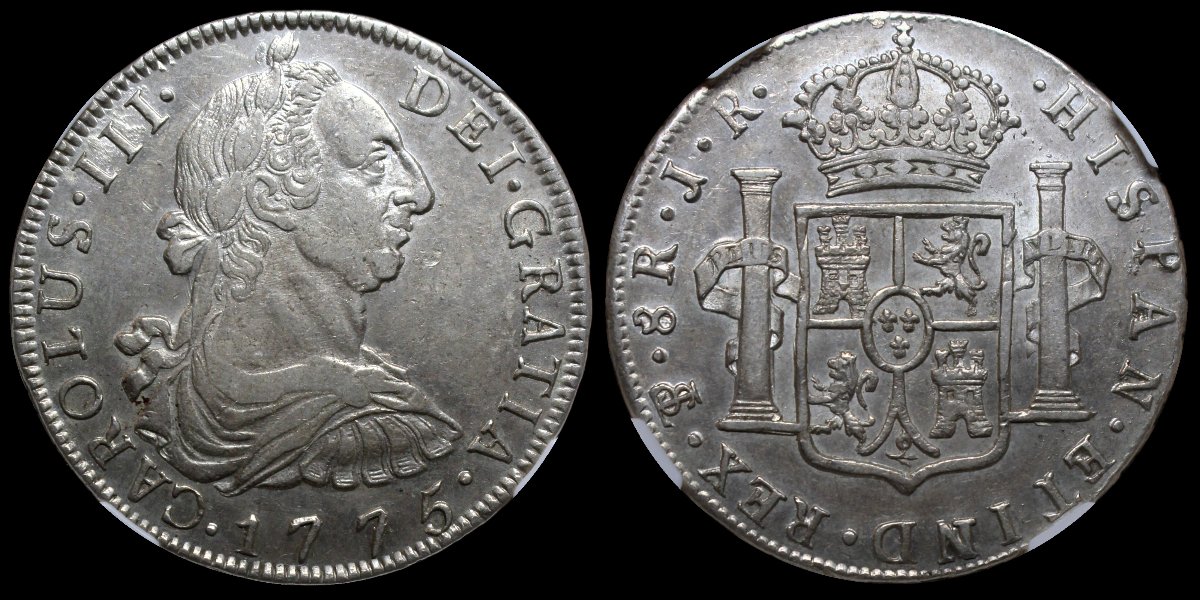 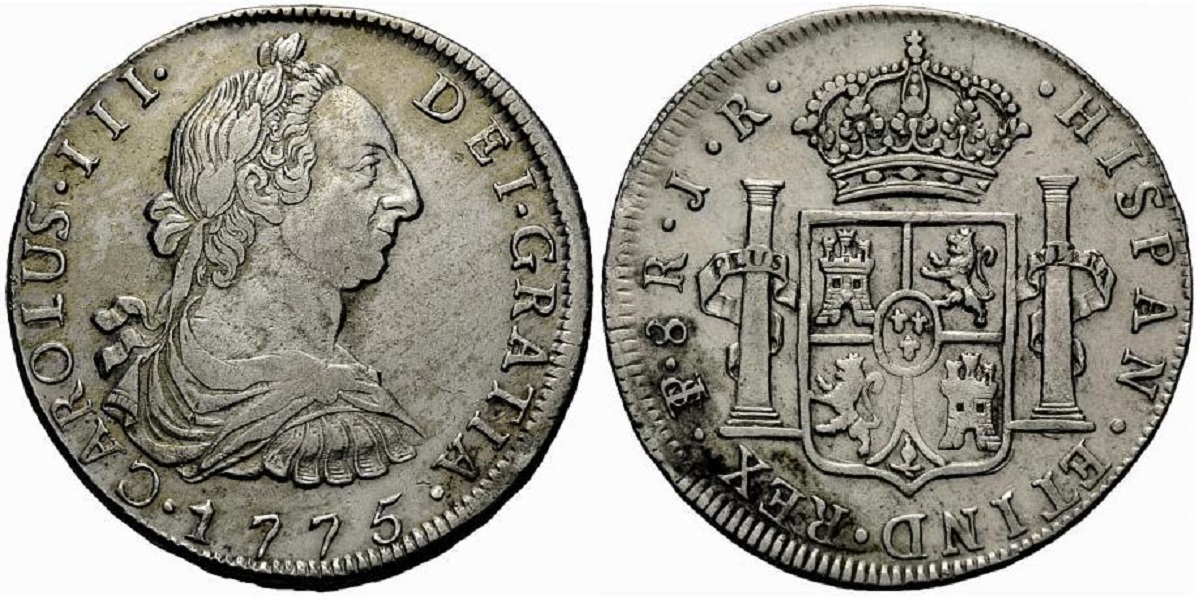 |
|
Pillar of the Community
United States
1801 Posts |
Here is another king punch (or as Bob calls them Matrix block). This one is in the Bogota Coin museum, they had several representing the various denominations but the lighting made it very hard to photograph. (I don't understand why they rejected my request to open the cases so I could get better photos...LOL) 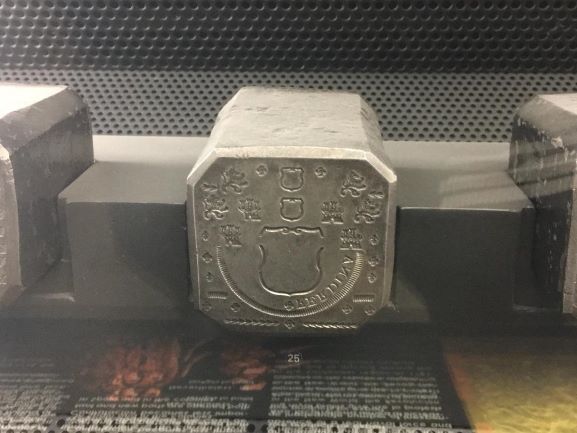 |
|
Pillar of the Community
United States
1962 Posts |
You personally VISITED?! Great pic, John. Older pillar punch - RARE coins today!! ------- By the way, before I forget... saw this while perusing the 1782s: One the one piece, the effect clearly is only present on the lower R castle... but on BOTH in the other example!! Hard to tell exactly from the small pic, but I could believe the 2nd piece is a bit low in silver. 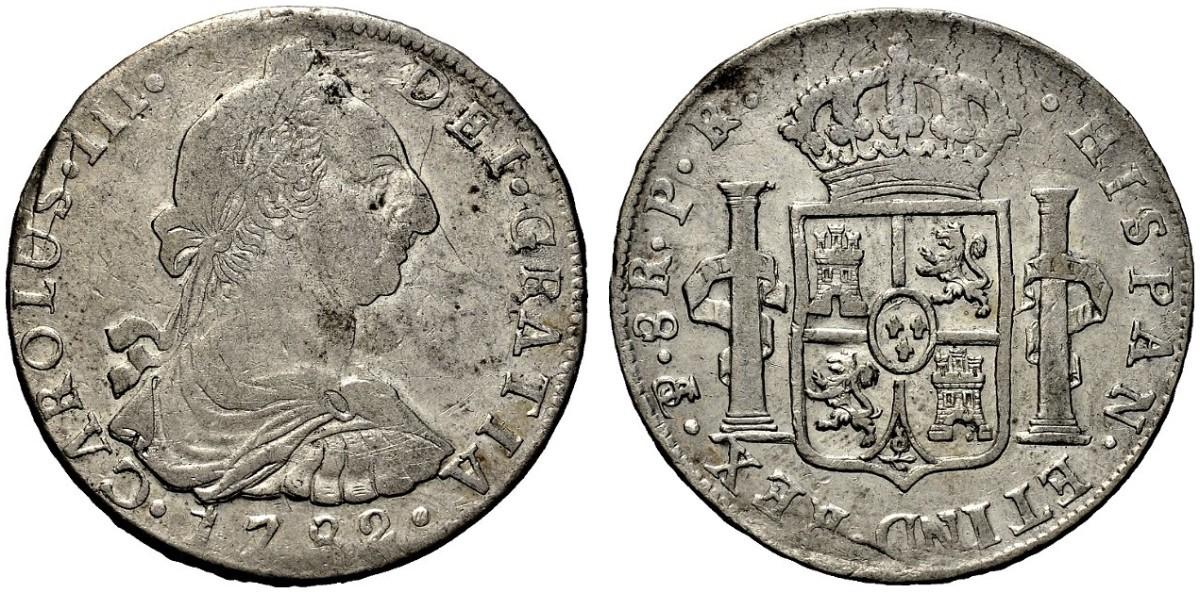 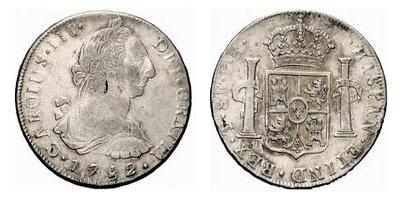 |
|
Pillar of the Community
United States
1801 Posts |
Realeswatcher
In October of 2018 my son and I spent 3 weeks in South America and while there visited the Lima National Numismatic Museum, the Numismatic display in the Cuzco Museum, the Quito National Numismatic Museum and the Bogota National Numismatic Museum.
All were very interesting. The Quito museum was a challenge to get into, the government had the central city area on lockdown because of some political event that was taking place and our guide we had hired specifically to get us to that museum had to beg and plead for them to let the two idiot Americans past the barricades and then again at the door to get them to open up for us. We had the whole museum to ourselves (museum host, our guide, my son and I)
|
|
Pillar of the Community
United States
1962 Posts |
Well, hey, you're the idiots that got the private tour!!
Glad you enjoyed - sounds like a great trip!! And good that you got it in before crazytimes descended...
Edited by realeswatcher
05/23/2020 7:17 pm
|
|
Valued Member
United States
97 Posts |
First, thanks for letting me comment. Two things I'd like to add. I have seen coins with two broken Lion's tail punches, one broken lion's tail and no broken tails. I wonder if this would be helpful. The fact that the same broken tail punch occurs with the broken castle leades me to believe that some of the broken castle coins must be genuine
Additionally, I should think that a person has to be one of the top Mexican coin authenticators in the world to be able to look at an 8 Real and claim to know it is genuine and in spec. and I'll bet even the ten top guys are not correct 100% of the time. Counterfeit coins have become too deceptive. Someone needs to go into the old collections in museums that were assessed prior to 1965 and examine those coins in every way possible. That would be a good start.
|
|
Pillar of the Community
United States
5362 Posts |
afewmorecents I agree that more study is needed.
There are two issues that I need to restate simply.
1. Any coin whether made in a mint or by a private party that is Fraudulent by virtue of metal content - should be so identified. When Riddell identified the Good and Bad Dollars of the World in 1839 - 1845 that was his criteria. That is the criteria of the US mint. Therefore that is my criteria.
2. Any coin made without proper legal authority, even if it contains the correct amount of metal is Counterfeit. That is also a US mint standard.
Regarding broken lion tails, I have not specifically studied those but do they occur on coins over as long a period as the Broken Castles.
|
|
Page 3 of 3
|
Replies: 35 / Views: 6,264 |
Page 3 of 3
|








 First Page
 Previous Page


 Posted 05/20/2020 10:06 pm


