| Author |
 Replies: 16 / Views: 17,986 Replies: 16 / Views: 17,986 |
Page 2 of 2
|
|
|
|
Bedrock of the Community
United States
19539 Posts |
|
|
Bedrock of the Community
United States
94367 Posts |
Big Silver calls it.  to the CCF! |
|
Pillar of the Community
 United States
5714 Posts |
Nickels, dimes, and quarters in circulation in 2004 are almost all cupronickel (about 75% copper, 25% nickel) and having a melting point of around 2140 degrees F. Pennies dated after 1982 are zinc and melt at 780 degrees F.
|
|
Moderator
 United States
195142 Posts |
to the Community! |
|
Rest in Peace
United States
10625 Posts |
Quote:
Pennies dated after 1982 are zinc and melt at 780 degrees F And rot at room temperature....  |
|
Pillar of the Community
United States
6845 Posts |
Just depends whats the coin is made of 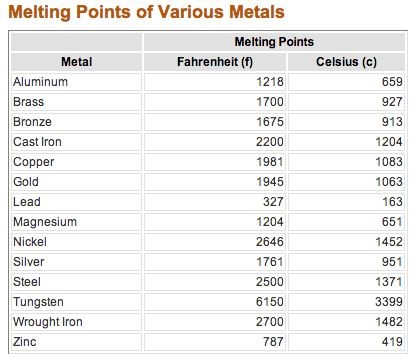 |
|
Moderator
United States
34539 Posts |
@swan, first welcome to CCF. Second, that is a fun little plot element. Depending on how technical your writing is, you could have it be hot enough to melt some coins, but not others.  "If you climb a good tree, you get a push."
-----Ghanaian proverb
"The danger we all now face is distinguishing between what is authentic and what is performed."
-----King Adz
|
|
Pillar of the Community
United States
5714 Posts |
Quote:
And rot at room temperature...  Edited by Zurie
11/05/2021 4:28 pm
|
|
Moderator
United States
195142 Posts |
Quote:
And rot at room temperature....  |
|
Bedrock of the Community
Australia
21789 Posts |
All alloys, which include most coins, have a temperature 'paste range', where one of the metals in the alloy will have melting point lower than another.
The 'paste range' is the difference between the highest and lowest melting points of each metal in the alloy, where one metal is liquid (lowest MP) and another still solid (highest MP
The paste range of brass, which is a solid metallic solution of zinc and copper at room temperature, is between 419 Deg.C and 1063 deg.C. The physical paste characteristics depend on the proportion of the metals that make up the alloy.
Dross normally (depending on the metals involved), forms on the surface of the melt.
|
|
Pillar of the Community
Canada
5419 Posts |
Best of all are the chocolate coins . They melt in your mouth at body temperature ..YUMMY |
|
Bedrock of the Community
United States
10284 Posts |
Please melt all the zinc Lincolns you can in the story.
Mix coins with magnesium, it burns hot.
|
|
Moderator
United States
195142 Posts |
Quote:
Please melt all the zinc Lincolns you can in the story. Mix coins with magnesium, it burns hot.  |
|
Moderator
United States
15881 Posts |
Some funny replies to welcome our newest contributor the the CCF. Quote:
the characters melts a metal donation box Ahh - there is your missing answer Mr. Mystery writing man. You need to melt the box first before you can melt the coins. Let's assume you plan your plot so that the melting character has a standard carbon steel container holding the coins. Then the melter needs about 2500F just to get past the box. Then you can get to those pesky Cu-Ni nickels, dimes and quarters. Hoping that your plot has all the Zinc Lincoln cents melted into an unidentifiable mass inside the box - just as they appear from everyday rot. Take a look at my other hobby ... http://www.jk-dk.art |
|
Moderator
Australia
16979 Posts |
The OP is in America, so I will assume they are talking about American circulating coins.
American coins - dimes and quarters, specifically - are unusual from a world coin perspective, in that they are made of clad metal - they are a metal sandwich, with a core of pure copper, surrounded by a relatively thick shell of cupronickel (which is an alloy made of 75% copper, 25% nickel. Copper has a lower melting point than cupronickel, so it will melt first.
So if you put a mixed pile of pennies, nickels, dimes and quarters in a box and slowly raise the temperature, here's my understanding of what will happen.
At about 420 degrees C, the zinc cores of the pennies will melt. As the copper plating on pennies is very thin, this will not survive the melting process; the copper will simply dissolve into the molten zinc. At around 900 degrees, the zinc will hit boiling point. At this stage, zinc in open air will start to burn; what happens to your box of coins depends on how airtight it is, and if oxygen can get in and/or zinc vapour get out. When zinc burns it creates zinc oxide, which is white; combined with copper oxides and you'll probably end up covering everything in grey powdery debris.
The next to go will be the copper cores of the dimes and quarters; these will melt at around 1090 degrees C. Note that if the box isn't moving or being jostled about during the heating, the cupronickel shells will still likely hold the partially molten coin together at this stage (kind of like a cheese sandwich full of melted cheese).
At around 1360 degrees C, the cupronickel shells of the dimes and quarters, and the entirety of the nickels (which are made of solid cupronickel alloy), will start to melt. They will completely melt above 1390 degrees C, leaving you a pool of somewhat impure molten copper. If you cool it down and take it out of the box now It will probably look greyish-brown, somewhere between silvery and coppery in colour. Covered in white powder from the zinc, it will probably be greyish in appearance, and not necessarily look like a lump of metal.
Which does leave the question of what kind of donation box is going to be used, that can survive a temperature of 1390 deg C.
Don't say "infinitely" when you mean "very"; otherwise, you'll have no word left when you want to talk about something really infinite. - C. S. Lewis
|
|
Page 2 of 2
|
Replies: 16 / Views: 17,986 |
Page 2 of 2
|







 First Page


 Posted 11/05/2021 1:00 pm





