| Author |
 Replies: 55 / Views: 13,819 Replies: 55 / Views: 13,819 |
|
|
|
Pillar of the Community
United States
4233 Posts |
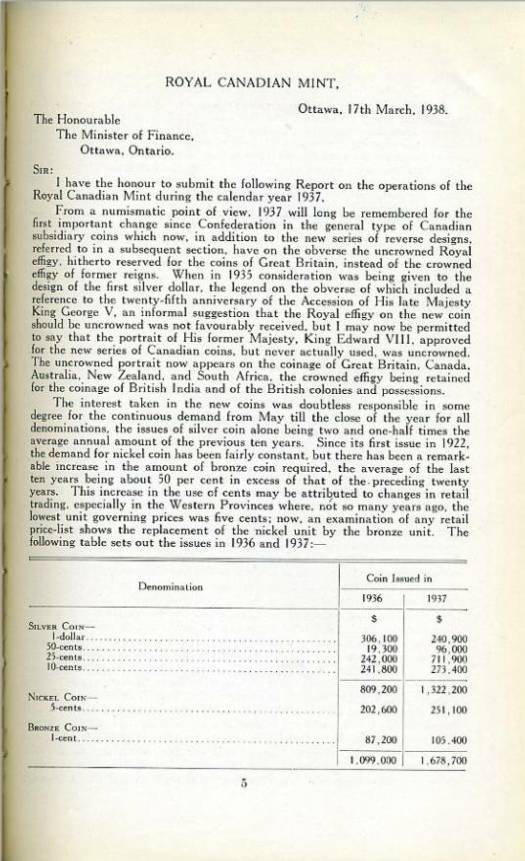
So, where do the mintage numbers for 1936 Dot coins come from? Bellmaker posted regular 1936 numbers, and it clearly indicates a shortage of coins "after August". Certainly all this is an interesting read, but I don't see any compelling evidence to deviate from the conventional story about these coins. I mean, surely a guy like Pittman isn't going to orchestrate some elaborate ruse, and enlist Charlton in the "deception", over a single cent that he sold for $1500? Didn't the mint hoard those 206,398 1921 50 cents until around 1929? I can speculate that they tightened up after those 1921s leaked out into circulation. But I guess it depends on the veracity of the 1936 Dot mint numbers. It's a bit difficult to believe that almost 900,000 coins didn't actually get minted.
|
|
Valued Member
 Canada
180 Posts |
|
|
Pillar of the Community
Canada
1581 Posts |
The mint has continued to release previous year DATED coins before, and reported them much the same way for the year of issue. This is nothing odd. The 2011 annual report provides a restatement that gathers several of these: http://www.mint.ca/store/dyn/PDFs/RCM2011AR.pdfLook at page 106, for the normal circulation. It shows 2008 released in 2009, 2009 released in 2010, and 2010 released in 2011. Why is 1936 the one year this must have been a special variety? |
|
Valued Member
Canada
180 Posts |
It is the Pittman 1937/1936 1 & 10 cent coins with a dot that the story belongs to.
1936 was a year of three Kings and that is the only out of the ordinary event that happened.
It is my belief that the dots on the 1936 coins, that are not attached to any story, represent this event.
|
|
Pillar of the Community
Canada
1505 Posts |
Bellmaker,
So if I understand correctly, you are saying that the story in Charelton's is incorrect and that there is no story attached to these coins. My understanding is that Charelton's story is based on discussions with Mint employees.
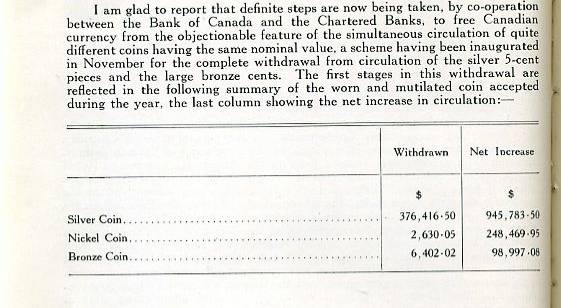
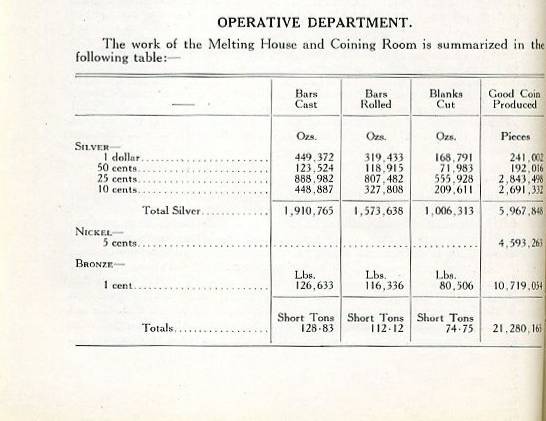
I am unclear what evidence your belief is based upon. I hope it is more than 1 full and 2 partial pages of an old mint report.
If you are asking people to believe you over Charelton, I hope you hope you can present some strong evidence and provide a competing explanation.
|
|
Moderator
 Canada
10477 Posts |
You are wasting your breath purelywasted... I refer you to this thread: https://goccf.com/t/191757&whichpage=4and, in particular, this quote: Quote:
No, I believe this is the part that is up to those who have a competitive desire to challenge. It is one thing to disagree with a point. It is another, to disagree and put your money where your mouth is, and prove it. "Discovery follows discovery, each both raising and answering questions, each ending a long search, and each providing the new instruments for a new search." -- J. Robert OppenheimerContent of this post is licensed under a Creative Commons Attribution-NonCommercial 3.0 Unported License. See: http://creativecommons.org/licenses...0/deed.en_USMy eBay store
|
|
Pillar of the Community
Canada
5420 Posts |
Basically I think that at this stage , it is an unprovable subject, due to the lack of real hard evidence. Part of the problem is that the 1936 and 1937 mint report are rather simplistic as to their depth and content. Another part of the problem is that all the principles such as any mint employee , Bank of Canada official, Pittman and Charlton and Roberts, are all now deceased. This in itself eliminates any possibility of first hand knowledge. Also as I stated earlier the information in the Charlton Catalogue has changed over numerous editions and is both controversial and contradictory. Haxby is of little more help except that he states that all known one and ten cent dots are indeed specimens ( A Guide Book of Canadian Coins and Tokens 1st edition). It seems that this is Canada's "ultimate" numismatic mystery and detective story. We can all surmise and have our own theories, but I have yet hear a better more thought one than the fact that the one and ten cents DOT coins are nothing more than an RCM back door job and thus an official fabrication minted well after the demise of George V, the abdication of Edward VIII, and the Coronation of George VI. If these coins were minted in the numbers stated 678,823 for the cent and 191,237 for the ten cents ,one would surely have surfaced by now in 2014. Yet not ONE major grading service has authenticated or grade certified a single example other than the 3 cents and 5 10 cents that were known about way back in the day. These coins can all be attributed back to two high ranking mint employees of the day and subsequently their families and no one else. Why would that be ? Dean has to come up with way better than two mint reports that are both simplistic in nature and barren in their scope, if he is to convince many of us on this subject. As a footnote in an earlier post I stated that Charlton reported a sale of an uncirculated 1936 Dot cent in one of the early Charlton's I can more accurately describe that situation. " A 1936 Dot Cent, Unc we see was sold by G.R.L. Potter to Harvey Brubaker, in 1955 for $900" .(source Coinman to Canadians a biography by H. Don Allen p.148). This coin subsequently ended up with JJ Pittman and was sold at the 1997 David Akers sale of part one of the JJ Pittman sale for $110,000 USD. Edited by Pacificoin
12/28/2014 9:58 pm
|
|
Pillar of the Community
United States
4233 Posts |
I'm still curious - where do those 1936 dot mint numbers come from?
|
|
Valued Member
Canada
180 Posts |
"I'm still curious - where do those 1936 dot mint numbers come from?[kbbpll]
Charltons over active imagination.
|
|
Pillar of the Community
United States
4233 Posts |
I don't see any "over active imagination" in Charlton. My 2012 says "It seems unlikely that any genuine 1936 dot cents ever circulated, despite the supposedly official mintage of almost 700,000 pieces", and regarding the 10 cent "Although the mintage of the 1936 dot variety is claimed to be 191,237, only five examples are known to survive today. All are specimen strikes, adding to the suspicion that circulation strikes were either never produced or were all melted." The verbiage is essentially the same in the 2005 and 2014 editions.
The 1966 edition says regarding the 1 cent: "The mint states categorically that all coins struck were immediately placed into circulation, but no satisfactory explanation of the great rarity of the two low values [1 cent & 10 cent], as against the comparative commonness of the 25 cent, has ever been suggested". The mintage in 1966 is stated as 678,823, with 4 known. (Compared with 8,768,769 for 1936 and 10,040,231 for 1937).
The 10 cent in the 1966 Charlton refers to the one cent page, and states mintage as 191,237 with 4 known. Both dates show values of "BU 4000.00".
The 1974 Charlton repeats the same information as the 1966, but adds "Beware of counterfeit 'dot' 1 cent and 10 cent pieces".
I don't see any reason to disparage Charlton in this; it appears they're just stating the best info they can come up with, and readily admit their uncertainty. So my question remains - where did these mint numbers come from?
And I reiterate my speculation that since they held onto over 200,000 1921 50 cent coins supposedly until 1929 with "escapes", according to Charlton, of only 50 known examples in 1966 and 75 known in 2014 editions, that they could have tightened up in the years between 1929 and 1937, that they indeed minted those 1936 dots in those quantities, and none escaped except the few specimens squirreled away by a mint employee. Again, I don't see any reason to doubt the conventional narrative.
But as Pacificoin says, at this stage we're never going to know with certainty, other that that obviously these coins are deemed extraordinarily valuable.
|
|
Pillar of the Community
Canada
5420 Posts |
There were no escapes of the 1921 fifty cent coins. Simply put if you so desired you could get one if you visited the mint or asked to purchase one . There was simply no demand for fifty cent coins. It is curious though the majority of the known 1921 halves are in very low grade meaning they circulated for a long period of time or are AU or better. A Fine 15 to EF45 coin is virtually unknown to the numismatic community. The figure of total 1921 survivors is 75 or so according to Charlton. There are probably still a few unknown pieces and of course some that circulated to the point of being dateless. The story of the 1921 fifty cent coins is far less a mystery than that of the 36 dot coins.
|
|
Valued Member
Canada
180 Posts |
"So my question remains - where did these mint numbers come from?"[kbbpll]
The Mint Report does not reflect the figures Charlton has in their pages.
|
|
Pillar of the Community
Canada
3234 Posts |
Quote:
Charltons over active imagination. ...  Now look who's calling the kettle black..... I do love it,..and please don't stop...  |
|
Pillar of the Community
Canada
5420 Posts |
The sad part is ......................the discussion of the story of the 1936 Dot Coinage is fascinating and could use some serious research.
|
|
Pillar of the Community
Canada
2632 Posts |
Its obvious bellmaker is not getting the answers he's looking for here at CCF or written in any book anywhere. It would take a lot more than just searching the internet for the answers your looking for bellmaker. RCM is going to have some secrets just like any other large company, we may one day find out the real story or maybe never. For me its not enough to worry about, all our history is tainted with hearsay so why start with the DOT? Personally I wouldnt be surprised if there was a ton of 1936 dot coins in some vault somewhere and we may never know..  |
| |
Replies: 55 / Views: 13,819 |







 First Page
 Previous Page


 Posted 12/27/2014 09:35 am