| Author |
 Replies: 11 / Views: 2,137 Replies: 11 / Views: 2,137 |
|
|
Pillar of the Community
Australia
4411 Posts |
Does anyone know what causes Perth Mint predecimal copper to tone such beautiful colours?  Without knowing I would take a guess that they use the same planchets as Melbourne but possibly different machinery? Did they coat the planchets with something before or after striking? I would love to know if someone has the info  |
|
|
|
Pillar of the Community
Australia
515 Posts |
They were just made that way  (PCGS MS66RB top pop) 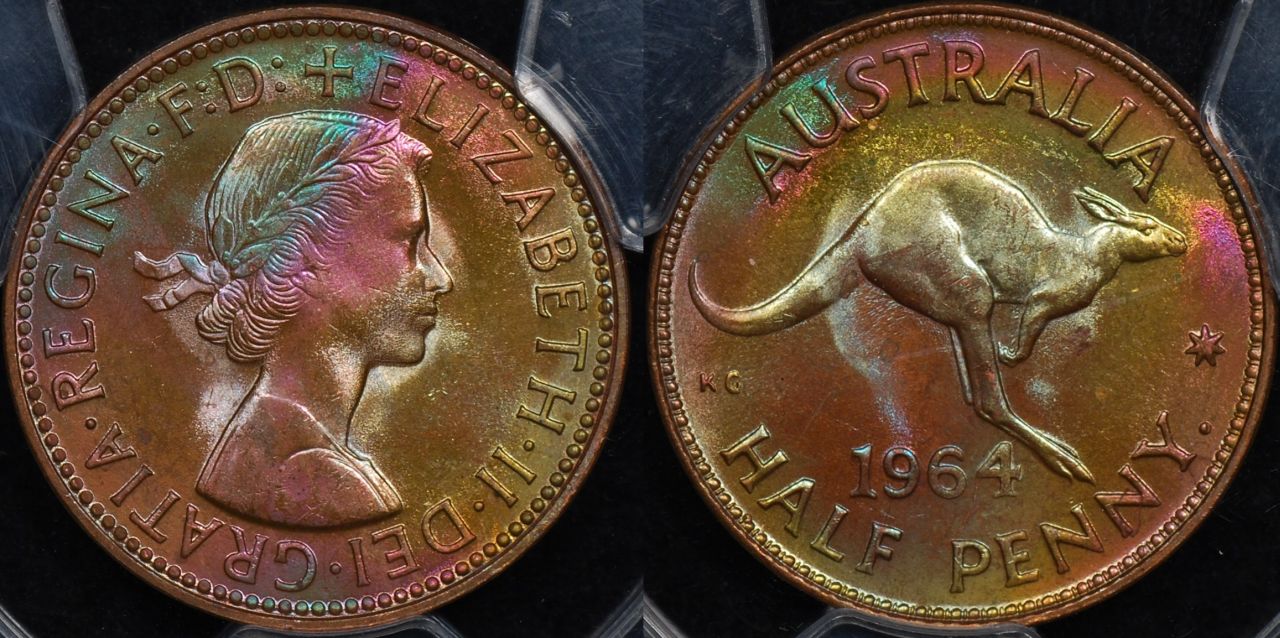 Edited by the-purple-penny
05/08/2012 11:08 pm
|
|
Pillar of the Community
 Australia
4411 Posts |
|
|
Pillar of the Community
Australia
1607 Posts |
Very nice PP,love the way the colours blend in to each other,the blue & pink  Unfortunately I have'nt yet mastered the art of capturing the colours properly but i'll keep trying different things until I get it right. |
|
Valued Member
Australia
157 Posts |
Hi enworb , I am no expert on pennies far from it , but I do remember reading somewhere that the the Perth Mint did washed their planchets where the melbourne mint didn't , maybe there was a very light cleaning agent residue left on the coin, which might be a factor in the toning . just my opinion |
|
Pillar of the Community
Australia
4411 Posts |
That was my best guess bellyflorin, that they treated the planchets somehow. I just wish I could photograph them as well as purplepenny
|
|
Pillar of the Community
Australia
515 Posts |
This is my beautiful Perth '52. PCGS rejected this, I sent it back, umm about 2 years later and it got slabbed that time.  |
|
Pillar of the Community
Australia
4411 Posts |
Rejected as altered surface PP? What did the grade come back as? I thought my collection was getting some nice colours together but yours totally trumps mine |
|
Pillar of the Community
Australia
1295 Posts |
There are many theories as to why Perth copper tones the way it does. These include washing the planchets, oil on the planchets, heat treating (or not heat treating) the planchets, and improperly mixed planchet metal. I lean towards the heat treating because rainbow toning is a function of surface microstructure. Something that is greatly affected by heat treatment. PP's 1952 half penny does show that whatever they were doing they did it from the early 1950's to 1964. It's interesting that their 1966 2c DON'T tone rainbow colours. So whatever they were doing differently stopped for decimal production.
|
|
Pillar of the Community
Australia
515 Posts |
It had got a body bag "questionable color" but I had faith in the little guy, sent him back and got an MS64RB. They (PCGS) have become more friendly towards coloured copper which is good for me as I love it. They have also now slabbed a few of my "purple pennies".
|
|
Pillar of the Community
Australia
3839 Posts |
I'll like to take it from a different perspective. Firstly, I think a mass spectrometry would be interesting to see if there is a difference in the alloys of the coins. I am somewhat suspecting that there would be different trace metals in the copper coins. Why? Perth Mint, located in WA would have areas that are rich in copper as well as gold whereas in Melbourne, I am suspecting that most copper would be sourced from NSW which would have lower gold content. Why I am coming up with this idea is because if you put traces of gold during glass making, that makes it the red color glass. I am not too sure what would make it purple but I am suspecting that it has to be some kind of element that's causing this. My partial coin collection http://www.omnicoin.com/collection/gxseriesMy numismatics articles and collection: http://www.gxseries.com/numis/numis_index.htmRegularly updated at least once a month. |
|
Pillar of the Community
Australia
4411 Posts |
I thought the planchets were from a common source and not produced by the mints?
|
| |
Replies: 11 / Views: 2,137 |
|







 Posted 05/09/2012 12:19 am





