| Author |
 Replies: 14 / Views: 6,487 Replies: 14 / Views: 6,487 |
|
|
Valued Member
United States
117 Posts |
Okay - if you look at the 'dots' in and around E PLURIBUS UNIM - take that same dot and place it somewhere else (out of place) on a coin - what is that? What is it called? Does it affect the desirability of a coin?
(So many questions - )
|
|
|
|
Moderator
 United States
23522 Posts |
The only issue I can comment on regarding that is Morgans - such dots appear on 1921's, and it's believed that they were the product of hardness testing on the dies. If the metal is of the proper hardness, punching the die with a specific punch at a specific force should create a hole in the die of a specific size. The result is a minted coin with a raised dot on it.
|
|
Pillar of the Community
United States
7629 Posts |
On zinc cents they are usually gas bubbles that come from impurities on the zinc planchets when they are plated in copper. The zinc corrodes under the copper and produces a gas that pushes the copper outward.
|
|
Pillar of the Community
United States
830 Posts |
On older coins, some dots (actually raised lumps of metal) form due to the mint using rusted dies. When rust causes pits in the dies, then corresponding lumps appear on the coins.
|
|
Valued Member
 United States
117 Posts |
One example I gave (albeit not the best, as I have better, clearer 'single 'dot' on a penny - somewhere) is on this 1964D
|
|
Valued Member
United States
117 Posts |
Sorry about that - I also have a 1987 with a single raised 'dot' right above the 1 of the date. 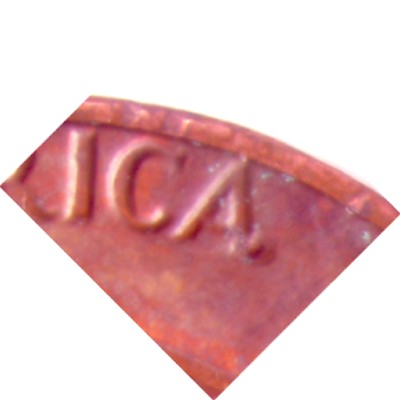 |
|
Valued Member
United States
117 Posts |
Here is another example of a "dot" - this is on a 1991D Lincoln 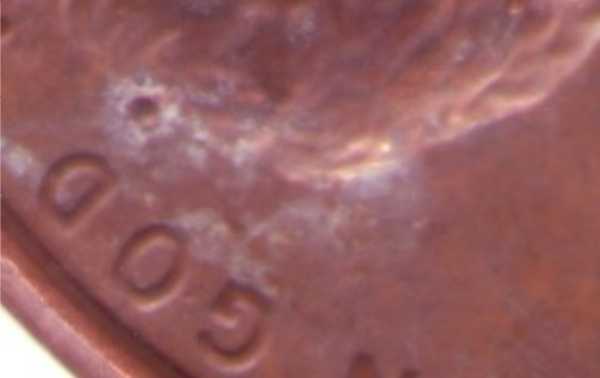 |
|
Valued Member
United States
382 Posts |
please see . read coppercoins response .. "zinc coins" which are since 1982 to date what Lincoln cents are made from / coated with a little copper on the out side of the zinc core,, thus "clad". yes in 1982 copper/bronze cents were minted concurrent with the zinc ones.as far as a single raised dot on a 1964 cent could be a number of things including (perhaps) a hardness test marked planchet.
|
|
Valued Member
United States
117 Posts |
I read the article die variety wrote, and he mentioned something about these being die gauges..(If I remember correctly)
|
|
Pillar of the Community
United States
1952 Posts |
no he said they are gas bubbles. and I agree
Gary
|
|
Valued Member
United States
117 Posts |
From Die Variety News Issue 6, page 36, last picture on bottom of the page, right hand side, and I quote "This die gouge (small dot) located just below the VDB designer's initials in the field will help to authenticate this 1971-S 1c PF CDDO-001/fs-032. A very popular Lincoln Cent proof DDO. Getting more difficult to locate specimens." Now this may be just for this particular cent, but alas, there are noted "dots". |
|
Valued Member
United States
228 Posts |
  I have always wondered what caused this, now I know..gas bubbles. ***Edited by Forum Dad to put a space between images so they stack if needed and don't stretch the page.*** |
|
Bedrock of the Community
United States
12437 Posts |
Fishnwidow,
gas bubbles primarily plague 1982 on up Cu plated zinc cents, not the earlier alloy types. Your coin looks like someone tried to hammer a nail through it. Notice the indent under "EN" on the reverse- the raised area on the obverse corresponds to that dent, metal being pushed from one side of the coin to the other.
|
|
Pillar of the Community
United States
7629 Posts |
I'll elaborate...
Gas bubbles are the primary reason for large, usually single blobs that look like tumors on zinc cents.
Multiple humps and bumps on zinc cents that look more like tons of little warts are the result of dirt on the planchet at the time they are plated.
Very small pock marks in the die at the time a coin is minted are called "die dots". They primarily show up on proof coins, but can show up on any coin. They are almost always microscopic.
Slightly larger sharp outcroppings from devices on coins are usually die gouges.
Bottom line...none of these "dots" add any value to a coin. At most they are sometimes used to help identify something that is valuable for a different reason.
"Plated" and "Clad" are two completely different terms that cannot be interchanged. Zinc cents are dipped, or plated in copper. Quarters and dimes are separate sheets of metal that are rolled together to create a clad. Difference....plating is dipping in molten metal. Clad is sandwiching together different kinds of metal.
|
|
Valued Member
United States
117 Posts |
The 2 examples I show above - are 2 entirely different pennies.
|
| |
Replies: 14 / Views: 6,487 |
|










 Posted 03/03/2007 1:01 pm


