| Author |
 Replies: 9 / Views: 2,084 Replies: 9 / Views: 2,084 |
|
|
Pillar of the Community
Hong Kong
1270 Posts |
I would like to show you two coins: one Spanish Mexican 8R 1805 TH which I think a counterfeit and the other 8R 1807 TH is real(at least I believe). I show the two coins side by side so you can compare them and share your experiences here or get the experiences from those experts of this forum. Keep information known by each other is important to all numismatists! The left-hand side is the real one (1807) and the counterfeit 1805 at the right side. For the edges pictures, the upper one is the 1807 piece. Specification: 1807: 26.48 grams, 39.3mm, S.G. measured by me 10.107 (corresponding to 77.84%Ag in my system), bought at June 2012 EUR42.50 from a Germany seller. 1805: 26.06 grams, 39.8mm, S.G. measured by me 10.058 (corresponding to 74.74%Ag in my system), bought at April 2012 US$67.66 from a US seller. Is it a Class 3 modern forgery, swamperbob? 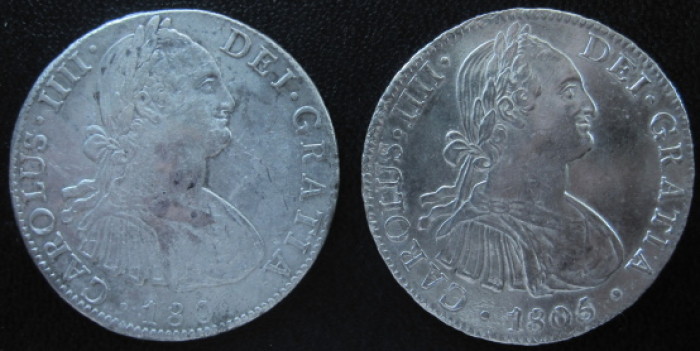 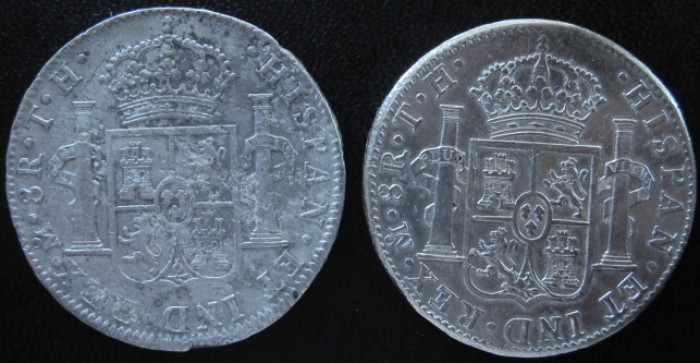 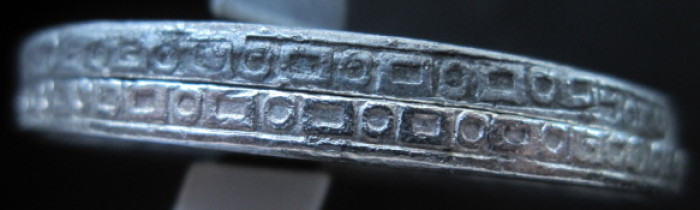 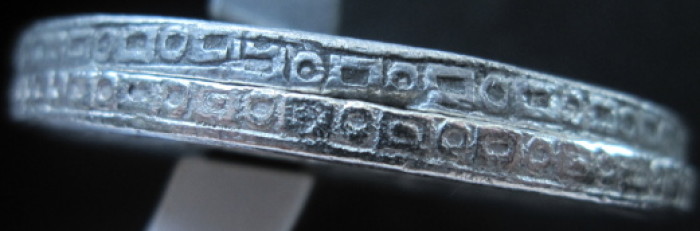 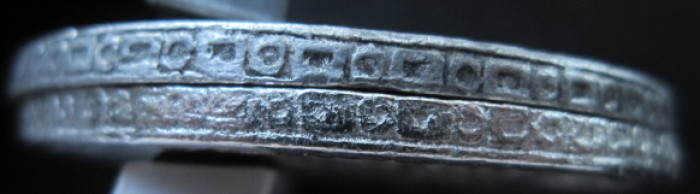 |
|
|
|
Pillar of the Community
United States
1812 Posts |
If it is a fake, they did a really good job and it would have fooled me.
|
|
Pillar of the Community
 Hong Kong
1270 Posts |
Broken-Coin, I hope the 1805 piece is not fake because I hate counterfeit coins, it makes me lost my money. The 1805 piece is very nicely struck, very silvery surface surface but I couldn't see anything wrong by the scans so I was also fooled by the seller. This is a dangerous specimen to cheat the coin collectors; it is hard to explain why the coin is so underweighted without any prominent wearing.
|
|
Pillar of the Community
United States
1761 Posts |
When the Counterfeit 8 Reale book comes out from the American Numsimatic Society in 2013 (late) I will doubt you will lose any money. Normally like the counterfeit British halfpence and farthings the counterfeits will be WORTH MORE than the regal issues.
John Lorenzo
United States
Co-Author
|
|
Pillar of the Community
United Kingdom
2139 Posts |
colonialjohn,
I'm surprised you think that counterfeit British halfpence and farthings are worth more than the legal issues.
I think there's a minimum and a maximum price that collectors are prepared to pay for contemporary counterfeits, and the minimum is more than the value of the late legal issues of George III, George IV, and William IV in Fine condition but I think the maximum will be less than the value of legal issues in better grades.
I'm prepared to be persuaded otherwise if you have evidence to the contrary.
|
|
Pillar of the Community
United States
1761 Posts |
Since you are in the U.K. everybody knows Cobwright who is the top English selling counterfeit dealer. He has the largest evasion collection, etc. see him on E-Bay ... an average Fine 1770 GIII Contemporary Counterfeit Halfpence (overall) will bring more higher prices than a regal 1/2d for 1770. This example can be used for any GIII 1/2d between 1770-1775. Same for the farthings and any GII issue. Casts not so as they are ugly and have not attracted the collector as struck pieces. The current world record for a GIII 1/2d is a 1772 in VF+ for $18,400. See here: http://legacy.stacks.com/Lot/ItemDetail/176215Mr. Simmons once said to me in his shop when he had a shop in London ten years ago when I visited your country - John - just can't figure it - some bring several hundred - some just a couple of dollars - in general each one brings more than a regal. If you never heard of Cobwright or Simmons Gallery in London then this may explain it. If you have - case closed. John Lorenzo United States |
|
Pillar of the Community
United States
1761 Posts |
Granted - once you venture into the 1800's this changes with GIV and onward - too common - not much interest. But not pre-1800. Hey - send me an E-Mail when you have some in the 1500-1600's period. I got all the cash you need in my PayPal account <BG>.
John Lorenzo
United States
Edited by colonialjohn
09/14/2012 3:53 pm
|
|
Pillar of the Community
Hong Kong
1270 Posts |
I think contemporary counterfeits do worth something but modern forgery is worthless, like this one. This Spanish/Mexican 8R looks like a toy money, it is not as compact as a formally struck specimen. The sound comes out when falling on the floor is quite different from a real portrait dollar. I also don't think this is the result of casting. Could it be made by electroplating? I have no idea about this coin!  The following scan shows a great fault on the reverse side. If I had been more scrutinized about the picture posted by the seller, I would never buy this coin. 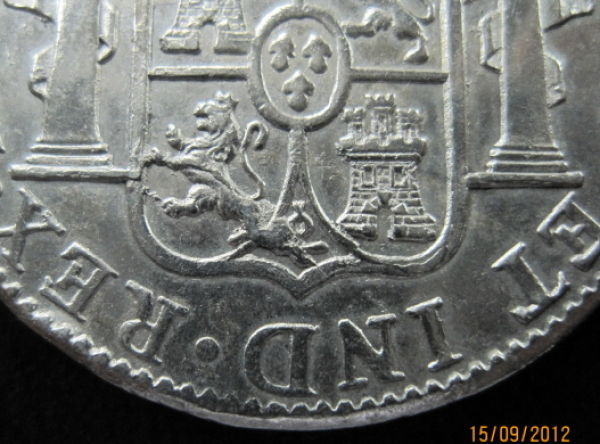 |
|
Pillar of the Community
United States
1761 Posts |
In my opinion this is a modern cast from a casting transfer process. Note the metal fall-out along the rim and the raised dots throughout (here and there), look at the right side of I and the top left serif of T in ET in your pic - probably Fe/Ni, german silver (Cu/Zn/Ni) or brass (Cu/Zn) with trace silver (1-10%) accounting for the "lower" pitch coin ring.
John Lorenzo
United States
|
|
Pillar of the Community
Hong Kong
1270 Posts |
|
| |
Replies: 9 / Views: 2,084 |
|










 Posted 09/12/2012 7:30 pm


