I am jumping in late - but as food for thought, I have a couple comments.
I am just getting into punch designs of the 8Rs in detail because of some preliminary research that I did for the book. I was interested in isolating some detail or details that could act as an easy point of comparison, thereby easily identifying forgeries.
The Castle design is I think a great place to start to try to assemble such a list of forged designs. It is a small detail that is often overlooked. It is also made with a punch that was created from a master matrix die block provided to each branch mint from Spain. Individual punches were created from that die block. The two Castles should always match on any one die but also from die to die. My question was FOR HOW LONG?
Theoretically, that use of the punch matrix block means that the Castles CANNOT vary too much year to year. However, the matrix block itself can be distorted (damaged) by wear, it can get gouged accidentally, etc. This leads to a line of thought that caused me to try to isolate what normally might happen to the block and separate those things from things that cannot happen.
One thing that should never happen to the matrix block is an addition of metal to create a new incuse feature in the punch or to reduce the size of a feature.
I do realize that a punch can also be re-cut and reduced size after it is originally created but a single punch should not persist years and years on end. Punches in very low volume mints like Popoyan are likely exempt from this thinking. But the high volume mints like Mexico City and Potosi should have much shorter punch life because of high die volume.
That is why I started looking at the castles - particularly the way the blocks were "laid out" in the walls.
To create a depression on a coin (like the mortar line in the blocks) requires a raised line on the working die and an identical line on the working die punch. The punch gets the features from a negative impression in the matrix punch block. So a gouge, scratch or ding in the matrix block will be there on all subsequent punches made from that die block a a raised line. This imparts a depression into the die and the coin will have a RAISED line. Therefore the recessed line in this case was not made by a cut in the matrix block but via an ADDITION of metal to the matrix block itself.
This violates one of my primary theorems - no metal can be added to the matrix block.
So an addition being ruled out leaves us with a good possibility of a forgery.
For people not familiar with the way forgers work, one high end form of forgery creates die punches from original high grade host coins. Each feature is copied to a punch which then is used to make dies. All that is needed to make a punch with the line in question is an original that had a dent at that point. The dent will appear on ALL dies made from that punch.
If the same damage is seen on more than one mint or in several different years - it points to the likelihood of one forged punch being used to make multiple counterfeit dies.
The damage will NOT go away it lasts as long as the Punch lasts.
So where am I going?
In the book, I show a crack that progresses on a single working punch. It is Bolivian associated with Charles III. The progression covers MANY years and in my opinion it is improbable that the punch is real because of the number of years the same crack appears. It also appears on several absolutely COUNTERFEIT coins.
This crack led me to hunt for other tiny anomalies that have been overlooked. One such is a line that crosses into the upper outside corner of the window on the left side of the castle (to the viewer's right).
It is common on Mexico City coins to the extent that initially wondered if I had found a feature on the Matrix block no matter what I theorized. It is too bad that most counterfeits are worn and the castles lack clear detail, but I located quite a few counterfeits with a line (identical or very similar). It appears on several Class 2 coins and even on a couple Class 3 - but is it an original feature or not?
It is too early to be sure - but right now I am leaning toward the line being a marker of a forgery. I have yet to find the identical line on any undeniably real coin. I have seen a couple on
TPG graded coins but in those cases, I am suspicious of the coin anyway because of other Class 2 anomalies.
I almost put a generalized discussion of this in our book but decided to limited it to just the one case of the crack. However, I had started assembling photos of castles with the break that appears to show on this 1820.
The 1820 is a very grainy photo but it appears to have a line in the corner of the window. I added the 1820 at the left on a reject photo collage - for what it is worth here it is. It is a reduction in detail done for the book and is a bit grainy.
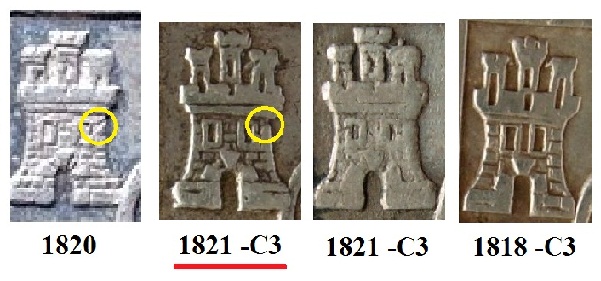
The three coins at the right are all Modern Numismatic Forgeries (C3).
The castles make a study unto themselves and I was surprised at the variations I had never really noticed. It is a very fertile area for study.
As a good example of a heavily altered punch (on a counterfeit coin) is the following Castle. It is likely a hand carved punch. Perhaps done from a transfer outline of a real castle.
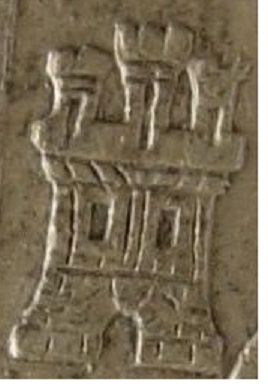
I went back to my original set of photos and located the original castle (the one underlined in Red) - it is a Zacatecas counterfeit from 1821.
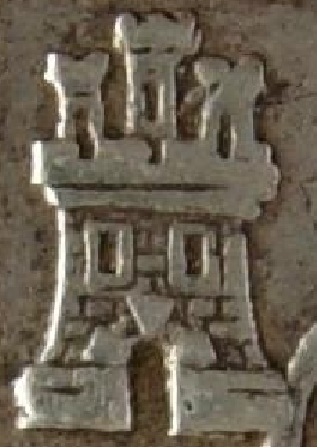
Here is a larger (clearer) picture of the line. On the coin it does not look like a crack. I looks more like a post strike impression on the surface of a coin made by a somewhat blunt or rounded point being dragged over the coin surface.
It is a clear photo because the original photos I took of my collection are 16 meg and were taken using a tripod. I have photos of the same clarity of all of my Counterfeit Portrait 8Rs all 727 of them.
Based on the foregoing, I would not believe any coin with the line shown in the next photo is real.







 Posted 11/19/2012 9:29 pm





 to the community Plonker.


