Coin Community Family of Web Sites Join Thousands of Coin, Bullion, & Money Collectors
Royal Canadian Mint products, Canadian, Polish, American, and world coins and banknotes. Specializing in Modern Numismatics 300,000 items to help build your collection! Vancouvers #1 Coin and Paper Money Dealer Join Thousands of Coin, Bullion, & Money Collectors Shop for APMEX Bullion on eBay!Coin, Banknote and Medal Collectors's Online Mall


Username:
Password:
Save Password
Forgot your Password?


This page may contain links that result in small commissions to keep this free site up and running.

Welcome Guest! Registering and/or logging in will remove the anchor (bottom) ads. It's Free!

Before & After Pics - MS-70 Used On Impaired Proof Half

To participate in the forum you must log in or register.
Author Previous TopicReplies: 6 / Views: 8,480Next Topic  
Bedrock of the Community
Earle42's Avatar
United States
10034 Posts
 Posted 01/14/2013  6:00 pm Show Profile   Bookmark this topic Add Earle42 to your friends list Get a Link to this Message Number of Subscribers
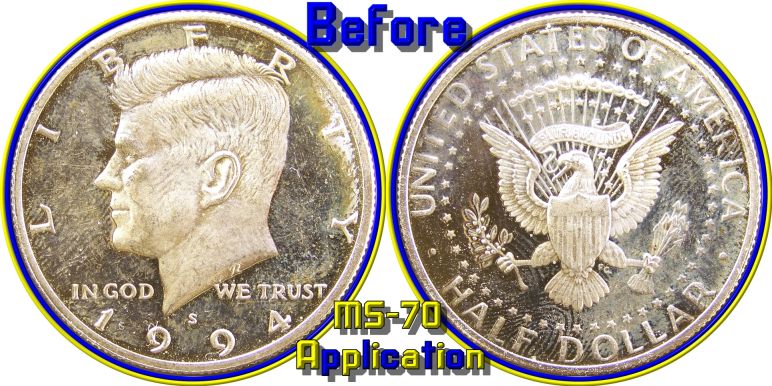
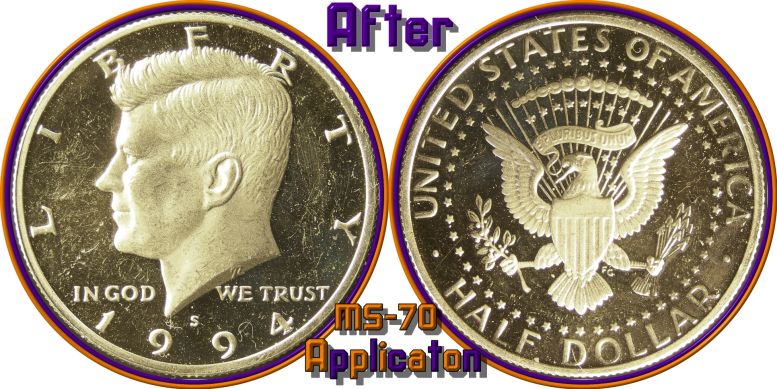
Got a 94-S impaired proof in circulation. I figured since its worth .50, it couldn't hurt to try "MS 70 Industrial Strength Coin Brightener" on it.

I like the results - and in hand the piece looks a lot better - the lighting setup I used accents the scratches in the picture.

Before-&-After-Pics---MS-70-Used-On-Impaired-Proof-Half


Before-&-After-Pics---MS-70-Used-On-Impaired-Proof-Half
How much squash could a Sasquatch squash if a Sasquatch would squash squash?
Download and read: Grading the graders
Costly TPG ineptitude and No FG Kennedy halves
https://ln5.sync.com/dl/7ca91bdd0/w...i3b-rbj9fir2
Pillar of the Community
mdpmedia's Avatar
United States
3546 Posts
 Posted 01/14/2013  7:28 pm  Show Profile   Bookmark this reply Add mdpmedia to your friends list Get a Link to this Reply
Hi,

For the less knowledgeable ones viewing this thread any cleaners such as ‘MS 70 Industrial Strength Coin Brightener' should never be used in an attempt to increase the numismatic value or eye appeal of a valuable coin having unique toning which will be removed or significantly altered by this cleaner.

Because this cleaner is primarily composed of NaOH (sodium hydroxide) it is technically not an acid and promoted as not removing the patina of coins.

A coin may appear better using this product but the professional coin dealers and traders would know in a minute if one applied this chemical especially on a MS-70 graded or toned coin.

Detergent-like compounds like this MS-70 cleaner require a Q-tip to apply the chemical; remember that just the movement of a Q-tip covered with this chemical on a MS-70-graded gem coin's surface could conceivably create micro scratches and subsequently diminish the coin's value down to a MS-69 status.

I have also heard stories about this cleaner altering the tone of some but not all copper coins.

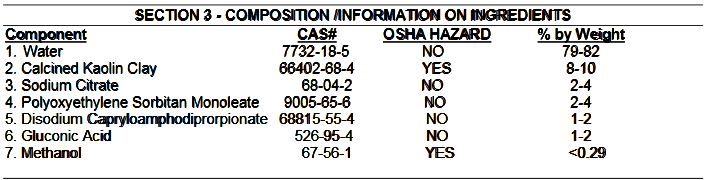
MS 70 Industrial Strength Coin Brightener is not intended to be used as a dip like Tarn-X whose MSDS chemical components are shown below:

Before-&-After-Pics---MS-70-Used-On-Impaired-Proof-Half

On another somewhat related note I use baking soda (sodium hydroxide=NaOH) by placing a pasty mixture of it with water onto the surface of silverware (never silver coins).

NaOH mixed with H20 is a safer, less expensive, and effective for removing tarnish from silverware, for example.

IMHO
mdpmedia


Pillar of the Community
mcshilling's Avatar
Canada
9158 Posts
 Posted 01/14/2013  7:33 pm  Show Profile   Bookmark this reply Add mcshilling to your friends list Get a Link to this Reply
Woow that looks cool

Now with it in hand if you did not know it was, shell we say cleaned, can you see that you have used MS70


edit, mdp posted will I was typing, think I got my answer.
Edited by mcshilling
01/14/2013 7:38 pm
Bedrock of the Community
Conder101's Avatar
United States
17884 Posts
 Posted 01/15/2013  10:58 am  Show Profile   Bookmark this reply Add Conder101 to your friends list Get a Link to this Reply

Quote:
Because this cleaner is primarily composed of NaOH (sodium hydroxide) it is technically not an acid and promoted as not removing the patina of coins.

Interesting statement considering the list of ingredients listed in the same post shows no Sodium Hydroxide at all.


Quote:
On another somewhat related note I use baking soda (sodium hydroxide=NaOH) by placing a pasty mixture of it with water onto the surface of silverware (never silver coins).

Another interesting statement considering there is no Sodium Hydroxide in baking soda either. (Baking soda is sodium bicarbonate Na(CO3)2 )


Quote:
NaOH mixed with H20 is a safer, less expensive, and effective for removing tarnish from silverware, for example.

NaOH, Sodium hydroxide, also known as lye, is typically used as a drain cleaner (Draino). It is a very strong base and unless it is highly diluted it is extremely corrosive to both metal and skin.
Edited by Conder101
01/15/2013 11:00 am
Pillar of the Community
mdpmedia's Avatar
United States
3546 Posts
 Posted 01/15/2013  12:00 pm  Show Profile   Bookmark this reply Add mdpmedia to your friends list Get a Link to this Reply
Condor,

Thanks for catching these mistakes. I wrote this hastily w/o double checking my comments.

When I stated baking soda I was actually thinking sodium hydroxide incorrectly without double-checking the product formulations/names carefully. Sodium bicarb, which has obviously always been baking soda still remains, however, safe to use on silverware and also safe to mix with water as I previously stated.

w/r/t to the NaOH (sodium hydroxide) and 'MS 70 Industrial Strength Coin Brightener' some of the comments I've heard and seen stated that it removed coin toning but also incorrectly referred to it as having NaOH: my mistake for not being more specific. I still would not use this product myself on any coin having significant toning.

But after having read the MSDS myself I do agree with you that NaOH in its original state does not exist anywhere on the sheet so 'possibly' those comments I found were referring to some reactive bi-products which I am not aware of these details. That's only speculation at this point and I personally do not have any data to back this statement up.

In summary I believe that my general recommendations are still valid but that the chemical compound symbols did not line up correctly with the ordinary common names of the chemicals all that well.

I do apologize for the confusion.

mdpmedia
Pillar of the Community
52Raymo's Avatar
United States
8516 Posts
 Posted 01/15/2013  12:09 pm  Show Profile   Check 52Raymo's eBay Listings Bookmark this reply Add 52Raymo to your friends list Get a Link to this Reply
Wow Earl, that's way better. It looked horrible before.
Oregon coin geek.....*** GO BEAVS ! ! ! ***
Bedrock of the Community
Earle42's Avatar
United States
10034 Posts
 Posted 01/15/2013  10:40 pm  Show Profile   Bookmark this reply Add Earle42 to your friends list Get a Link to this Reply
@mdpmedia

Thanks for posting to remind people not to clean coins that are actually worth something. I forgot some people not familiar with the golden rule of "DON"T CLEAN COINS!" might read this and make a mistake.

I mentioned, on purpose, I knew it was only a .50 coin so I did not mind treating the coin, but I should have been a lot more specific.

@mcshilling:

Quote:
Now with it in hand if you did not know it was, shell we say cleaned, can you see that you have used MS70

There is no way this piece could ever again pass for a good proof since the surface is scratched, hence the small white lines remaining in the "After" pic. This is why I chose this piece to experiment.

However, after seeing the results on the proof, I was curious as to a normal clad half. I experimented on one of many nicer looking, still-decent-luster 71-P halves I found in a roll (a lot of these out there). I have to admit the 71 came looking very close to a brand new NIFC when side by side. I am not sure I could tell if it had been treated. All the chemical did was seem to remove the dirt. But I still would not use this to treat anything of value.

I admit I suspected NaOH or some other strong base as the primary ingredient since it leaves your skin (accidental - small amount!) feeling slippery like bases do. But I cannot find an ingredients list anywhere.

The bottle says to apply the liquid (I poured it on carefully) , let it sit just a second, and then rub (however, I rolled) a Q-tip lightly over the surface of the coins. This was enough to remove the unwanted stuff (except scratches of course).


How much squash could a Sasquatch squash if a Sasquatch would squash squash?
Download and read: Grading the graders
Costly TPG ineptitude and No FG Kennedy halves
https://ln5.sync.com/dl/7ca91bdd0/w...i3b-rbj9fir2
Edited by Earle42
01/15/2013 10:41 pm

  Previous TopicReplies: 6 / Views: 8,480Next Topic  

To participate in the forum you must log in or register.


Disclaimer: While a tremendous amount of effort goes into ensuring the accuracy of the information contained in this site, Coin Community assumes no liability for errors. Copyright 2005 - 2026 Coin Community Family- all rights reserved worldwide. Use of any images or content on this website without prior written permission of Coin Community or the original lender is strictly prohibited.
Contact Us  |  Advertise Here  |  Privacy Policy / Terms of Use

Coin Community Forum © 2005 - 2026 Coin Community Forums
It took 0.4 seconds to rattle this change. Forums