Coin Community Family of Web Sites Join Thousands of Coin, Bullion, & Money Collectors
Join Thousands of Coin, Bullion, & Money Collectors Royal Canadian Mint products, Canadian, Polish, American, and world coins and banknotes. 300,000 items to help build your collection! Vancouvers #1 Coin and Paper Money Dealer Specializing in Modern Numismatics Coin, Banknote and Medal Collectors's Online Mall Royal Estate Auctions - $1 Coin Auctions


Username:
Password:
Save Password
Forgot your Password?


This page may contain links that result in small commissions to keep this free site up and running.

Welcome Guest! Registering and/or logging in will remove the anchor (bottom) ads. It's Free!

Class 1 Or Class 3 Counterfeit? Please Judge!

To participate in the forum you must log in or register.
Author Previous TopicReplies: 24 / Views: 3,808Next Topic
Page: of 2
Pillar of the Community
wonghinghi's Avatar
Hong Kong
1270 Posts
 Posted 02/15/2013  11:59 pm Show Profile   Bookmark this topic Add wonghinghi to your friends list Get a Link to this Message Number of Subscribers
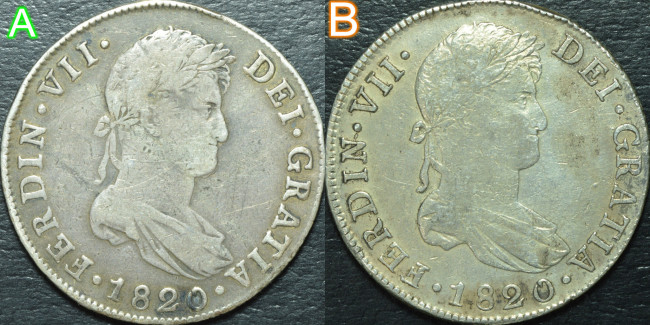
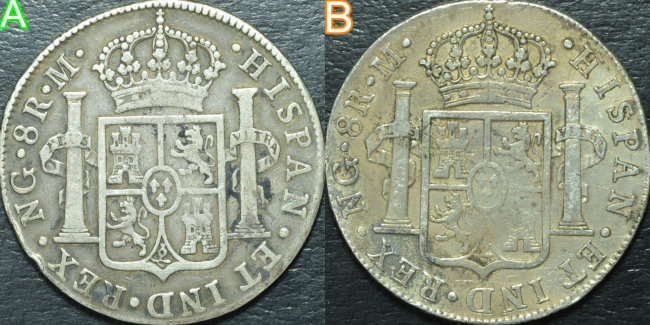
Hi members, I have been pondering the two New Guatemala 8R 1820 for a long time but I can't make a conclusion.

Coin A
I think this is genuine, was bought after I recognized my first NG 8R is a counterfeit. Weight 26.61 grams, 38.3-38.5mm, S.G. 10.185 (corresponding to 82.9%Ag in my system).

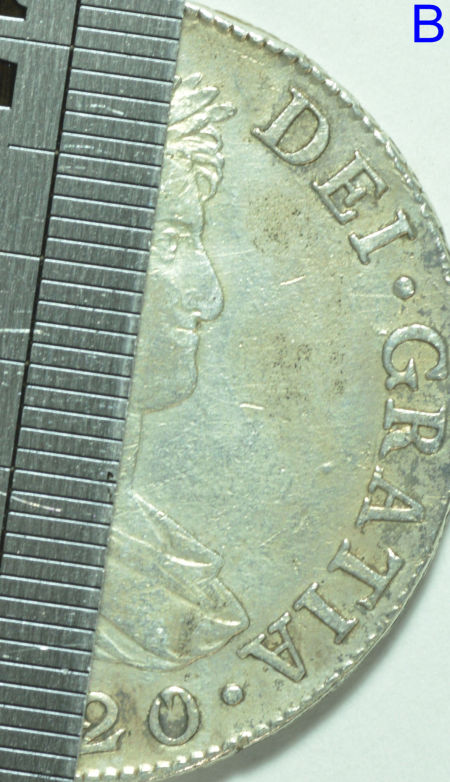
Coin B
I can't find any clear-cut difference between it and my "supposed" genuine coin (A). Why I think it a counterfeit is from the evidence of S.G. measurements, I measured this coin for S.G. 3 times by different date, the S.G. values are 9.74, 9.63 and 9.66 (%Ag from 46-52% in my system). Other data of this coin, 26.88 in weight and 8.1-38.3 mm in diameter.

I post the pictures of both coins here for your comparison. My questions is that would coin B (counterfeit) be a class one contemporary counterfiet struck for circulation? If it is, how come the die was so close/similar to the real one (coin A here)?

If coin B is a class 3 counterfeit struck to cheat coin collectors, why didn't the counterfeiter to add some more silver to the coin, then it might become a perfect forgery to rip off most of the coin collectors.

I hope someone can contribute his expertise to comment on the coins and my judgements.
Class-1-Or-Class-3-Counterfeit?-Please-Judge!

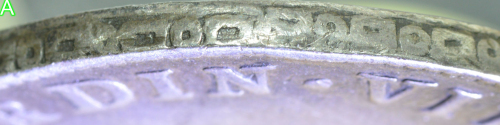
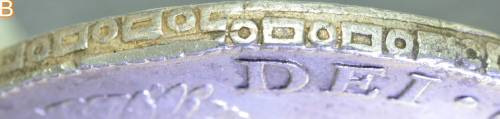
Both coins show two opposite edge overlaps:
Class-1-Or-Class-3-Counterfeit?-Please-Judge!

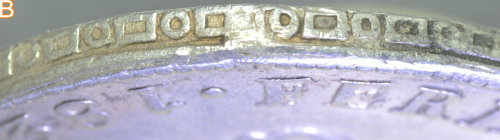
When see carefully the "square/circle" edge patterns of both coins look very similar, the squares and circles from both coin are of same size.
Class-1-Or-Class-3-Counterfeit?-Please-Judge!
Pillar of the Community
swamperbob's Avatar
United States
5362 Posts
 Posted 02/16/2013  01:49 am  Show Profile   Bookmark this reply Add swamperbob to your friends list Get a Link to this Reply
Your coin has me in a quandary at present. It is 2AM here and I was headed to bed. Perhaps I should sleep on what I think because you may not like the answer.

Pillar of the Community
wonghinghi's Avatar
Hong Kong
1270 Posts
 Posted 02/20/2013  09:59 am  Show Profile   Bookmark this reply Add wonghinghi to your friends list Get a Link to this Reply
Swamperbob, why don't put a few comments on the coins here, I am waiting..., just say the truth.
Pillar of the Community
swamperbob's Avatar
United States
5362 Posts
 Posted 02/20/2013  2:02 pm  Show Profile   Bookmark this reply Add swamperbob to your friends list Get a Link to this Reply
Here are my thoughts. Sorry it took so long but this one was not typical. The two coins appear to be made using slightly different Portrait King punches. That is NOT normal at least in my experience from Mexico City.

If you notice look at the profiles of the two coins they are not identical - nose length and shape is a good indicator. The B coin looks flattened out. Based on the photographs I made the assumption that the two coins are identical in size and were photographed at the same scale. Therefore measurements of key dimensions can be compared. I use several to compare punches. Dimensions that cross the perimeter at right angles is best to minimize measurement errors.

Two key dimensions (knot in pony tail to bridge of the nose and knot to the intersection of the neck and jaw) are different lengths by nearly 2mm.

So we would have to postulate TWO different King Punches were used at the same mint at one time. That is in my opinion possible but is a difference worth noting. I also note that the King punch on the A coin matches the King punch for Mexico City in 1820. I don't know if the mints ever supplied dies to other mints or if the same matrix was used at each but that is quite possible.

I checked the fonts and punches and both coins seem to be identical. The letter-set and numbers match and appear regal in style following the Mo style very very closely. (Late date Class 2 coins do use punch sets that match the originals - earlier sets do not. Most early Birmingham fonts are NOT regal.) So the font match does not necessarily mean both are real or both counterfeit.

Next I checked the overlaps. Both coins were edged on a two die edger the physics matches. The A coin has damage that makes a precise length measurement difficult for one overlap. But I believe I can see enough to get a relative length. The centers match the center of the coin.

The two coins however do have laps of slightly different lengths. The A coin is clearly longer. That is normally variable dimension coin to coin and as long as the lap is not excessively long say 20% of the circumference it is fine.

At the end you post two photos of the edge designs and indicate they are the same.

I agree that the lengths of the pattern match.

But both do not have squared circles only the one at the top. The A coin edge has actual squared circles. To prevent distortion effects look at only the circle nearest center - third from the left and fourth from the right. The right side of that circle is square at the top - the side away from the compressive effects of the strike. If you notice the gaps between that circle and the adjacent rectangles is different. The gap to the left is narrower than the gap to the right. Checking the 4 pictures of the edge I think that the A coin shows variation in elemental size and is clearly not an identical pattern. The question becomes why is there a squared circle on that edge. Is it just a die chip? I only see one clear squared circle not numerous examples as normal.

The B edge is correct - wall thicknesses and gaps are identical as I would expect on a regal issue in a normally functioning mint.

So what is my conclusion about this entire matter.

1. The SG points to coin B as some form of fraudulent issue. It has too little silver to be standard. Therefore it is one of three things (1) a Class 1 contemporary counterfeit, (2) it is a more modern Class 3 counterfeit or (3) it is one of the illusive Debased Originals. Only XRF testing MAY provide a way to be sure but is likely only to be able to identify a Class 3 coin.

2. The SG points to coin A containing nearly the correct amount of silver. This means it is either Genuine or a Class 2 counterfeit a restrike.

3. The Class 2 restrikes in silver were made copying Mexico City coins. This is the case in the later post 1830 issues. Before 1830 silver restrikes of Bolivia are known and Peru suspected but NO Class 2 NG coins have been located.

4. So after all this I concur that your A coin does appear to be Genuine - the odds are in favor of that. All you need to do is closely examine the one squared circle and find a plausible reason for it being there,

5. The B coin is not standard that is a simple fact. Could it be a genuine debased original made at the mint on a bad planchet. These coins have always been suspected of being made and you find them mentioned in a lot of books but I dispute their actual existence. In our new book we have effectively debunked the Riddell "Low Standard" coins as being simple well made counterfeits using a NON REGAL style. I personally have never seen nor have I owned a debased original made in the mint. So I place the chance of this one being such a coin VERY low.

6. One factor not discussed is the style of the B coin. It matches the Regal matrix exactly except for the dimensions of the portrait. The ability to make a direct transfer of an image from a coin to a die did not exist before 1830. We hope that we have proven that in the book.

7. The earliest forms of transfer resulted in some forensic effects that pass over to the dies and can be seen in the coins produced from transfer images. The most well known are the spreading effects of impact transfer. This spread ranges from almost nothing if the forger calibrates his shot by adjusting the powder charge. Too much force causes a greater spread. Later impact transfers can be remarkably well done.

8. The obverse die shows spread - the reverse die may show a slight spread side to side but not top to bottom. (Here again I am relying on the photographs being taken at 90 degrees to the coin and at precisely the same scale.) But now the possibility of a transfer impression forgery made after 1850 or so becomes very possible.

9. So I believe we are left with two strong possibilities the coin is a circulating counterfeit made at a later date using transfer technology but was meant to circulate or that it is a much more recently made 20th century Numismatic forgery.

As I said earlier XRF might be able to prove the coin is Class 3 IF in it contains certain trace rare earth trace contaminants. But if no such traces are present you are left with NO RESOLUTION because older silver can be used by a modern forger.

Now looking at it the other way to prove it is a Class 1 coin you would need to determine exactly when the original coins stopped circulating. If the 8R was out of circulation in Guatemala (replaced by a debased coin say) then you need to find a place where it could circulate and would be accepted without SG testing. In China the Schroffs were using SG tests by 1840 so that rules out China at a minimum. The Philippines or Straights Settlements is a very likely target about 1865.

If I were establishing probabilities at this point with the information at hand I would say that:

The A coin is Genuine.
The B coin is a Numismatic Forgery (this may be disproven by a link to the Philippines but I have yet to find references to NG coins being targeted)

That is the best I can do without an XRF.


Edited by swamperbob
02/20/2013 2:15 pm
Pillar of the Community
wonghinghi's Avatar
Hong Kong
1270 Posts
 Posted 03/22/2013  05:20 am  Show Profile   Bookmark this reply Add wonghinghi to your friends list Get a Link to this Reply
I have re-examined these two coins again recently and have the following findings.
Coin A : diameter from 12-6 o'clock = 38.4mm
Coin B : same as above = 38.3mm

Coin A : diameter from 3-9 o'clock = 38.4mm
Coin B : same as above = 38.4mm

I have rolled both coins side by side and I am confident to say the total number of squares and circles of both coins would never differ more than 1.

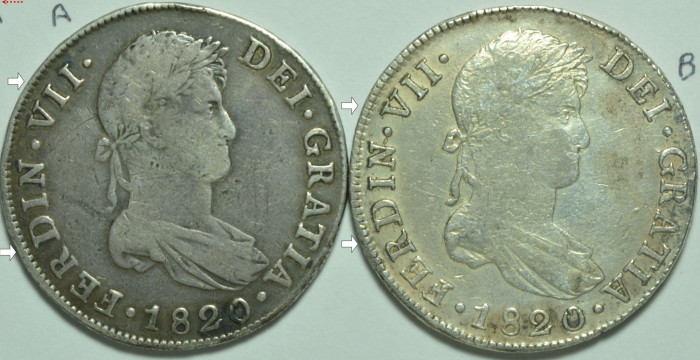
Refering to the following pictures, I find the edges of the left side (white arrows) of both coins have the same shift.

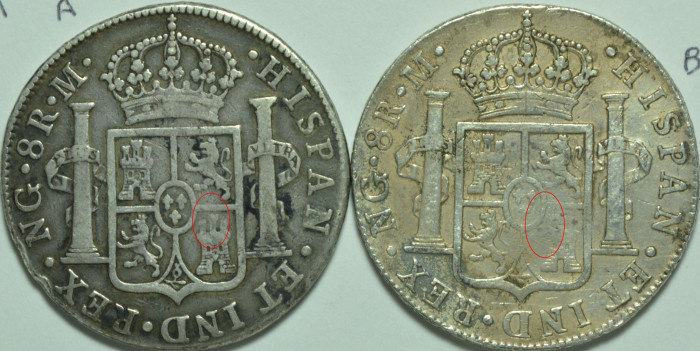
On the reverse side, the weak striking position is at similar site (red circles).
Class-1-Or-Class-3-Counterfeit?-Please-Judge!

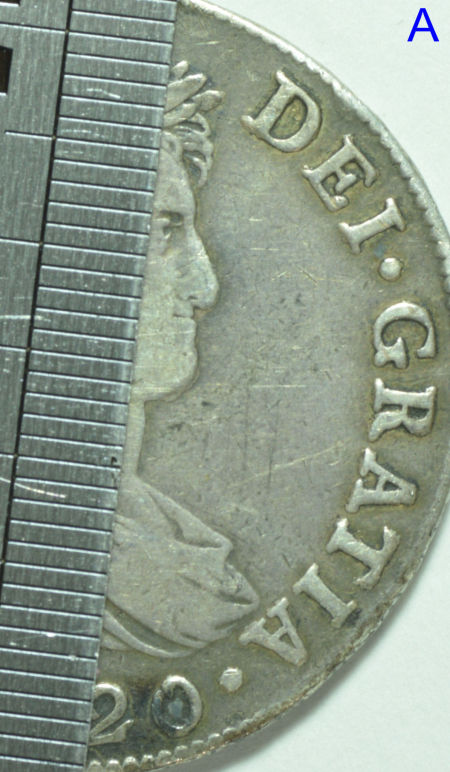
I also measure the portrait size by the neck length and the distance from the pony tail to the nose tip. Both looks very very similar. Please look.
Class-1-Or-Class-3-Counterfeit?-Please-Judge!
http://www.coincommunity.com/forum/...0_double.jpg[/img

All proofs persuade me both coins were struck from the same mint but coin B is a debased original. It is quite hard to believe the B coin if it is a counterfeit, why is it so similar to the original. An excellent image transfer can be achieved on the observe and reverse sides but could it be so accurate for the coin edges? If anyone comes across of a debased original of any coins, please show your examples?

Swamperbob, I have read your observations and explanations for several time and I would like to thank for your patience one more time and as always. Now I show the new findings here, they seem to show both coins are more similar than you expected. At least the difference in measurements within the portraits is so small. Would you like to see again this post?

Also there are two questions asking for you. At point 4, you said "... all you need to do is closely examine the one squared circle and find a plausible reason for it being there." What is the implication of "squared circle" for the edge of these portrait dollars?

Second, do you think if both coins are examined by XRF and found they both have similar % of trace metal elements, could we conclude that they were from the same mint, same era but coin B be a debased original?

Thank you your comments again, swamperbob. Henry

Pillar of the Community
colonialjohn's Avatar
United States
1757 Posts
 Posted 03/22/2013  09:49 am  Show Profile   Bookmark this reply Add colonialjohn to your friends list Get a Link to this Reply
Just to add my Two Cents worth - even on debased Ag alloys we see good gold/platinum levels - generally the gold and platinum levels are equal and in some situations the platinum is higher than gold. The range is usually 0.2-0.8%. Sometimes it can get to 1.0-1.2% but generally for Pt only exceeding 1.0% from our studies. Lead has to be present due to the cupellation process of silver always giving trace lead in the composition (varies but present - can't really give a % range) - so if we see no lead, platinum and gold its an AUTOMATIC modern forgery. When we see these levels at appropriate levels then its either a genuine piece, contemporary forgery or later restrike of the 18th/19thC. At this point we then introduce the Ag level and if below 85-88% then we consider it a later debased silver restrike. These mints were very good at hitting ~90% every time. Even a reading at
< 85% is a level to worry about. So in conclusion with XRF Analysis the four critical elements are Silver - a Level near 90%, gold & platinum (0.2-1.2% but usually 0.2-0.8%) and lead being present. During remelting to produce later counterfeits as may have happened with the fake 1733/1734 Klippe issues we see lower lead levels and debased Ag alloys with these fake casts from a (4) specimen study in my collection. In my opinion diameter is worthless as all good Sheffields have good diameter and weight. Unless you have a good XRF device I would go by weight (26.0-27.0g), edge diagnostics, specific gravity and full dentils. There still a chance it could be counterfeit but unless we use XRF to me this is good enough - for now ... these Sheffields and debased Ag alloy CC8R made/used primarily for the China market are TOUGH. Only real experience can take you to further diagnostics as Bob Gurney can do on this channel ...

John Lorenzo
United States
Edited by colonialjohn
03/22/2013 09:54 am
Pillar of the Community
colonialjohn's Avatar
United States
1757 Posts
 Posted 03/22/2013  10:18 am  Show Profile   Bookmark this reply Add colonialjohn to your friends list Get a Link to this Reply
Trace elements to a particular manufacturing location simply can't be done with just XRF - Never. Only suggestions may be made like really high Pt levels may suggest a South American mint location. At this time Pb Isotopic studies and linking these values to standard mining ore samples of known mining locations in the area have started to show SOME promise of linking an artifact like a coin to place of origin. We are still a FULL generation away from doing that with these 8R's (in my opinion). No data bases yet have been created ... etc.

See here:

The silver of the South Iberian El Argar Culture: A first look
at production and distribution
La plata de la Cultura de El Argar del Sur de la Península Ibérica: una primera
aproximación a su producción y distribución
Martin Bartelheim (*)
Francisco Contreras Cortés (**)
Auxilio Moreno Onorato (**)
Mercedes Murillo-Barroso (***)
Ernst Pernicka (*)
ABSTRACT (1) (2) (3)
More than 700 silver objects are known from the
Middle Bronze Age El Argar culture, which contrasts
significantly with the rest of Bronze Age Europe, where
silver is mostly rare. This has traditionally been explained
by the difficulties of extracting silver from complex ores
by cupellation and the relative abundance of easily accessible
occurrences of native silver and silver chlorides in
the south of the Iberian peninsula. However, until now in
the Iberian Bronze Age the use of native silver has only
been inferred by the absence of evidence of cupellation.
The results of trace element analysis of a series of silver
objects from several Argaric settlements reveal for the
first time positive evidence for the use of native silver.
Lead isotope analyses show that hardly any of the objects
were made of silver from known and characterised mining
districts.

John Lorenzo
United States
Pillar of the Community
wonghinghi's Avatar
Hong Kong
1270 Posts
 Posted 03/26/2013  06:53 am  Show Profile   Bookmark this reply Add wonghinghi to your friends list Get a Link to this Reply
Colonialjohn, thank you so much for your explanation about the principle of XRF, it will be an valuable asset to me to understand how to differentiate a modern forgery from those century-aged silver coins.

I am really interested to try this analysis for my tow NG 1820 silver 8R. I hope to dig more about this technology before sending them to you for analysis.


Quote:
So in conclusion with XRF Analysis the four critical elements are Silver - a Level near 90%, gold & platinum (0.2-1.2% but usually 0.2-0.8%) and lead being present.


About the data shown above, the rare and noble elements are the secret of the old silver mine that made the silver coins different from today.

Questions:

Does this mean someone want to do XRF or the business related to XRF analysis of old coins, there must be a database of different mints at the era silver coins were commonly produced there? XRF means X-ray Florescence is a modern technology, when was it started to be used in identifying old coins? When did the database start to build (accumulate)? There were so many silver mines in Europe and Latin America, does this mean each mine or mint needed to have its own data base? All in all, is XRF a reliable method to differentiate old contemporary counterfeits from modern forgeries or it is only limited to Latin American 8R and certain time interval?

Another question:

Is it necessary to cut a minute piece of spcimen from the coin for the analysis or it is only a measurement of physical reflection from the surface of the coin?

Thanks if you can provide more information about XRF, colonialjohn.

Maybe I will contact you through email later.

Henry
Pillar of the Community
wonghinghi's Avatar
Hong Kong
1270 Posts
 Posted 04/23/2013  06:42 am  Show Profile   Bookmark this reply Add wonghinghi to your friends list Get a Link to this Reply
I receive the XRF results of these two coins today. The results make me feel more certain both coins were struck in the same mint.

Here are the results:

Coin A: Cu7.54, Ag90.29, Pt0.79, Au0.15

Coin B: Cu3.11, Ag94.4, Pt0.89, Au0.24

I think the XRF did not measure the Ag right. From my S.G. result (I had done it at least 3 times), coin B must be a debased specimen.
Pillar of the Community
wonghinghi's Avatar
Hong Kong
1270 Posts
 Posted 04/23/2013  09:38 am  Show Profile   Bookmark this reply Add wonghinghi to your friends list Get a Link to this Reply
Sorry, I miss the %Pb for both coins.

Coin A: Pb0.31
Coin B: Pb0.45

By the guidelines from colonialjohn, both coins are genuine and from the same mint but one is an official strike and the other a debased specimen. That's my conclusion. Any comment from your observations?
Pillar of the Community
swamperbob's Avatar
United States
5362 Posts
 Posted 04/23/2013  12:15 pm  Show Profile   Bookmark this reply Add swamperbob to your friends list Get a Link to this Reply

Quote:
By the guidelines from colonialjohn, both coins are genuine and from the same mint but one is an official strike and the other a debased specimen. That's my conclusion.


In this case, what is proven is that the coins were made of silver refined (likely from Mexico or South America) no later than the first half of the 19th century. However, the SG also shows in one case that the coin is NOT solid silver.

Remember one fact - Class 2 counterfeits were made in the first half of the 19th century and they do contain essentially perfect silver if they were made using Mexican silver. These Class 2 counterfeits can often be identified visually - the XRF tests proves the age and means they are NOT Class 3. But the XRF test does NOT mean they are GENUINE.

I believe as I said before that you are likely dealing with two varieties of Class 2 counterfeits one made to a lower standard than the other. The real question was when they were made. So they are unlikely modern.

They were unlikely made for interior China because they are not Carolus issues, but I have very recently discovered a clue (unsupported as yet) that would indicate that Ferdinand coins were also made for other markets to take advantage of a lower premium over silver melt that was present in other areas. That is a different story one too new to go into here. It is in the working theory phase. I have been pursuing this line of research because I have several coins that appear to be Class 2 silver types but which are Ferdinand designs.

To return to my theory that both coins actually fall into a counterfeit category we need to be clearer about what XRF tests provide.

XRF does not penetrate into the core of the coin so the coin may have been made using a technique that leaves good silver at the surface.

There are two primary methods.

The Sheffield process is one such method. The core of a Sheffield coin (usually nearly pure copper) is covered with thin layers of silver. That surface layer is coin silver of the era and will test properly if Mexican silver was used. (If Mexican silver was used at a secondary location, this postulates conditions similar to the Mexican mints when melting and rolling the silver so as not to remove volatile elements).

The second and more likely method that could have been used is a debased silver alloy which is pickled AFTER the coin is struck to raise the surface % of silver. Pickling removes the surface copper from the coin and alters the color and composition of the upper layers. That is the same part of the coin that XRF measures. The heavy trace contaminants are unaffected by pickling resulting in a test showing a shift in Ag and Cu ratios but not the contaminants. Pickling can of course be overdone removing too much silver and resulting in an underweight coin which also will look sea salvaged because of loss of metal.

So that means XRF can be fooled and is worthless. Right? WRONG.

What I did not see in the XRF test results you posted are any other trace contaminants like Tin or Yttrium or Cadmium. The test results of coin A add up to 99.08% and for coin B 99.09 %. Therefore something is missing from both coins - almost 1%. XRF can be done to different levels and can detect major as well as VERY MINOR components.

XRF tests are also limited by other factors and some lightweight metals and all non-metals are not detectable.

This is where the high tech science comes in.

Were there any trace contaminants in the 20 - 80 ppm range? These are the ones that tend to identify modern silver in the mix. They are what is left in the 0.001 part of the 0.999 fine silver bars from present day refineries.

This inability to see into the core is remedied if the coin has a test cut. The readings in the test cut are often totally different than XRF tests of the surface. Worn areas at the high points are also great to look deeper into the coin. They often show completely different percentages.

This is why I have wondered if it would not be advisable to core drill every coin tested to get a sample of the interior metal BEFORE it is encapsulated as genuine. The drill hole in the edge would permanently mark a coin and prove it was authenticated. IT would prevent re-holdering and the fraud that goes with it. The hole could be very small - exactly like museums do with all ancient statues to prove authenticity. The core sample would be more accurate and could be tested in several different ways. SEM analysis of the crystals provides a lot of good information.

XRF surface tests only go so far, but they can still be used to exclude the majority of Modern fakes by the very minor trace contaminants.

The principle is that to make a fake today you need to measure elements at XRF levels of accuracy to get the alloy right. If a forger takes "pure" silver and "pure" copper the trace contaminants will be different today than they were in 1800. Pure silver in 1800 meant 95-98% silver 2-5% other metal. By the second half of the 19th century it meant 99% silver with 1% other metal. By the turn of the 20th century 99.9%.

Today if you pay extra you can get 99.999% fine silver BUT what do you mix with it? Who produces 99.999% fine copper? The answer is NO ONE DOES. Most copper today has nearly 1% trace contaminants. What those are varies and they do not match elements seen in 1800 refined Mexican copper.

If the modern silver used by our theoretical forger was produced from silver salvaged from electronics components there are a couple rare earth elements used to increase conductivity that are VERY difficult to refine out of the silver. They are usually seen even in the 0.0001 remainder of the purest silver available.

So today there is a problem even in the best metal labs which precludes cheaply manufacturing an identical alloy. The more it costs our forger to make his coins the fewer he will make. Mass production of coins will be discoverable by XRF testing.

I know many people are now thinking just melt old coins. Perfect source right? WRONG AGAIN.

Melting the coins will in fact alter the alloy by driving off the volitile elements that are always seen in the originals. Also depending on the crucible composition and even furnace linings there are contaminants that can re-enter the alloy in the refining and melting process.

To make an 1800 coin precisely would require using all of the melting and processing methods of the time period. This gets very costly and would slow the process to a trickle.

In this discussion, I am getting ahead of the present capabilities of XRF because of the small data base. However, if you view this as the beginning step in a long process - it will not be to long before a good database exists - then if core sampling ever catches on and lighter elements not now picked up by XRF can be included - a whole new range of trace contaminants including carbon will be available.

I see this as just the start of bringing counterfeit identification into the 21st century. It is also the only way we will be able to exclude counterfeit coins in the future. As digital engraving improves, I can see a day when an absolutely perfect die can be re-created digitally. If that is done all the visual clues will disappear and we will have only the metalurgy left for positive proof.

I am very optomistic that Counterfeit Detection can stay one step away from the technology of forgery. Sometimes we are one step ahead, sometimes one step behind but always close.

That is the real "fun" of doing this.

Pillar of the Community
colonialjohn's Avatar
United States
1757 Posts
 Posted 04/24/2013  09:43 am  Show Profile   Bookmark this reply Add colonialjohn to your friends list Get a Link to this Reply
I guess everyone has an opinion. Just to be clear you sent me three coins but I do remember one 8R being Ag = 85%. These others two were at these Ag levels as you reported from memory. In my opinion these Ag levels at 90% and above make the coins genuine with these Ag, gold (Au) and platinum (Pt) levels UNLESS the edges, castle windows, etc. show otherwise. My point is XRF gives you a "starting point" but the diagnostics on the coin with the XRF results give you the FINAL overall conclusion. So with Coin B with Ag at 94.4% and good Pb,Pt & Au levels this is not a modern piece and its either Class 1 or Class 2. It may be Class 2 as previously described since it may have an improper edge, keyhole castle windows, etc.. Levels get higher than 90% due to L. Beck's silver surface enrichment principle which states with time silver will tend to the upper surface creating a silver rich surface and a poorer Ag core. Shipwreck coins have Ag levels at times to levels of 98-99% Ag due to L. Beck effect and seawater leaching out the more oxidized metals like copper and zinc leaving almost pure silver.
So when I analyze a coin and the silver value >90% with good Pb,Pt & Au I am thinking Class 1 or Class 2. If the silver value is 85% I am thinking JUST CLass 2 assuming again good Pb,Pt & Au. Good Pt & Au is normally 0.1-1.0 or slightly higher. Pb is normally 0.5-1.5%. Very low lead values <0.1% show or SUGGEST strongly that remelting has occured as lead is boiled off and reduced somewhat in a remelting counterfeit operation.
I have a paper coming out shortly on the 1811-1822 Chihuahua Mexican War of Independence Cast/Overstrike pieces via Mexican Numismatic Association as previously indicated - this will have a good analysis chart on alot of what was discussed in this topic thread.
Henry its both MOTIFS + XRF that dictate the final GNL Class designation. It just makes it easier when you can get XRF results. With your three coins - lets say if anyone would call ANY of them 20thC modern fakes - then they are WRONG! Without question ... IN MY OPINION. XRF simply narrows down your Class options. Makes sense?

John Lorenzo
United States
Pillar of the Community
colonialjohn's Avatar
United States
1757 Posts
 Posted 04/24/2013  10:00 am  Show Profile   Bookmark this reply Add colonialjohn to your friends list Get a Link to this Reply
The other point XRF is just a compositional tool Henry - we can't really make definitive conclusions on origin with these results ... we can only SUGGEST ... in my Chihuahua paper I have reported a good Ag/Pt/Au/Pb 1811 Chihuahua cast with no regal edge (i.e., circles & squares) with the same BASIC composition as other 1811 regal edge pieces. So in my conclusion I have SUGGESTED that for the first year of the 1811 Chihuahua casts there may have been a short lapse in time (i.e., several months) until the regal edge was applied to ALL 1811 pieces as an extra anti-counterfeiting device other than the T and Pillar of Hercules countermarks ... Henry ... all I can do is ... SUGGEST.

John Lorenzo
United States
Pillar of the Community
United States
1962 Posts
 Posted 04/24/2013  4:03 pm  Show Profile   Bookmark this reply Add realeswatcher to your friends list Get a Link to this Reply
John, did you see that he's getting a Specific Gravity in the 9.6-9.7 range for "Coin B", which is the one showing 94.4% Silver at the surface? (with gold, platinum, lead...). If he is anywhere near correct with that, there's no question that this is:

A) non-regal, Class II, whatever - some kind of older counterfeit

--OR--

B) some kind of debased issue that originated at the mint. 1820 is right as the whole independence thing is culminating... maybe some debased pieces were leaving the mint officially or unofficially?

Whichever it is, with 94% silver at the surface and that low an overall SG, it has to be that someone did something to the surface of this coin to pass it off as higher-grade silver than its core was comprised of... plating, pickling, something.

======

Bob, relatedly, would it really be that likely to be dealing with a "Class II" bullion restrike here? This is a Ferdinand piece, which as discussed, wasn't preferred in China... plus it's Guatemala mint, clearly 4th down the list of most commonly encountered mints. Doesn't seem to be a likely target.
Pillar of the Community
swamperbob's Avatar
United States
5362 Posts
 Posted 04/24/2013  6:43 pm  Show Profile   Bookmark this reply Add swamperbob to your friends list Get a Link to this Reply
realeswatcher You are right in pointing to the obvious problem here. We are getting sidetracked in the details. We need to focu on the primary question GENUINE or FAKE.

The 1820 coin with the low SG is most certainly NOT a Class 2 Silver restrike made for the China trade at least with the Interior parts of China. The SG also proves it is a fraud (either mint produced or counterfeit). But both coins also have INCORRECT EDGE DESIGNS. That would indicate both coins were made OUTSIDE the mint by a counterfeiter. The coin with the right SG should have the mint edge if it was made in the mint.

Both coins are also clearly transfer technology copies so they have to have been made AFTER 1830.

That much is certain.

So, to re-cap, we can rule out GENUINE first. Neither coin can be a genuine coin. One is debased and NEITHER has the correct edge. By definition, we have to also rule out Class 1 since BOTH COINS USE A TECHNOLOGY THAT DID NOT EVEN EXIST UNTIL ABOUT 1830.

At this point we have ruled out both Class 1 and Class 2. This leaves us for present with Class 3.

In my opinion, we are dealing with a VERY EARLY Class 3 coins which may in time to come be placed into a Class 2B status. But we are ahead of ourselves AGAIN.

The reason I say this is because there are other facts that I mention in the book that are pertinent but not well known. In 1865, the Portrait dollar was adopted as a new trade coin and standard in the Straights Settlements. To do this a supply of Carolus and Ferdin dollars was needed.

Where did those "new & unchopped" coins come from?

Supplying silver in a portrait form was a good method of disposing of silver when there was a world glut following the Comstock discovery of 1859 and the European shift to gold from silver after 1854 (culminated in Germany dumping silver in 1873).

China and the trading partners of China were the only places in all the world which retained a significant interest in silver as money.

In the interior of China, only Carolus dollars were accepted at a HUGE PREMIUM. But on the coast Ferdinand dollars and even the Eagle dollars of Mexico were accepted at a smaller premium.

There was, at all times, a small premium over silver paid for Ferdinand coins in costal China. The eagle coins were less popular but compared to US Trade dollars the premium always existed. The rate of the premium varied over time with a peak for Ferdinand near 10-14% but an average over time of about 4% which applied even to the Eagle dollars. That 4% may not seem like much today but it would at the time pay for the costs of fabrication and delivery from the US to China. (Delivery cost an average of 2.5 cents per coin leaving 1.5 cents per coin for manufacture.)

This meant that silver from the US mines which which had no market in the US or elsewhere as bullion or US dollars had a small premium in China and its neighboring countries provided the silver was turned into Mexican coins.

Because of these facts, I do believe that there was even a market for silver restrikes of the Ferdin and Eagle dollars - just not as easily proven a market because the margin was far smaller.

The remaining uncertainty over this part of the issue is why I decided to eliminate the silver Ferdin's from this book and hold them until some subsequent update after more data comes to light. I own about 2 dozen Ferdin coins that are silver counterfeits. I own at least as many Eagle dollars as well(Cap and Ray counterfeits made of silver).

I moved the Ferdin silver counterfeits to Class 3 to prevent possible disputes that could result over classifying them as either Class 1 or Class 2 along with the Carolus dollars.

I think the case for mass manufacture of the Carolus dollars in silver proves itself easily from the period sources, but the added market for the lower regarded Ferdin and Eagle dollars could cause added confusion and result in peripheral arguments that would detract from the main point that Class 2 coins DO REALLY EXIST.

These Ferdin dollars, like both of Henry's coins, are definitely fake. One has a very low SG and the other has a bad edge. So Class 3 is, FOR NOW, better than nothing at all and far better than calling them REAL.

That is the biggest hurdle - real silver of the right amount does NOT MEAN A REAL COIN. We are simply too new at XRF testing to tell if these 1820 dated coins were made in 1825, 1835 or 1865. We may be able to do this in the future but not now.

But they are both forgeries of some sort.

Remember, for most collectors this subject is new ground. Too much too soon especially of these side discussions lends nothing to the main point and sets up a smokescreen of side discussions that could damage the acceptance of the main point.

Time will clarify all of this. It has taken over 100 years to get the whistle blown. Lets not sweat the periperal details now.
Valued Member
Germany
194 Posts
 Posted 04/25/2013  02:05 am  Show Profile   Bookmark this reply Add dosmundos to your friends list Get a Link to this Reply
From following various discussion threads in this forum I got the impression that the 1821 Zacatecas Ferdin must have been a popular target for later restrikes because so many different varieties and small style differences exist.

Did I get that wrong?
  Previous TopicReplies: 24 / Views: 3,808Next Topic
Page: of 2

To participate in the forum you must log in or register.


Disclaimer: While a tremendous amount of effort goes into ensuring the accuracy of the information contained in this site, Coin Community assumes no liability for errors. Copyright 2005 - 2026 Coin Community Family- all rights reserved worldwide. Use of any images or content on this website without prior written permission of Coin Community or the original lender is strictly prohibited.
Contact Us  |  Advertise Here  |  Privacy Policy / Terms of Use

Coin Community Forum © 2005 - 2026 Coin Community Forums
It took 0.51 seconds to rattle this change. Forums