| Author |
Replies: 24 / Views: 3,814 |
|
|
|
Pillar of the Community
United States
1757 Posts |
I really have to question that s.g. result with a Ag reading at 94%. All Sheffields (i.e., silver plated) in a circulated state will normally show some degree of silver peeling particualrly along the rim areas. I also do three spot XRF shots on the surface to make sure there is not a high spot anomaly. Normally - regal legitimate pieces measure at this level of 92-96% Ag due to silver surface enrichment. In our study or from the 200-300 pieces that were XRF analyzed for the CC8R ANS book it was mainly an exercise on determining all the different alloys and to also see the Ag ranges of debased specimens with primarily Cu & Zn being substituted in the alloy for Ag. This specimen may be an oddity of sorts. This situation here explains one thing for sure why there are hundreds of 8R Portrait counterfeits sitting in PCGS/NGC/ANACS holders today. I have had other researchers indicating to me I need to recheck my analysis method or get a better scale ... its 94% Ag on the surface with good Pt/Au & Pb.
|
|
Pillar of the Community
United States
5362 Posts |
I think the key is accuracy of the SG test. I am of course presuming that the test was done accurately when I make comments about the coins.
An error at this point would negate EVERY COMMENT made up to this point.
The only way to get a low SG for a correct regal alloy is for the coin to be partly hollow (contain air) or for the alloy to contain elements not seen by XRF tests.
The XRF results totalled 99% of weight so a light element is ruled out.
The mint procedures of pouring small fillets which are then rolled - drawn (laminated) - blanked and struck will eliminate most internal voids. Some do occur but what is postulated here is a void that does not approach the surface at any point. Possible of course - just unlikely.
Post strike drilling seems to rule itself out because the coin is still the correct weight and the volume (exterior shell) is unaltered.
For me, the best answer is usually the simplest answer (Ockham's razor). The SG is low because the alloy is incorrect at the core. XRF reads the surface only.
How the coin was made to produce that effect needs to be determined.
|
|
Pillar of the Community
United States
1757 Posts |
Actually its a project I am working on now ... actually for a business type presentation with another researcher here at EDAX for a Material Analysis trade show for Ametek - EDAX in August 2013 ... we are looking at the effects of the L.Beck silver surface enrichment process on struck coins using (2) examples. L. Beck did his study using recently made cast coins with various amounts of Ag/Cu. With regals I was getting results in the 92-96% range. So to explain this to E-Bay buyers - Bob you seen my coins for sale - I had to explain WHY the Ag readings were above 90% - in this EDAX study we will be looking at (2) coins. A 1964 90% Silver Kennedy half and a 2 Reales El Cazador shipwreck coin. We are analyzing both with XRF and SEM/EDS with the later seeing the microstructure of the core and surface. The first part was done and what we saw was NO! silver surface enrichment for the Kennedy half. It seems a half a century is not long enough to indicate any Ag enrichment or any detected Ag movement to the surface. In other words the Kennedy half read ~ 90%. XRF results for the El Cazador were 98% Ag on the surface but we have not cut it in half yet to examine core/surface (only $45 coin) with XRF and SEM/EDS. The point is I do not expect much Ag % increase at the surface for a die struck coin. I would be very surprised if this Henry coin were 94% Ag at the surface and 35-45% Ag at the core ... it just can't be from my analysis so far after 300-400 CC8R analyses ... from the assay the only possibility is the core is high copper and low silver ... if this was the case we would not see a coin toned in this matter or the weight would be low.
|
|
Pillar of the Community
United States
1757 Posts |
Makes me wonder if that area around REX is surface peeling?
|
|
Pillar of the Community
United States
1962 Posts |
Pre-script - have you guys played around at all with actually melting/assaying coins? Quote: ...from the assay the only possibility is the core is high copper and low silver ... if this was the case we would not see a coin toned in this matter or the weight would be low That's a good point. Doesn't seem like there could any significant amount of a white metal hiding in there... something would show at the surface, no? One thing, though, about the "or it would be low weight" part... I assume the coin is in transit right now. Has anyone noticed/tested whether this piece is appreciably thicker? Anyway, SG error is an easy answer... but if he got 10.18 for "Coin A", which he presumably would have done at the same time b/c these coins were considered together... shouldn't whatever drastic error he was making have shown up in that figure as well? That is, unless that "Coin A" has a lot of lead in it and actually has a much higher SG itself... John, a suggestion - you're obviously capable, perhaps you should verify SG as part of your testing. It's a necessary reading to have (accurate) if one is going to even bother going to the effort of doing XRF. =========== On a separate note... if you're going to do a study on, in layman's terms, the degree of copper leeching... you should analyze some "in between" stages, I would think. Just common sense, what would really happen to a '64 Kennedy? It saw little circulation wear, and would for the most part be sitting in a fairly protected environment... and for not that long a period of time. Then, at the other extreme, you're taking a specimen that was acted upon by relatively severe conditions for 200 years... to the point where copper leeching is a known phenomenon on salvaged coins if only from seeing coppery spots on them. I would be curious to know if anything happened to: a heavily worn Bust Half.... an untoned AU-UNC 200 year old piece (maybe a nice half R or 2R would be a good candidate, since the idea of how old a given 8R is is being thrown into question)... How about a crusted land hoard find? A heavily toned cabinet coin? How about a heavily whizzed old crown, where severe hairlines have affected the surface? Surely with a little effort, you guys could find some cheap enough specimens to sacrifice... Things like that would give various data points and variables to draw some conclusions from. On that note - have you observed whether excessive wear does anything to alter the metals ratio you find with XRF? (anything to do with relative hardness of the component metals?)
|
|
Pillar of the Community
United States
1962 Posts |
Quote: Makes me wonder if that area around REX is surface peeling? Need bigger pics from afar to verify whether that's something missing there as opposed to something growing, but that looks possible. Perhaps would have been a good spot to zap...?
|
|
Pillar of the Community
 Hong Kong
1270 Posts |
Just a few words about the S.G. test and XRF.
I have done S.G. test for over 150 coins. Every time I do it, I use a 9999 silver as the 100%Ag standard and a Cartwheel 2d as the 0%Ag standard. Recently, I add a Canadian maple silver coin (pure silver) and a Cartwheel 1 d in-between my meaurements as a high and low controls. Others include supermarket bottled distilled water and an 2 decimal electron scale. I find an error of about 3-7% down from the target values in my system. I am very proud to (thanks to swamperbob's guidance) perform this test from Aug last year because I am able to confirm the Ag content of my coins but I also found some unexpected coins fake to me accidentally. This debased 1820 NG 8R(Coin B) is one of them. The only limitation of my system is doing a coin under 10 grams. The error incurred will be very big. Then after about two months, I bought Coin A (mainly for comparison purpose).
On Sep 15, I measured the S.G. of coin A and B in the same batch and A got S.G.10.185 while B got 9.659. I am absolutely sure Coin B must be a debased specimen. The ring tone test between the two coins show difference, they show no observable difference in volume to me.
S.G. presents a pure physical property of an alloy, it would involve errors in measurement but they are mostly predictable and sometimes avoidable. But for XRF, it involve a delicate instrument, would it incur some sort of irregularities during measurement? I don't know.
There are my worthless suggestions to XRF.
Is there a calibration procedure for the instrument? Any controls in your system?
If someone immerse a debased coin in a silver compound solution before XRF measurement, can you recognize, John? So do you think there is a process for washing the coin before measurement?
XRF measures the surface of a coin. Do you think we can make a deeper edge scratching (a few μm) and make this the area of measurement.
Through this thread and have my coins sent to John for XRF measurement, I understand more about XRF now. Thank you John and swamperbob. I am a bit disappointed XRF can't pinpoint the era of minting of a coin. It really doesn't? Is it a problem of insufficient data?
Anyway, XRF can give a more complete metal account in a coin and as least it shows the precious metal elements that won't be added by a modern counterfeiters. XRF still has its value so far.
Forgive my poor English, hope you can understand my meaning.
P.S. I am pondering and digesting the lengthy explanations of swamperbob so I will present my opinion of his points here.
|
|
Pillar of the Community
 Hong Kong
1270 Posts |
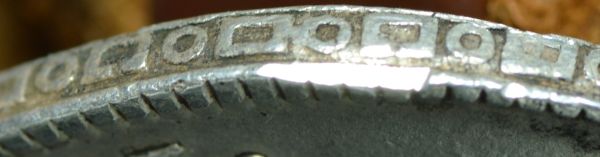
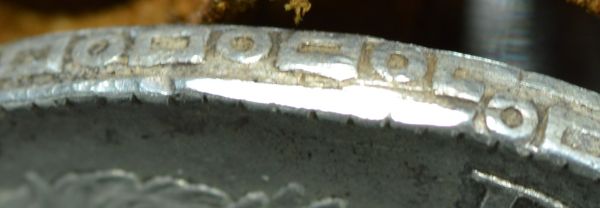
The full XRF results of Coin A and B: (I suppose other elements are not important for our interpretation so I didn't show all last time) Coin A: Cu7.54, Pb0.31, Ag90.29, Zn0.04, Ni0.02, Fe0.08, Bi0.06, Tin0.24, Pt0.79, Au0.15 Coin B: Cu3.11, Pb0.45, Ag94.4, Zn0.02, Ni 0.01, Fe0.08, Bi0.05, Tin0.27, Pt0.89, Au0.24 When I re-examine Coin B, I find two small sharp cuts at one side of the edge. Were the clips being used for Ag content analysis? Who knows? If one really did, it would not be a Chinese because Chinese used chops to identify the authenticity of a coin. Just a side talk here, please see the pictures below:   I think this will be one of the most controversial threads to some experts of this forum. Do you remember, swamperbob, before the result of XRF, you said:The A coin is Genuine. The B coin is a Numismatic Forgery.After the XRF results, you said: ...But both coins also have INCORRECT EDGE DESIGNS. That would indicate both coins were made OUTSIDE the mint by a counterfeiter....At this point we have ruled out both Class 1 and Class 2.By colonialjohn: ...So with Coin B with Ag at 94.4% and good Pb, Pt & Au levels this is not a modern piece and its either Class 1 or Class 2. ...So when I analyze a coin and the silver value >90% with good Pb, Pt & Au I am thinking Class 1 or Class 2.Frankly, I have no idea about the edges of both coins are regal or not because among my 30+ Portrait 8R, I have only these two New Guatemala 8R so I have no ground to argue about the edge of coin A and B. But by XRF results, the level of Pt and Au, they prove that coin A and B are aged coins, not modern. For the high similarity in appearance of both coins, I tend to believe they were struck from the same die and as direct transfer of an image existed after 1830, it makes me believe they were produced from the same mint before 1830? Could both coins be produced after 1830, say 1865, as a numismatic forgery? Never! ~as this 1820 8R is not any sort of rarity. As a circulating counterfeit? Yes, especially for coin B! If the latter is the scenario, where would it be struck? Anywhere outside N.G.? Probably, then why the counterfeiter not struck for a more popular Mexico 8R? For the two actual coins on hands and the results of XRF, they make me feel coin B is more likely a debased original than Class 2 or Class 3 counterfeits and coin A is likely be an original. Realeswatcher's choice B is what I think the most likely scenario. Of course it is better to have a real original 1820 8R for a comparison between the two coins, otherwise, this becomes a phenomenon of belief or disbelief, that is another "fun" to the hobby of coin collection. P.S. I don't remember where I read, Fred. VII's portrait coins were really not as popular as Car.IV or Car. III's for the reason at Car. IV's time, Chinese enjoy a more peaceful time than the early 19th Century. So Chinese people loved Carolus more. Probably another unproven reason, Carlous portrait looked more likely a buddha, that was why he was more popular than his son. A debased Ferd. VII 8R of New Guatemala has zero chance as a circulating Class 2 counterfeit in China, I suppose.
|
|
Pillar of the Community
United States
1757 Posts |
Henry - Coin B Analyses as you indicated: Coin B: Cu 3.11, Pb 0.45, Ag 94.4, Zn 0.02, Ni 0.01, Fe 0.08, Bi 0.05, Tin 0.27, Pt 0.89, Au 0.24. If you were to show me this analyses I would consider it a real 8R. Good Ag/Pb/Au/Pt. But as I indicated we now need to examine the coin. Bob is more experienced than me in this fashion. With Ag = 94.4 other than a Sheffield (silver plated) 8R I can offer no other explanation. It showed no signs of being a Sheffield (silver-plating). Based on the Pt/Au its not modern and the lead level shows no indication of it being re-melted. Copper the most common metal used in Sheffields as the INTERNAL debased alloy read only 3.1% so I would be shocked of a 20-40% Cu core! Copper also leaches to the surface. No harm was done to the coin on the edge. XRF analysis is totally non-destructive to the entire coin. See this Sheffield: http://www.ebay.com/itm/MEXICO-SPAN..._1334wt_1328Note the extreme copper leaching to the surface. A 30-40% Cu core whether a Sheffield or not is going to give you some signs. I see NO signs - no surface copper toning. XRF = Cu = 3.4%. High weight. No signs of a mercuric/amalgam/silver washing. Coin B: Its a 19thC v.high Ag forgery. Case closed - Please - I have a headache <BG>. Realeswatcher - I do own three 1733/1734 fake Klippes. They are also considered fakes. Current thinking is most of these good fakes were made from remelted Ag of genuine 8Rs. After my Chihuahua article I plan to submit to the MNA this next 1733/1734 study article. So I have looked at the remelting issue ... but I do not have enough data to confirm or track Pb levels based on remelting - its just common knowledge in Material Analysis projects. The Kennedy half and 2 Reales El Cazador coin study in August 2013 is just a simple article showing two contrasting coins and also suggesting that time and environmental conditions are necessary for die struck coins to experience silver surface enrichment. This article will view the microstructure of the coins core and surface showing the different Cu/Ag regions and there migrations internally/externally using SEM/EDS and associated XRF compositional data.
Edited by colonialjohn 04/26/2013 11:05 am
|
| |
Replies: 24 / Views: 3,814 |
To participate in the forum you must log in or register.
Disclaimer: While a tremendous amount of effort goes into ensuring the accuracy of the information contained in this site, Coin Community assumes no liability for errors. Copyright 2005 - 2026 Coin Community Family- all rights reserved worldwide. Use of any images or content on this website without prior written permission of Coin Community or the original lender is strictly prohibited.
Contact Us | Advertise Here | Privacy Policy / Terms of Use
|
| Coin Community Forum |
© 2005 - 2026 Coin Community Forums |
| It took 0.32 seconds to rattle this change. |
 |
|