| Author |
 Replies: 15 / Views: 6,153 Replies: 15 / Views: 6,153 |
|
|
New Member
United States
5 Posts |
Hello, I would like to know if anyone is familiar with a 1903 Indian Head penny with a double die reverse. I have scoured the internet for information and have been unsuccessful. As a matter of fact, I couldn't find anything regarding double die reverses for Indian Heads of any date. Please take a look at the image I've provided. I'm really trying to ascertain the value of the coin, and its relative rarity. An information you can provide would be greatly appreciated. Thanks, --Will 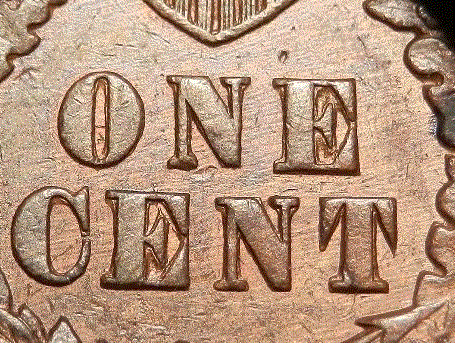 |
|
|
|
Pillar of the Community
United States
5901 Posts |
That looks to be classic "Longacre" doubling, it doesn't add any value to it. https://goccf.com/t/123829Check out the discussion previously about the same subject. |
|
Pillar of the Community
United States
1436 Posts |
 w/ macmercury. Somewhere I have saved a really good "doubling" picture. Please note that this is not my drawing, but one submitted on the CCF... not sure who at this point. 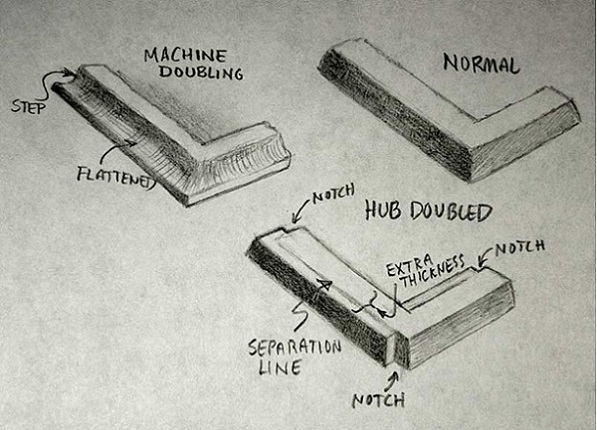 Edited by Dave H
05/07/2013 10:20 pm
|
|
Pillar of the Community
United States
2540 Posts |
1) It is doubleD die.
2) That is, as stated, Longacre doubling, no added value
|
|
Pillar of the Community
United States
1436 Posts |
I found out that it is coop that originally posted the picture on the forum. It sure is a great learning tool!
|
|
Moderator
 United States
14463 Posts |
williandres99, The proper place to send a thank you is in this thread. 
|
|
New Member
 United States
5 Posts |
I'm sorry it's taken me so long to get back with you. I've been ill and it's taken me a little time to catch up. Thanks to everybody that responded to mu question. You've given me quite an education. Following links you provided, I was able to locate a discussion published by TreasHunt regarding an article by Frank J. Colletti on Longacre Doubling. Awesome! Your responses spurred me to do some research of my own. You see, everyone commented that this phenomenon is common. However, I've been collecting pennies for most of my life (and I'm as old as dust), and I've never seen a coin with this doubling until now. So I surveyed all the Indians I have (about 200) to find some more examples. I couldn't find one. Am I in a Longacre black hole? How is this possible? No need to respond unless you feel compelled to do so--these are rhetorical questions. Thanks again for your assistance.
--Will
|
|
Pillar of the Community
United States
1374 Posts |
The Longacre doubling can occur on other denominations, not just the cent. For the Indian cent, it most often occurs on the ONE CENT on the reverse. In fact, it is extremely hard to find an IHC with a perfect ONE CENT. There is almost always Strike Doubling, Die Deterioration, or longacre doubling. LD also appears often on the letters on the obverse. I can't explain it, but the Longacre doubling will occur during a late die stage. There are several late die stage indicators that can't be accurately explained until you are familiar with them, or unless I'm working with someone one-on-one with an example to point it out exactly. One indicator are what I call "die stresses", where the fields in the die begin to break down and become rough. The pic that Dave H posted has been posted here probably a hundred times. But, it doesn't have Longacre doubling. It would be nice if it were included. Edited by Drsandman2
06/02/2013 01:45 am
|
|
New Member
United States
5 Posts |
Very interesting. Is Longacre doubling more common on any of the other denominations? If so, which of these denominations display this property the most frequently, and do they require "perfect" lettering too?
|
|
Pillar of the Community
United States
1374 Posts |
I've seen it on Seated halves, where it seems to occur around the stars frequently on the obverse. I'm pretty hardcore into IHCs and Flying Eagles, so I don't look at other coins from this era very often. |
|
Bedrock of the Community
United States
17884 Posts |
I disagree with Drsandman2 about one thing, Longacre doubling is typically seen on early die states. The doubling is created during the hubbing of the die (the features deliberately had the "shouldering" around them) and should have been polished off during the basining of the dies. As the dies wear or are later repolished the doubling becomes weaker and/or is removed.
|
|
Pillar of the Community
United States
1374 Posts |
From what I understand, Longacre doubling was a technique to extend the life of used dies. Also, it was my understanding that it was done by the engraver, and not by the hub. How could a reducing lathe put Longacre doubling on a die without that doubling being on the hub?
Also, how is it that the ONE CENT on the reverse of IHCs most often have LD, but not the other devices... whereas on the obverse it is on the letters around the rim? In essence, it was only done to the letters, and not the other devices. A reducing lathe turns, so if LD was done with a hub, it must have been started from the middle and stopped before it reached the wreath on the reverse of the IHCs. On the obverse, it must have been set outside of the portrait so that only the encircling letters were doubled.
LD is very crude, and varies with the die. It doesn't appear the lathe was reset such that it made the doubling. If it were, the doubling would be equidistant and uniform. In fact, it is very crudely done and varies wildly between dies.
Do you have references? I'll ask around myself. I'm interested to know for sure.
Thanks, Conder.
Edited by Drsandman2
06/04/2013 03:14 am
|
|
Pillar of the Community
United States
1374 Posts |
Also, I found an IHC today that very clearly exhibited Strike Doubling and longacre doubling at the same time. I'll try to find it and post pictures. I'd like to see someone draw that, lol. |
|
Bedrock of the Community
United States
17884 Posts |
Longacre doubling can be found on the devices as well as the lettering, and it can also be found on proofs, which obviously are not the result of trying to extend the life of worn out dies.
I have been writing the occasional item about this form of doubling since the mid 80's before it even had the name Longacre Doubling. I developed my own theory back then of how it came about.
As we know it doesn't appear until after 1848 when Longacre had to create new designs for the gold dollar and double eagle. now unlike the earlier engravers Longacre did not get the appointment to the Chief Engraver position based on merit and ability. He got the post through political influence. Longacre was not a die engraver or die sinker, he was trained as a flat plate engraver for documents or banknotes and had no experience with three dimensional engraving. This was probably why his first patterns for the gold dollar were made by actually hand engraving the gold planchets.
At that time dies were being made by full hubbing, and the hubs were made from a master die. But how was that master die created? The mint did not have a reducing lathe until after 1858. Breore that time the central device punch was hand engraved, hardened and then used to sink the main device of the master die. The rest of the letters, stars, etc were then punched into the master die by hand. When the master die was finished it would be hardened, polished and could then be used for making full hubs. This was where I think the Longacre doubling first appears. In odred to make a good die you have to sink the features not only fully, but evenly. The letters and stars all need to be impressed to the same depth or it would be noticeable. But Longacre was not experienced with die sinking. I believe he deliberately made his punches with a shoulder around the features. Then when the die was being sunk once the image of the shoulder started to show on the die you knew the feature or device was sunk to the proper depth. And when the working dies were basined, when the shoulders disappeared you knew the dies were basined properly and the features were at the proper depth.
Since the sinking and basining were not consistent or even, the doubling often appears crude and uneven. But on early die states of some dies the doubling can be seen to be sharp and even around the letters either following the contours of the letters, or in some cases being a square or retangular block around the letter. I have seen examples of early state dies with even doubling all the way around the letters, and the same die in a later state (identified by the same die cracks on both in later stages on the later) with the doubling being weak and uneven around the letters due to wear and/or polishing.
After Longacre died and new designs were introduced Longacre doubling disappears. But Longacre designs that were used long after his death still tend to show the doubling. I suspect this is due to master dies and working hubs on hand still being used years later. Because any design modified after the mint got the reducing lathe, and longacres death in 1869, should have been created from a full model with all of the features and no shouldering would have been needed. (You will also not that designs by Barber or Morgan do not come with Longacre doubling. If the doubling was the result of reworking the dies to extend their life, why only rework Longacre design dies and not the Barber and Morgan designs as well?)
|
|
Pillar of the Community
United States
1374 Posts |
Ah, okay that all makes sense. Fills in a lot of gaps. Keep in mind I don't collect Morgans and certainly not anything by Barber. I suspect that I get older, I'll get into these later classic types. Also, I don't own any classic proofs, so I wouldn't know. Out of my reach. Your points make me think that the LD was not intended to extend die life in the way that I expected. If it were, then why would it be on proof dies which didn't strike at most a few hundred coins? Using it as a marker that you've sunk the devices evenly makes much more sense, and the engraver could go back and polish things off. I see LD now as a catch 22 - you want the earliest die states for sharpest strikes, but at the same time specimens that don't exhibit LD are generally more desirable. I can see why you want all the devices sunk evenly, not only for aesthetics, but uneven devices can cause uneven pressure upon the die when it was struck. So, dies with uneven devices would be more likely to crack. Maybe I'm talking myself in circles here, but the LD wasn't to reduce friction around the devices to reduce stress on the die and deterioration... instead it served to ensure even sinking, which would increase die life. I suppose the reason why LD would appear on proofs is that they had no other option for making those dies; they didn't have special punches without a lip just for proofs. Looking over Wexler's history on the subject ( http://www.doubleddie.com/58201.html ), it states that around 1886 the letters of the IHCs were placed on the galvano. However, we both know that LD did not stop there. Now I suspect that some dies must have been employed using working hubs from a galvano, some were created using the old method of punching them into the dies. What do you think? Thanks Conder, I always appreciate your feedback. Edited by Drsandman2
06/06/2013 01:43 am
|
|
New Member
United States
5 Posts |
Drsandman2, did you ever locate the IHC that very clearly exhibited Strike Doubling and longacre doubling at the same time? I'd be very interested in seeing those photos. Thanks. |
| |
Replies: 15 / Views: 6,153 |
|










 Posted 05/07/2013 06:58 am


