| Author |
 Replies: 16 / Views: 3,119 Replies: 16 / Views: 3,119 |
|
Valued Member
United States
364 Posts |
Hi all! This is not a US coin but I can't seem to get much of a response on the site for Canadian errors. This doubling appears to not be Mechanical Doubling, but looks like a true double die...Branch,stem and leaves are COMPLETELY separated. There is no "shelf" like a strike double. If these were letters the serifs would be completely split I have no doubt. Any thoughts from my American brethren? (moderator please let this topic go for a little, it will be educational!) 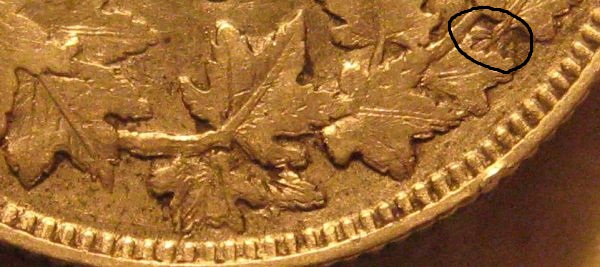 |
|
|
|
Pillar of the Community
United States
1572 Posts |
Would you be able to provide a similar photo of a non-doubled die coin of the same area for comparison purposes please? Otherwise the areas I have circled in white seem to be doubled as well. Understand, however, that I have little or no idea what I am talking about.  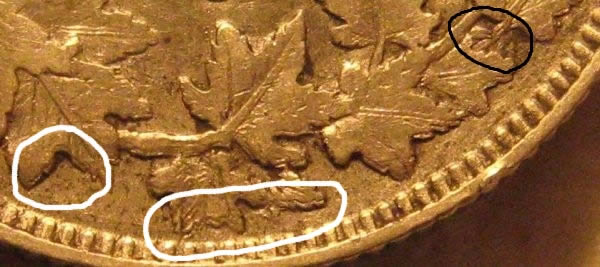 |
|
Valued Member
 United States
364 Posts |
The areas you circled are doubled too, I was circling the biggest spread areas with clear separation. Here is a picture of an MS coin from heritage, same area. 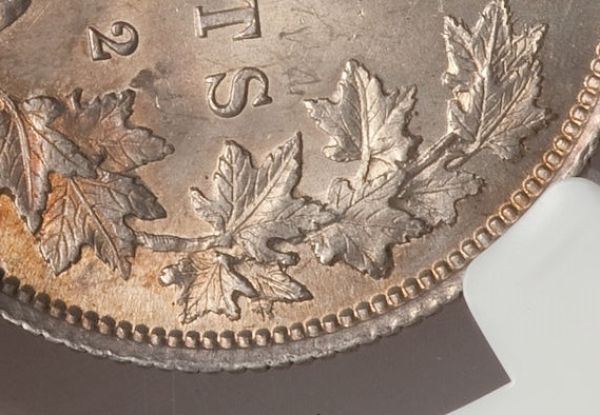 |
|
Pillar of the Community
United States
3453 Posts |
Is it my imagination or does the heritage coin show similar leave features? If so, could the leaves be Die Deterioration? |
|
Valued Member
United States
364 Posts |
I think it is your imagination---here is another from heritage..... 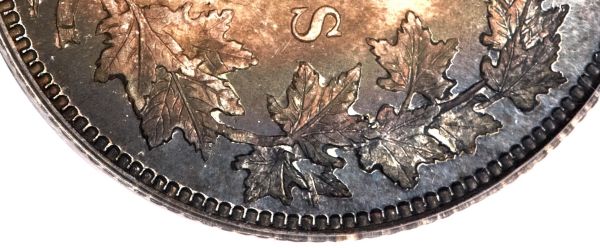 |
|
Pillar of the Community
United States
2651 Posts |
It looks like a circulated or a LDS coin....It seems like the doubling should be thicker if it was a DD. Also there should be more Doubling on other parts of the Leaves in my opinion. The splitting on the pointing parts of the leaves makes me wonder... I am very far from an expert and I would await others responses. Those are just my thoughts.
Edited by Jayman931
05/30/2013 02:53 am
|
|
Pillar of the Community
United States
3453 Posts |
It is this area in the first picture your provided that makes me wonder about Die Deterioration. 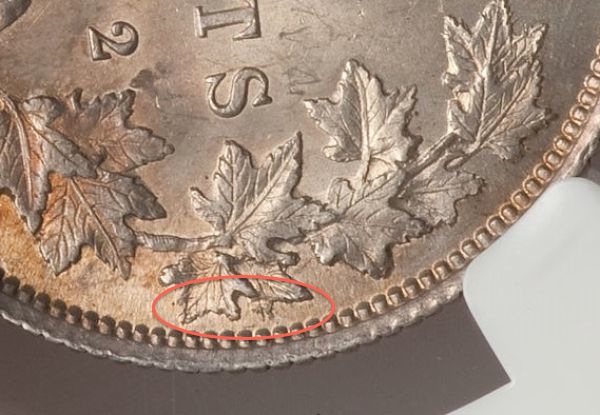 I do not see the same thing on the second picture. It sounds like you believe it is a DD - would it be cost effective to send it to a TPG? |
|
Valued Member
United States
364 Posts |
I really do believe it is a double die, I will probably send it to ANACS and see what they think. The spot that convinces me is the little sharp point of leaf that is clearly split and separated. If that wasn't there I would have a lot more doubts, but that is the "smoking gun" from everything I have ever read about Doubled dies. But I am no expert. However I can't find any reference to an 1872 double die 25 cent piece. Then again many varieties from the 1800's were not discovered until very recently. 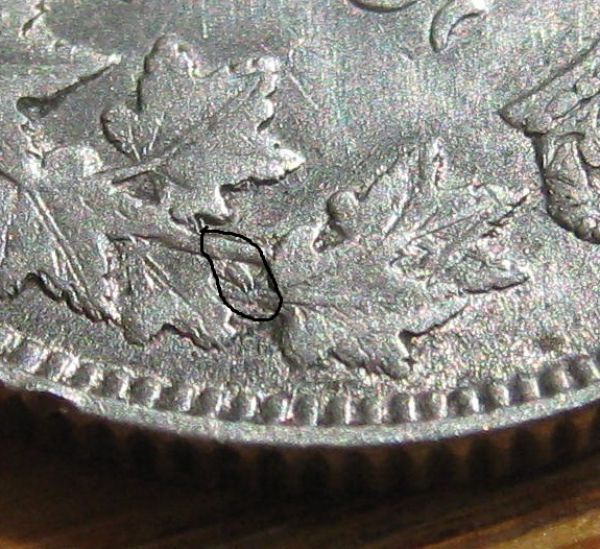 |
|
Pillar of the Community
United States
2651 Posts |
I agree the split on that part looks good. Are the dies they use on Canadian coins produced the same way they are in the US?
|
|
Valued Member
United States
364 Posts |
I am not familiar with their process, especially back in 1872. I have sent it off to ANACS to see what they think, I had some others to grade anyway. I will post what they say about it.
|
|
Bedrock of the Community
United States
62064 Posts |
Roach's coin is VLDS. A lot of die wear, but I feel this is a doubled die. I can't get an overlay going on this. For some reason, the images won't let me edit them. But the devices may be enlarged. I find it interesting. But you might need to compare the coin to an other normal VLDS coin. The images from Heritage is an EDS coin.
|
|
Bedrock of the Community
United States
17884 Posts |
I'd say it is definitely a DDR. |
|
Pillar of the Community
United States
814 Posts |
I think its a DD too. I lots of doubling. But I'm no,expert.
|
|
Pillar of the Community
United States
7629 Posts |
The coin is obviously a doubled die. Nice find. I have no idea what the collector demand is for such an item. If there is none, only nominal premium value for the curious. American coins seem to be an anomaly worldwide in that rather minor hub doubling can be very valuable. There are examples of rather extreme hub doubling on coins of other nations that carry a hefty premium (like the 1978 Mexico 20 peso) but those are very few and very far between. I have a number of modern Greek coins that exhibit nice hub doubling, but I am also aware that I have them for curiosity sake only, and their value is not above that of any other coin from the same issue, date, and grade.
|
|
Valued Member
United States
364 Posts |
Well ANACS agrees----AU 55 details (Cleaning?) Double die Reverse. So I found this coin with doubling on the other side on ebay that sold for big bucks----http://www.ebay.com/itm/1872-H-CANADA-SILVER-QUARTER-Doubling-on-some-letters-Please-Look-/221223165314?pt=US_Canadian_Coins&hash=item3381ed9d82 That is not an established variety either. Maybe it is worth a good amount? I guess it just may take me a while to find out...Is there a Canadian equivalent of TELETRADE? |
|
Valued Member
United Arab Emirates
283 Posts |
It surely is a double die. Hope it gets you a good price.
|
| |
Replies: 16 / Views: 3,119 |





 Posted 05/29/2013 4:17 pm





