| Author |
 Replies: 17 / Views: 4,115 Replies: 17 / Views: 4,115 |
|
Pillar of the Community
United States
1372 Posts |
However this happens ... this coin, along with another 1875 Philadelphia minted half dollar that I have purchased, exhibits details from a foreign coin ... I'm leaning toward a 20 Kronor, a gold coin from (I believe) Belgium. Whatever coin it is, has a draped coat of arms. An outline of the Lion can be seen on Liberty's midriff on this example. It was sold by a dealer as "cleaned and scratched" ... but our scratches have spearheads, or the tips of perhaps flagstaffs on them. That's the one thing I can't find on the 20 Kronor coin ... and is a pretty prominent feature on the coin that led me to this research. It does appear to be like the staff on a swiss 5 franc coin, but it appears too many times on the coin for that to be the likely source. I'm certain that the scratches aren't scratches. They appear on the reverse of the coin as well, and the Lion's paws are integrated intothe eagle's talons. It's a very interesting coin. I looked at all of the philly minted Seated half dollars, and have seen maybe 4-5 examples of coins where one can spot the lion. It's generally on the lower half of the obverse. This was during the mint's early days of sub-contracting coinage for other countries, so it's plausible for this to have happened. These pictures were compressed from 625K or so, so details might be harder to discern. This coin can be seen with the full size pictures by clicking on the original ebay listing if you care to look at the larger images. http://www.ebay.com/itm/37085285470....m1439.l2649Chance 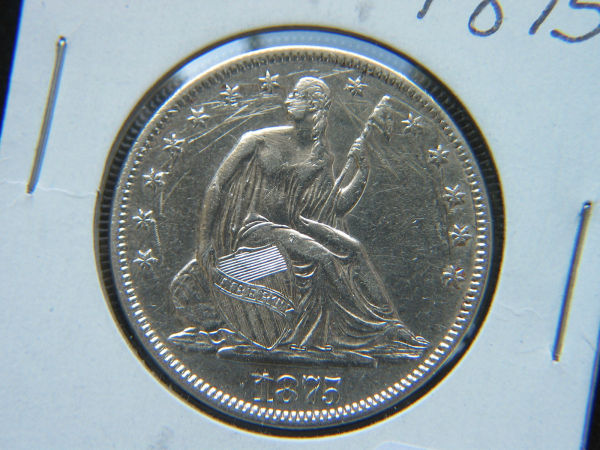 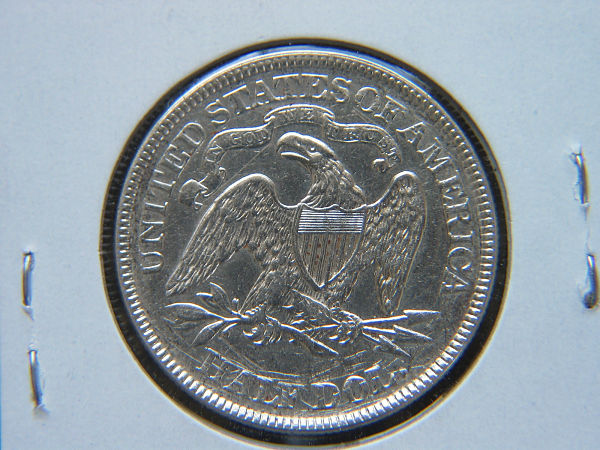 |
|
|
|
Pillar of the Community
United States
9807 Posts |
PMD definitely, from the ebay photos it is easy to tell these are nothing more than scratches into the coin, done after it left the mint. Also being on both sides, someone really worked this coin over. A real shame as this coin was in pretty high grade before the scratches occurred. Die scratches would not go through the lettering of the coin, most evident on the reverse, the letters on the die would be incuse and any scratcheing would not go into the recess of the lettering. Any die scratching or polishing would show raised lines, and the ebay photos easliy show these are deep into the surface of the coin. To me it makes the coin worth maybe 10% of an undamaged coin at best, not much over bullion value as the damage is so obvious and affects the design in a negative way. I'm not sure I could place a value at more than a few dollars above G4 grade on this one.
"Buy the Book Before You Buy the Coin" - Aaron R. Feldman - "And read it" - Me 2013! ANA Life Member #3288 in good standing since 1981, ANS, Early American Coppers Member (EAC), Colonial Coin Collectors Club member (C4), Conder Token Collector Club member (CTCC), Civil War Token Society (CWTS) member, Liberty Seated Collectors Club (LSCC) & Numismatic Bibliomania Society member (NBS), USMex, Member in good standing, 2¢ variety collector. See my want page: http://goccf.com/t/140440Edited by westcoin
07/14/2013 04:17 am
|
|
Pillar of the Community
 United States
1372 Posts |
The drapery knots do NOT appear to be incuse ... they appear to be raised features, and the stars rise up out of them. Then there's the lion's paws merged into the eagle's talons. How do you suppose they did that? Then there's the other 4 or 5 coins presently on ebay, all from different sellers, with the same kind of features, but less dramatic. If the planchet were damaged before the coin were even struck, it's entirely possible that those marks wouldn't all be lost when the coin was struck. If that were the case, then incuse lines could be present across the legends and devices ... no? Chance Edited by Chancellor Sutler
07/14/2013 07:59 am
|
|
Pillar of the Community
United States
9807 Posts |
I doubt it there would not be any incuse lines left on a planchet after striking, the metal would under go a big transformation as it heated up from the pressure and was struck.The coining machines produce between 180 to 250 tons of pressure, not much would survive under pressure like that. Inspections of the planchets also would be done, and unless one of the rollers that flattens and lengthens the strips of silver from bars would have damage, this would be seen and changed out pretty quickly, as it would show up as a repeating pattern on each long strip of metal before the individual planchets were cut out, and they are also inspected before they go on to the next step in the process the upsetting machine which creates the upraised rim edge. I see no way that anything beyond extra metal in the planchets would cause anything like this, and if it were a foreign object or improper alloy mix there would be a different color and remnants of the other metal embedded into the coin.
"Buy the Book Before You Buy the Coin" - Aaron R. Feldman - "And read it" - Me 2013! ANA Life Member #3288 in good standing since 1981, ANS, Early American Coppers Member (EAC), Colonial Coin Collectors Club member (C4), Conder Token Collector Club member (CTCC), Civil War Token Society (CWTS) member, Liberty Seated Collectors Club (LSCC) & Numismatic Bibliomania Society member (NBS), USMex, Member in good standing, 2¢ variety collector. See my want page: http://goccf.com/t/140440 |
|
Bedrock of the Community
United States
17884 Posts |
If there were incuse lines on the planchet before the strike they MIGHT survive on the raised features of the coin, but they would be crushed in the field areas.
|
|
Pillar of the Community
United States
1372 Posts |
What led me to that idea was adjustment marks on early coins ... But ... There's something afoot in 1875 and 1876 with the Seated half dollars. LOTS of these coins have foreign undertypes. There are even coins slabbed by PCGS and NGC as MS and Proof which exhibit the undertypes. And ... there's more than one coin design. From what I have seen, there are at least 2 different types. I have now seen dozens of 1875-76 Half dollars with this unusual trait. Even worn coins will show some traces. Much like the date on a Buffalo nickel goes pretty deep into the coin... so it seems to be with the silver coins as well. Seems the deeper recesses would be harder than the legends or devices from work hardening. I'll post links to some of these, as time allows, in case anybody wants to look at them. I even found one where it's obvious that the Lion is wearing a crown. I'm pretty sure there's never been any heraldry like that on American coins. Chance |
|
Moderator
 United States
23522 Posts |
With all due respect, it's plain in the ebay seller's much larger images that this was the scratched and cleaned example he claimed it was. And the only foreign issues the US produced in that era were 1- and 2.5-Centavos coins for Venezuela; they didn't produce another coin for a foreign country (excluding Hawaii) until 1895. The origins of the 20 Kronor lie in Denmark and Sweeden, neither of which ever subcontracted the US Mint. |
|
Pillar of the Community
United States
1372 Posts |
That's all fine and dandy, Dave.... and with all due respect, I am aware that they were only making those 2 denominations for Venezuela at the time.
That doesn't change the fact that the undertype on these coins is neither of those coins. Nor does it change the fact that it "is" there.
It's something of a mystery. Something that begs investigation.
You guys all just want to do the same thing ... if it isn't in the book, dismiss it out of hand as though everything there is to be learned ... has already been learned. When you close your mind ... I guess your education is complete.
Spend a little time looking at some of these ... you'll see what I'm talking about.
I'm still skeptical about those being scratches. Some appear to be incuse while others appear raised, and some have tips that resemble flagstaffs and arrow heads...or spear tips.
I'm going to send this coin, and the other one I bought ... to Bill Bugert. I'll bet he can look past the obvious. Nobody here seems to be able to get past the "scratches". There's LOTS more going on with this coin, and it's the only one that I have seen that has those particular marks. It's unfortunate, becauae nobody can see or address anything else.
How do the eagle's talons come to appear as they do on this coin? That is absolutely NOT normal. Something has happened that has altered that feature on this reverse die. I've seen it on other 1875s as well, but not all of them.
Maybe somebody that had access to the machinery had a bunch of stolen foreign silver and whacked into a more recognizable and liquid form ... you won't find that in the treasurer's report.
Chance
|
|
Moderator
United States
23522 Posts |
I find it very difficult that anyone could see this as anything but a heavily-scratched coin. For crying out loud, some of the scratches extend into the denticles and rim, and into the stars and devices at depths impossible with any original donor coin: 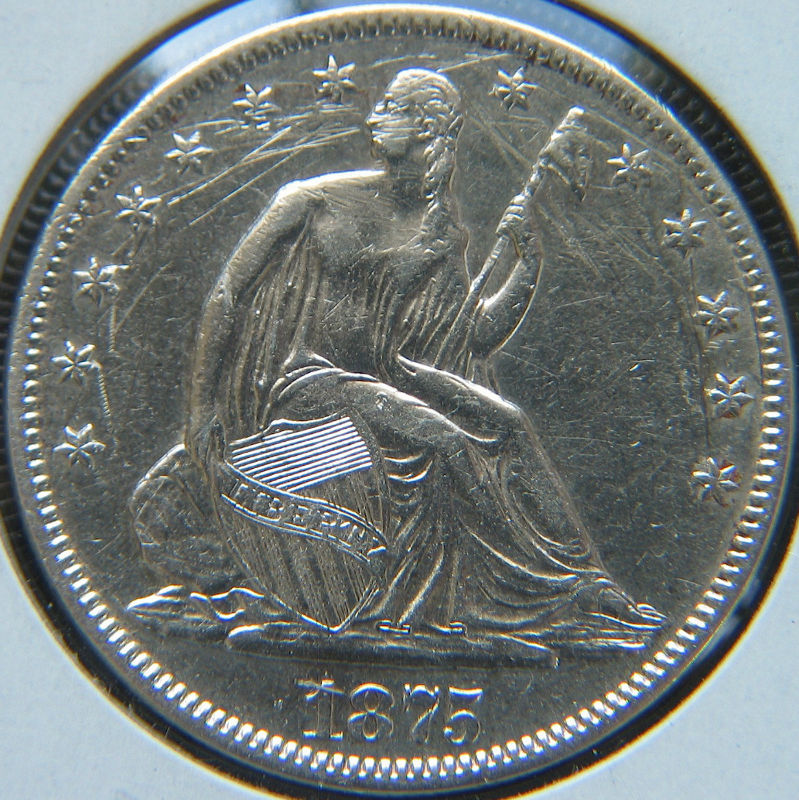 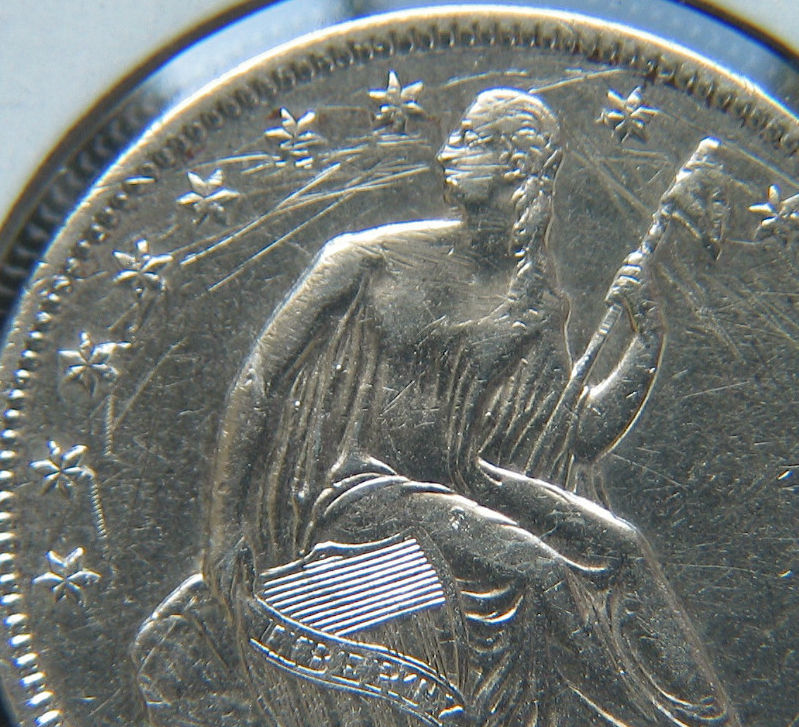 |
|
Pillar of the Community
United States
9807 Posts |
 with SsuperDdave, I'm defintely not against dismissing something strange, or unexpected, (that's what I love about die varieties - like VAM's, where many new discovery pieces have been found through due dilligence and lots of searching), but the two examples I've seen you post on (this one and the IHC) are obviously PMD. Even with the interest in vamming, it takes two coins with the exact same pick up points, to confirm something new, and a lot of new discoveries have been made recently, I'm not sure of the numbers - but I'd venture a guess that is a couple of hundred new die pairings found in the past decade. Yes new and exciting discoveries await out there yet to be found, researched and proven. Not to be a downer but when ever there is moved metal on a coin it is plain and simple PMD - ALWAYS - every time - no exceptions to that - ever. "Buy the Book Before You Buy the Coin" - Aaron R. Feldman - "And read it" - Me 2013! ANA Life Member #3288 in good standing since 1981, ANS, Early American Coppers Member (EAC), Colonial Coin Collectors Club member (C4), Conder Token Collector Club member (CTCC), Civil War Token Society (CWTS) member, Liberty Seated Collectors Club (LSCC) & Numismatic Bibliomania Society member (NBS), USMex, Member in good standing, 2¢ variety collector. See my want page: http://goccf.com/t/140440 |
|
Pillar of the Community
United States
1372 Posts |
Can't (for the life of me) get you guys to move beyond those "scratches".... so let's try a different approach. A different coin. One that doesn't have those marks. Do you see an undertype on this coin? I see a coin that was struck on a coin that had a coat of arms on it. I also see evidence of large letters to either side of the date. Chance  |
|
Moderator
United States
23522 Posts |
Quote:
Can't (for the life of me) get you guys to move beyond those "scratches".... That's because they're scratches. Only you think otherwise. Quote:
Do you see an undertype on this coin? I definitely see a pattern of some sort on the coin. Can you feel the edges when you scrape a fingernail across them? |
|
Bedrock of the Community
United States
17884 Posts |
I see a coin that had something stuck to it that interfered with the toning pattern
|
|
Bedrock of the Community
United States
12437 Posts |
Quote:
Do you see an undertype on this coin? I see a stain that loosely resembles a Rorschach Test |
|
Pillar of the Community
United States
2540 Posts |
Strong suggestion:
Buy new glasses.
|
|
Pillar of the Community
United States
814 Posts |
Quote:Quote:
Do you see an undertype on this coin? I see a stain that loosely resembles a Rorschach Test  Epic, because its true. But seriouly. I see nothing on any of these coins that would indicate undertype of any type. Perhaps a side by side with the coins your thinkin were used might help. But I dont think theres anything more to these coins than what they are advertised as. Edited by GoldenChest
08/12/2013 11:00 am
|
| |
Replies: 17 / Views: 4,115 |










 Posted 07/14/2013 07:49 am


