| Author |
 Replies: 3,989 / Views: 392,548 Replies: 3,989 / Views: 392,548 |
|
|
|
Bedrock of the Community
United Kingdom
18740 Posts |
1943 British West Africa one penny:  Whereas the British adopted a decimal system for East Africa, West Africa used coins of similar appearance but on a £ s d system. These coins were used in Ghana, the Gambia, Sierra Leone and Nigeria. Interestingly, the penny was made of cupro-nickel, whereas the contemporary two-shilling piece (worth 24 of these coins) was nickel-brass. There were also holed cupro-nickel halfpenny and one-yenth-of-a-penny coins. It is said that the one-tenth-of-a-penny coins were mainly used as washers, as it was cheaper to use one than to buy a washer from an ironmonger's store! |
|
Pillar of the Community
Australia
9780 Posts |
ASLAN, thanks for that additional info. Steve  |
|
Pillar of the Community
United States
2669 Posts |
 1943 Palestine 10 Mils Palestine coins were minted from 1927 to 1946, and there are 59 coins in the set. It's a neat set to collect. A good book on these is The Coins And Banknotes of Palestine Under the British Mandate, 1927-1947 by Howard M. Berlin. There is also a fairly good guide on ebay here: http://www.ebay.com/gds/Palestine-C...70353/g.html which has a lot of good beginning information. |
|
Pillar of the Community
United States
1109 Posts |
Here is a 1943 French 2 Franc coin, issued by the Vichy government of France (which was collaborating with the German occupiers). I believe the French on the obverse says "French State" and the French on the reverse translates to, basically, "Work, Familiy, Country." My French is a bit rusty, but my Spanish and German seem to fill in the missing pieces at times like this, so I think I am right. This phrase on the coin would be in keeping with one of the Nazi German themes of presenting the image that work makes everyone better (as seen also in the slogan ARBEIT MACHT FREI...in essence, "Work makes one free") It is made of aluminum, so I am sure it would float nicely in nalaberong's little flotilla of aluminum coins posted the other day. 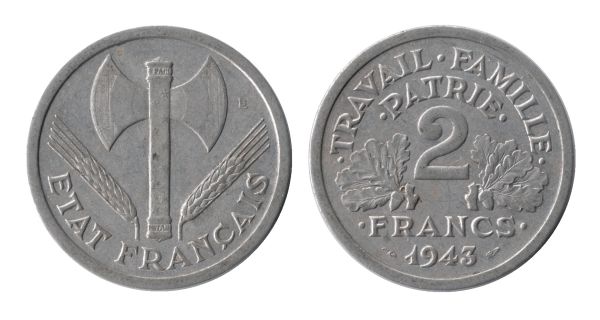 Edited by skyshark124
01/05/2014 07:43 am
|
|
Pillar of the Community
 United States
1908 Posts |
This junk tub find isn't in the condition most collectors would prefer, but it's relatively scarce and it has a few redeeming virtues. This or one similar a 'must-have' for anyone doing an avian-themed collection. And how many coins are there outside this small Central American country that are denominated in the name of an exotic bird?  GUATEMALA 1943 25 centavos GUATEMALA 1943 25 centavos; 0.720 silver; size= 27mm; mintage= 900 thousand: 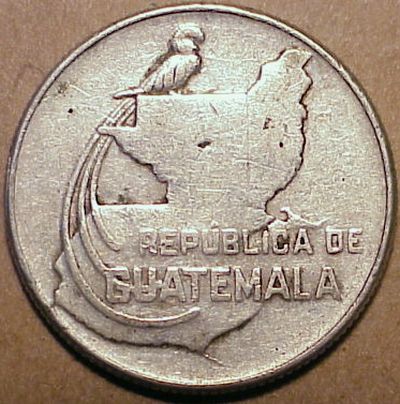 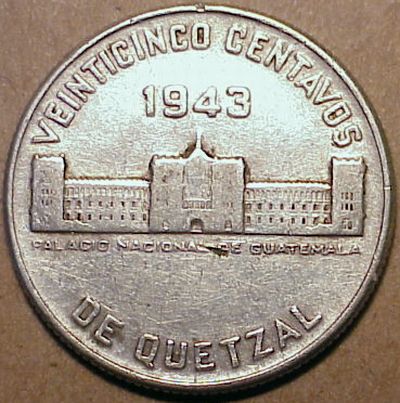 |
|
Pillar of the Community
Canada
2805 Posts |
For 1943, I am forced to post a Canadian coin! I'm surprised nobody has posted any of this wartime series.  Hey, a brass nickel! Actually, the alloy is called tombac, but the point remains - this is a brass nickel, not a nickel nickel. Why? Well, nickel is an ingredient of stainless steel, and in wartime, stainless steel was much more valuable than silver, so the U.S. just switched out the nickel with useless silver-manganese (insert subtle dig at gold-hoarding preppers here). Even though Canada was the world's largest producer of nickel for many years (thanks to a meteorite that smashed into Sudbury millions of years ago and deposited ample quantities of space-metal), there still wasn't enough to go around, so in 1942 the first brass nickels rolled off the presses. To differentiate the dark brass nickels from dark copper pennies, both round and similar in size, it was decided to give the nickel an unmistakable 12 sides, a tradition that was kept until 1962 (when the collar die maintenance became too expensive). The first 1942 tombac nickels just had Kruger-Gray's beaver design on them (that guy again?!), but it was realized that a more patriotic design would go over well. The American V-nickels and Churchill's famous "Victory" hand sign combined to create this V-design in 1943, with a flaming torch over a V that stands for both Victory and Five. But as the war raged on, even copper and zinc became in high demand, and so the nickels of 1944 and 1945 were made out of plain steel. Come 1946, we were back to 100% nickel - and there's a good chance that the metal in those nickels came from space (well, technically every metal did, but this was more recent than that). |
|
Pillar of the Community
United States
7298 Posts |
1943   |
|
Bedrock of the Community
United States
10065 Posts |
I am sorry for a duplicate kind of post, but nalaberong shared a lot of info I was not aware of and so I thought I would add a small, but cool feature I enjoy about this coin. @nalaberong I learned a lot about the 1943 Canada nickel through your post. I have had this as a favorite since the early 70s. What originally drew me to them is that as a kid I though it cool a secret message was encoded onto its back in Morse Code - mapped out in the included pic is "We Win When We Work Willingly." But I also wonder why they put the beginning of the sentence at the bottom to the left of center rather than centering it at the top? 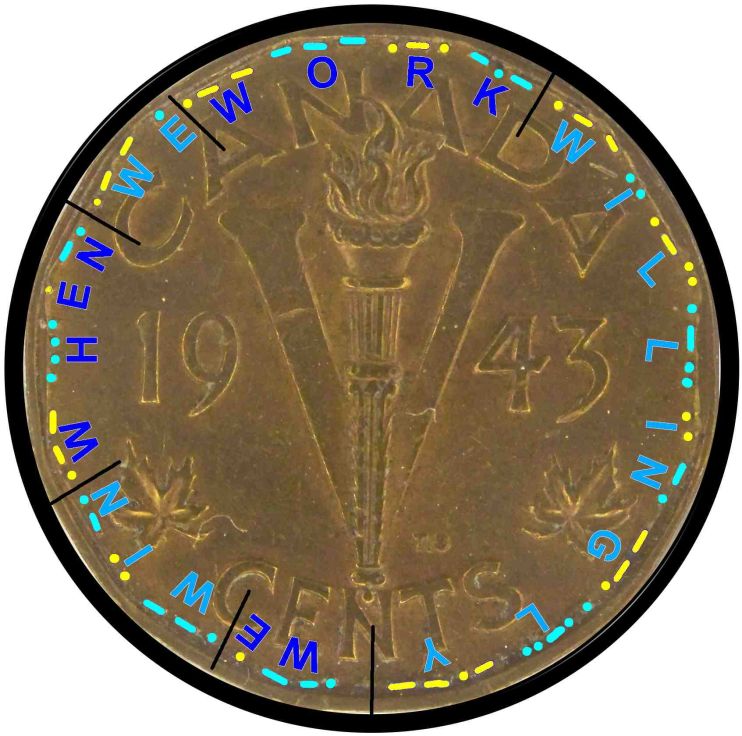 How much squash could a Sasquatch squash if a Sasquatch would squash squash? Download and read: Grading the graders Costly TPG ineptitude and No FG Kennedy halveshttps://ln5.sync.com/dl/7ca91bdd0/w...i3b-rbj9fir2 |
|
Valued Member
United States
263 Posts |
A secret Morse Code message? Now I want one too!
|
|
Bedrock of the Community
United States
11951 Posts |
1942 Canada nickel 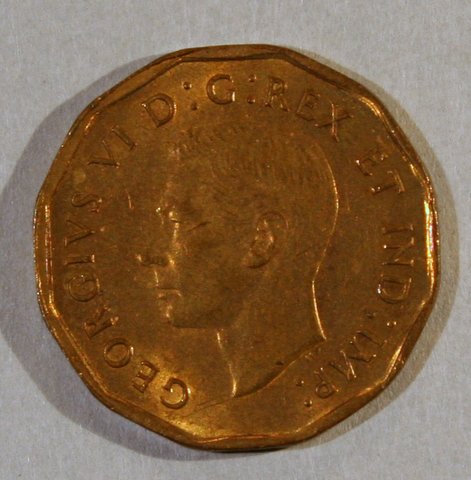 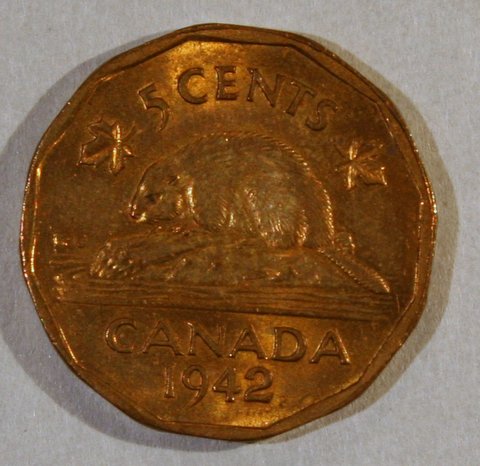 |
|
Moderator
 United States
14463 Posts |
|
|
Pillar of the Community
United States
1234 Posts |
Quote:
It begins... hoping to see some occupation zinc over the next couple of days!
-nalaberong here's some for you, Etat Francais 20 Centimes. 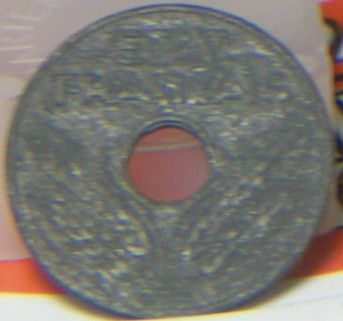 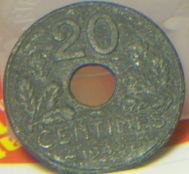 So the pictures are not great but the coin is even worse, that is what happens to zinc. Thanks for pointing out the Morse code on the nickel Earle42, and thanks to mysilveryears you can go back to page 24 of this post and see the next time Canada changed the composition for 1951-1954 the composition was steel w/nickel & chromium plating, spanning George VI and Elizabeth II for obverse images, and replacing nickel for a second time since WWII that time for "The Forgotten War", Korea. EDIT: Silly old Krause, just spent 4 minutes comparing two editions then decided to get the scale 3.5g Thick Flan, thanks for helping narrow down my collection. Update, well Krause never was too good at Updates, one of my Krause's said thick flan only the other said both were made for '42, love Krause but they can get annoying. Edited by ASLAN TVorlon
01/06/2014 01:10 am
|
|
Moderator
United States
14463 Posts |
ASLAN TVorlon, According to Krause, there were two versions of the 20 Centimes 1941-1943. KM# 900.1 was made from a thick flan, and is 3.5 grams KM# 900.2 was made from a thin flan, and is 3.0 grams and combined there were 112,868,000 minted in 1942 Do you know which you have? UPDATE - looking at numista in detail, apparently 1942 only used the thick flan. But there was no mention of this in Krause.  |
|
Valued Member
United States
263 Posts |
|
|
Bedrock of the Community
United States
10045 Posts |
This 1942-I Australia halfpenny has the "long denticles" reverse of 1943. It's a bit of a rarity in this grade--around MS62.  |
| |
Replies: 3,989 / Views: 392,548 |






 First Page
 Previous Page


 Posted 01/05/2014 07:03 am