| Author |
 Replies: 66 / Views: 9,923 Replies: 66 / Views: 9,923 |
|
|
|
Pillar of the Community
United States
1674 Posts |
It could simply be that they want to make their money on it, since the coin will pass the TPG's. Or it could be that there were genuine examples with the same characteristics that were subsequently copied with the same design details. Either way there seems to be a gray area with these things. |
|
Pillar of the Community
France
1591 Posts |
Maybe they'll actually sell for more as contemporary couterfeit in a year or so ;) :D
But yes, things are going wrong ... everyone can't know every coin out there, but has to listen to evidences provided to him when in doubt.
|
|
Pillar of the Community
2087 Posts |
Money talks!! What I mean is if coins are purported to be rare valuable or significanly collectible, and have known people standing behind them it is just too hard to go against the flow. So people will bend. In a,collecting, generation or so these coins will be seen as fakes.
as for the grade on the coin...I have to say any grade above very fine is a joke, and, IMHO, it is not appropriate to accept any graffiti on a coin and then call it anything like uncirculated. Think about it! Circulated is generally supposed to refer to a coin that has been put away before it has been circulated, the graffiti tells us immediately it isn't uncirculated. that coin is VF at best!
|
|
Pillar of the Community
France
1591 Posts |
Frankly, I prefer the simpler system we have un Europe, without this complexe numbering scheme. Here, Unc means uncirculated, not some AU 61 which have some marks all over depending on who does the grading ? This ultra divided scale + slabs just has one point : pushing the market up, making it clear for the average guy (the price is written on the box), and making coins become like collector baseball cards ... some do that as investment only as well, that's another story, anyway everyone does as he likes - this is just not how I see coin collection :) An example - I bought this coin from ha.com last week, frankly with all those marks on the face side, how can you put that two points from MS-60 ? http://coins.ha.com/c/item.zx?saleN...&lotNo=27318 |
|
Pillar of the Community
United States
1962 Posts |
Bob, I'm being a bit lazy in not searching past archives on here, so I apologize if you've discussed this (these) specific CC in detail in an older thread... what's your thought on the Riddell 221, 223, and any related pieces? Riddell says "snake too long, ground too low"... is that correct - that there are no genuine examples with perhaps different dies than what Riddell was comparing to? In other words, is it certain that there isn't a genuine ("regal") version struck with the same exact dies? These clearly look die-struck with detail at least VERY close to genuine examples (though that's just casual observation, not careful study). It must reflect either access to actual mint punches (to make a fairly close die), OR access to the entire die itself, right?
|
|
Pillar of the Community
 United States
5362 Posts |
realswatcher You say Quote:
It must reflect either access to actual mint punches (to make a fairly close die), OR access to the entire die itself, right? That is the approach that Ponterio and Dunigan are adopting that a struck coin with very close dies has to be genuine. I believe it is missing the forest because of the trees. There are period records from several sources of a die replicating process that involved the creation of die punches that each copied ONE element of the die exactly. The forger concentrated on cutting a perfect 1. Then on making a perfect 2. Making a small match like that is possible if you have a very talented engraver. The result was a Matrix punch set that matched or nearly match the originals. This became easier if you postulate that the work was done in England or another European nation where the properties of galvanism were already in use for metal duplication. By 1829 it was possible to do either to make a counterfeit die that would be a close match to an original. So the way to ID a forged die is to find problems with products made from that precise die. The 221 has been confirmed to be a counterfeit based on dozens of SG tests and one XRF test. Coins made from the 221 die all show several identical features that I have NEVER seen on a coin that I personally confirmed to be real. So to dispel any uncertainty I will list those with pictures very shortly.
|
|
Pillar of the Community
United States
5362 Posts |
I am going to try out my line of thought here before contacting the principles in this case. To bring everyone up to date I asked Bruce Raplee if he would allow me to examine the coin as well. As some one pointed out earlier - some old school experts take strong exception to fellows like myself who do not rely just on subjective opinion gained through years of experience but add to that scientific tests as objective proof. The Riddell 221, 223, 365 and 371 are far and away the MOST COMMON contemporary circulating counterfeits anyone is aware of. They appear on ebay at least once a month and can be found at almost every coin show in the US. They were exceptionally well made and were extremely successful as forgeries. They were the Henning nickels of their day. They still number in the thousands of copies even today - far too many for one die pair to have been responsible for all of this production. I actually have 4 subject coins. I will not use any of my own copies but I have 15 in different metals and 27 counting duplicates. The following pictures are limited by transfer size so bear with the process. 1. The Riddell # 221 taken from Riddell's 1845 book - this is a photo copy of the 1969 reprint which I use routinely. The Google books version is a copy of an original print but only slightly better in terms of clarity. For those unfamiliar with Riddell's work it should be noted that he made type metal impressions of the coins in his book which were used in the actual printing of the book. They contain some extra crud here and there but they do capture the earliest accurate pictures ever made of circulating counterfeits in the history of Numismatics. 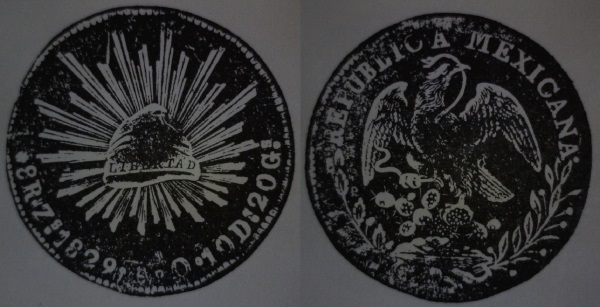 2. The NGC version belonging to Bruce Raplee which was reviewed by Mike Dunigan and he believes it is real. This coin appears to be a precise match to the Riddell coin when examined detail by detail, as I hope to demonstrate. 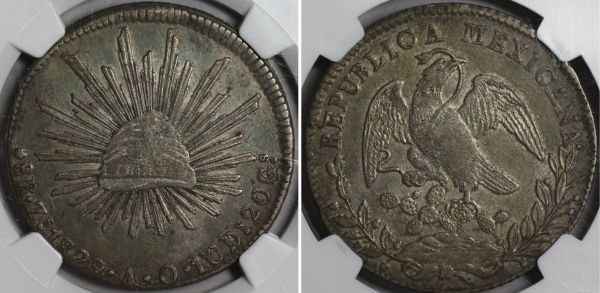 3. The Ponterio coin which I believe is a coin made from a hubbed identical die pair. This exhibits wear characteristics pointing to more than one die being used. 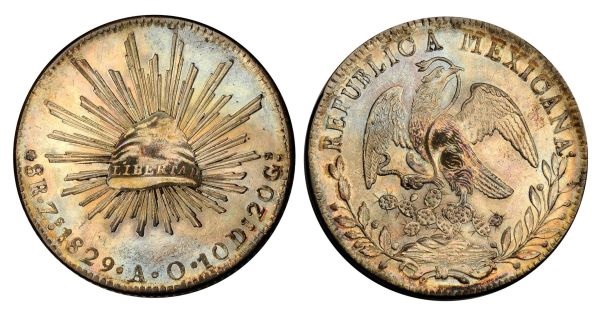 4. The Dunigan example of the 1829 Zs AO from his book. This is not the best picture in the book but since he illustrates examples of each of the years around the date - the range and variation of several different dies is easy to compare coin by coin. 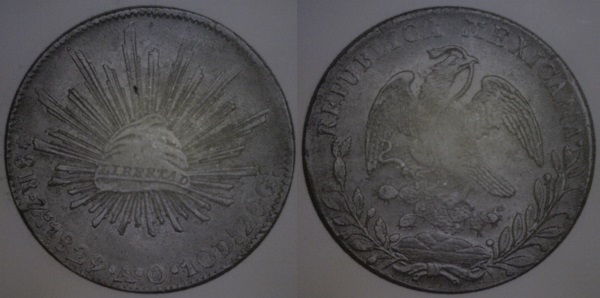 When you look at the 4 coins and compare them - the Dunigan coin is the only one that appears out of place. Note first the dentils that form the circular border on the coin. All of the Dunigan issues when enlarged show that Zacatecas has a matrix punch for the dentils that was in the form of an arc of 5 dentils. This punch was applied repeatedly along a scribed line (a circle) which can sometimes be seen on high grade coins from poorly finished dies. Note on Dunigans coin that you can see the places where the 5 segment arcs meet. Then look on all the other pictures and it is clear that the forgers used a punch that was straight and had 10 dentils in length per section to form the border. That is the largest most visible clue to this forgery second only to the broken toe. It is hard to miss. It was a hub feature. |
|
Pillar of the Community
United States
1674 Posts |
I would think that a debased silver coin would not make it past the sniffer at NGC, not the expert's eye and feel. How can one say that the example Riddell lists is a forgery based on details rather than silver content alone?
|
|
Pillar of the Community
United States
5362 Posts |
Numismat You say ... Quote:
I would think that a debased silver coin would not make it past the sniffer at NGC, not the expert's eye and feel. How can one say that the example Riddell lists is a forgery based on details rather than silver content alone? If you really believe that, then you are incorrect. A debased coin can not be easily detected if it is a Sheffield Plate variety. The entire exposed surface of a Sheffield plate coin will be 900 fine silver. It will test with acid as 900 fine silver. It will even pass XRF tests. It is a perfect system unless you perform a Specific Gravity test or unless you cut into the surface DEEPLY. There is an English historical record from the 1830s that indicates a Sheffield plate coin was chopped over 70 times by the Chinese without being revealed as a forgery. But a Sheffield plate coin will eventually wear through and expose the core. It may take 20 years or more. That is why I always start with a worn Sheffield coin first - one that can not be disputed as a forgery and then I work my way back using the clues based on the specific die pair to the MS or near MS copies that the "experts" believe are real because they look correct. This is where science will trump "expertise" every time. The only defense the experts mount at that point is an un provable contention that a "debased planchet" must have been smuggled into the mint. But that is just wishful thinking. They hope a fraudulent planchet was switched out. But then that also makes the coin a fraud at the very best. But I ask in all honesty if I backtrack the precise die pair (or hub pair) from 27 known counterfeit coins - how can so many experts who have never done one SG test or one XRF test possibly prove their subjective position that I am incorrect in my contention that the DIE PAIR or DIE HUBS used were in fact forgeries. Show me one coin that passes SG and XRF and uses the identical die design - then I will accept their opinion. But until, they submit verifiable scientific proof I believe my position is the strongest. The second part of your comment is proven by Riddell's actual entry. Riddell said it was a "counterfeit". If he had suspected it was a mint strike or made with mint dies or even made with some stolen mint stamps he would have said so. He refers to these as "Debased Dollars". He did just that in numerous cases. In this case the straight segments that combine to form the dentil "circle" are completely sufficient to prove this die pair was NOT a mint product.
|
|
Pillar of the Community
United States
1674 Posts |
Very interesting stuff Bob. Sorry to play devil's advocate but some of your most informative posts come in response to ones that ruffle your feathers a bit. :)
|
|
Pillar of the Community
United States
1962 Posts |
OK, so from what you've seen:
-- it appears NO coin from the Riddell 221 die pairing is genuine... which would eliminate the possibility of a full stolen die (unless somehow stolen BEFORE it was ever put into use at that mint?)
-- that means a freshly fabricated counterfeit die had to be created, which means punches were used... and your thought is that these punches were fabricated by copying details from genuine coins (rather than regal punches being stolen or used secretly by crooked employees - which could confirm Riddell's observation about the snake and ground being slightly off)
-- pieces produced from that pairing hint at more than one die being used to produce these, which implies a hubbed die must have been made
One technical question - you postulate that there seems to have been more than one die, so there must have been a hub (positive image), but the die elements on genuine coins were copied as individual (positive) punches... SO, the punches must first have made a "master die", which in turn was used to make that hub, yes?
======
Random note on the detail - there are obvious differences in the branches bewteen the Resplandores 1829 plate coin you're showing and the 221 pieces... more non-221 examples would need to be compared, though.
|
|
Pillar of the Community
United States
5362 Posts |
Numismat I understand the devil's advocate approach and thank you for taking that approach. I want to make the case as air tight as possible so that there is no wiggle room left to slip out with one of the old excuses. I promised close with photo comparisons in addition to the foregoing. Here are some of the side by side enlarged views - they come out much better when viewed at 4-5 mp on a 36 inch screen. But here goes. Star - 8 - R This is the first side by side comparison. All of the 4 examples will be presented in the same order - Riddell - Dunigan - Ponterio - NGC. If you notice, the Riddell, Ponterio and NGC coins represent a match. There is one very significant difference between those three coins and the Dunigan example of an 1829 - the shape of the ray tip. This is only one example but many of the rays seen in the Resplandores examples have small differences - indicating a different set of ray punches was in use to make the three matching dies. The position of the star is different but that has no particular significance. 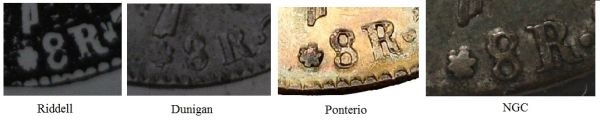 Zs - 1829 Zs - 1829 Once again the three match but the Dunigan exemplar has a different superscript on the Zs. The bottom of the S is solidly closed even on high grade examples and as the coin wears the top loop closes as well. Riddell's picture shows gaps in the digits of the date especially the 2. But the Ponterio and NGC examples use a different base on the 2. The tail of the 9 on every genuine 1829 I have reviewed shows a slight recurve in the tail (this was typical of the portrait series as well). The picture of the Dunigan exemplar shows a slightly damaged tail but the recurve is present though not entirely clear. Notice that the Riddell - Ponterio and NGC examples all lack the recurve. Finally closely look at the rays (not the position of the rays - the make up of each ray) - once again the rays on the Dunigan coin do not match the others. 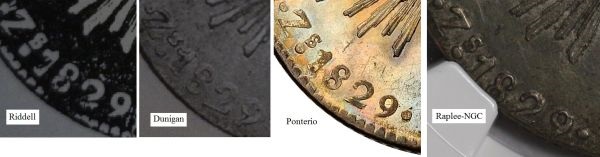 A - O A - O The A is damaged in the Riddell picture but the two letters appear to be a match. Once again the Riddell, Ponterio and NGC coins are identical (with differential die wear). The real difference is in the ray tip (lonest at the left). The Dunigan ray is simply different. In general these small rays under the cap are smaller (thinner) with far less pronounced internal lines. 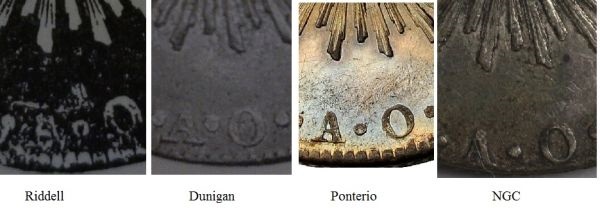 10 Ds 10 Ds There is a subtle difference in the opening of the 0 but other than that the 4 coins are very close. 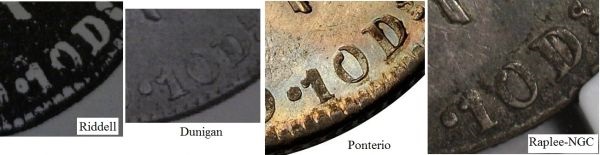 More later
|
|
Pillar of the Community
United States
5362 Posts |
realeswatcher Your initial conclusion is the one I reached after 30 years of studying examples of these forgeries. The dies used to create the series of broken toe eagles R#s 221 and 223 (which comes in every date from 1929 to 1836) are ALL counterfeit. It is just that simple. I have not seen ONE example of the broken toe that was genuine in over 50 years. These coins were struck from dies that were created using punches because identical details are spaced differently on some of the various die pairs. But the master eagle punch (the King Punch to use Riddell's term) has the broken toe identifier. Are there others? That is the big question. There may be other equally well made forgeries still hiding in plain sight. Sheffield plate counterfeits are like that. Just ask Colonel John. The critical issue regarding these dies is that these dies were not made with a circular ring of dentils. They are NOT "real mint dies." To theorize that the die is genuine requires that genuine coins with straight segments (14 in all) have to exist. My question is where are all these 14 sided originals if this was a normal mint methodology? I have not seen one in 50 years. At least two of the numerous varieties - the 1829 AO and the 1832 OM have clear indications of originally being pressed from full hubs. These hubs may have been created later but they use the same punches and King punches as the other die varieties. One problem I face in creating a complete die family is that I need numerous near MS coins from each die to study die chip, break and wear patterns to determine how many dies were used and in what possible order they were used. Mules are particularly valuable in this regard. So far most readily available examples of these counterfeits show significant wear through the outer plate with a loss of fine detail. These low grade examples show little promise of contributing to a complete die sequence. There are just a couple more sequences of pictures I want to show. All three sequences show that just three coins - Riddell, Ponterio and NGC examples are identical. The only coin with die punch deviations is the genuine coin from Resplandores. These deviations are not just positional they are proof of different punches. First is the letter M in MEXICO which is clear on all four coins. If you notice the point of the M that faces downward is ECCENTRIC on the three versions I refer to as counterfeit but is centered on the genuine Resplandores coin. Can anyone point to that M on a genuine coin Zacatecas coin? If you notice, there is a difference between the M on the Ponterio example and the M on the NGC coin. The upper left corner of the M shows significant die wear enough so that the left leg is disconnected on some. This is a die marker that could possibly be used for die sequencing if only about three or four dozen more examples in this grade could be found. 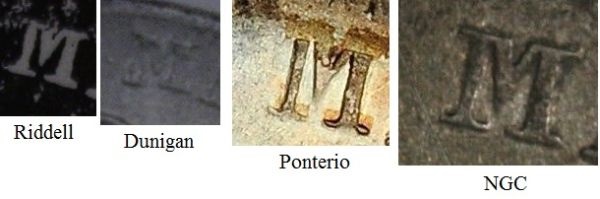 The snake and Eagle's head is one of two die discrepancies used by Riddell to identify this forgery. Riddell says "snake's neck too long". Notice that the neck right behind the snake's head loops higher above the eagle's crest on three of the four coins. It is clearly longer as Riddell indicates on those coins. The snake was, if I am not mistaken, part of the King Punch used at the mint and this loop should be identical unless the die was recut. I have never seen a genuine coin including the Dunigan examples with this same enlarged loop. 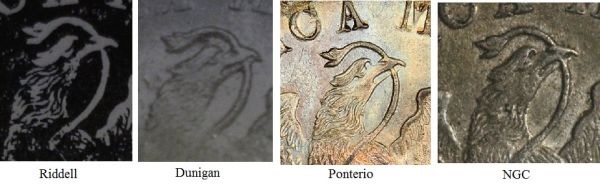 The Hill or ground under the eagle. This refers to the second feature used by Riddell to identify the 221. Riddell says "ground too low". To understand this you need to understand the eagle and snake of Aztec legend. The cactus that the eagle is standing on is located on a small hill that extends out of the waters of lake Anahuac which is the site of present day Mexico city. So what is depicted is a hill that appears out of the lake surface. If the ground is TOO LOW that means the water line is too high. That is exactly what appears on the detail below. The Genuine coin has a LOWER water line than the counterfeit. Once again the correlation is three to one. 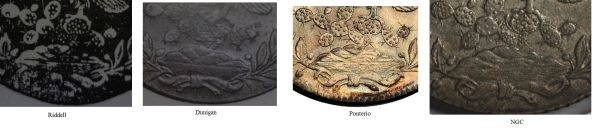 Because this sequence is a bit too large to be clearly appreciated I made a second to compare the genuine Dunigan coin with the Ponterio counterfeit. These pictures are VERY clear and both of the others are the same as the Ponterio example. Here is that comparison showing the lower water line. The rounded hill at the right side extends clearly higher above the waterline on the genuine coin. 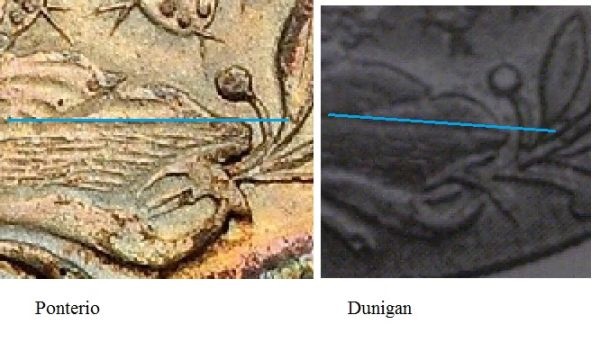 The "Broken-Toe". This is my primary identifier of for type. The missing segment of the top toe is a great marker because the dies that made the typical 221 and 223 coins DO NOT create a high wear point at this place. We all know that genuine Zs coins are weak at precisely this point. So I ask you why do these dies produce such great feet that last until the rims and half the perimeter lettering is gone. Why because the dies were not cambered nor were the designs cut as deeply into the die face as these. That is absolutely a function of the set of this King Punch (or die hub). To me the difference is so obvious that it makes me wonder why it is not seen as easily by others. This is simply not a Zacatecas die pair. Finally regarding this sequence please notice that even the button's on the cactus pads match on the three examples that I call counterfeit but on the genuine coin even the claw and toe positions are different. This is also a King Punch feature. No deviation should occur. 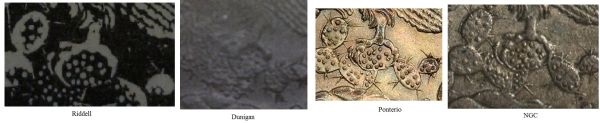 The final feature is the segmented dentil circle. I think it is very clear but to prove it I have created two sequences of pictures showing how the dentil circle was applied to the die. The two ways once again align three to one. Here is what I mean. The genuine coins illustrated in Resplandores and the coins from Zacatecas that I have examined which are genuine all exhibit a dentil circle composed of a series of arc segments that are 5 dentils in length. These at times pass segment to segment with no noticeable deviation. Other dies like the one that made Dunigan's 1829 coin was not well aligned end to end so that the joins are more or less obvious. The other three coins have dentils that align in straight rows of 10. They can be identified when enlarged by the overlap in the dentils which is slightly different in size than all the other dentils. 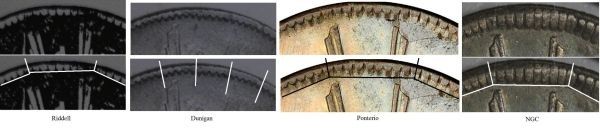
|
|
Valued Member
Germany
194 Posts |
Bob,
My initial response was the assumption that the "Broken Toe" die might have come from the mint and was used for illicit activities. However, you make a very clear case for this die (hub) to be a product from outside of the mint. To use your own words, there's no "wiggle room" left in my opinion. Even if one were unable to understand the concept of a "king punch" and why there should not be any die differences in the features that form part of it, the dentils punch and its "non-use" in any undoubtedly original coin from the Zacatecas mint should be sufficient.
There still remain three questions to me:
1)
The Ponterio and the NGC coin appear to be Sheffield plates. What are the counterfeits you own and/or have seen? Riddell describes his coin with a fineness of "near 63-1000". Would this mean that he melted the coin, thus mixing silver plating and copper core, and received the 6.3% silver content, without describing the coin as being copper with silver plating or silver wash, something he does with many other examples?
2)
XRF does not help with (intact) Sheffield plates. But due to its copper core, a Sheffield plate should be underweight, and should not pass the SG test, right? So would that be the way to test the NGC coin without cutting it?
3)
Are there any visual hints for a Sheffield plate you would be looking for if you took the NGC coin out of its plastic coffin? Or is there no way of telling as long as the plating is not damaged or worn through?
|
|
Valued Member
United States
426 Posts |
Thank you very much for that information that you took the time to present swamperbob! Even though the counterfeits might look like genuine 8R's in the beginning, after close examination of the details you provided it is clear that they are not legit.
|
| |
Replies: 66 / Views: 9,923 |








 First Page


 Posted 01/26/2014 04:52 am


