Coin Community Family of Web Sites Join Thousands of Coin, Bullion, & Money Collectors
Royal Estate Auctions - $1 Coin AuctionsCoin, Banknote and Medal Collectors's Online Mall Royal Canadian Mint products, Canadian, Polish, American, and world coins and banknotes. Vancouvers #1 Coin and Paper Money Dealer Specializing in Modern Numismatics Join Thousands of Coin, Bullion, & Money Collectors 300,000 items to help build your collection!


Username:
Password:
Save Password
Forgot your Password?


This page may contain links that result in small commissions to keep this free site up and running.

Welcome Guest! Registering and/or logging in will remove the anchor (bottom) ads. It's Free!

What Is Wrong With NGC? 1829 Zs Ao 8 Reales

To participate in the forum you must log in or register.
Author Previous TopicReplies: 66 / Views: 9,706Next Topic
Page: of 5
Pillar of the Community
swamperbob's Avatar
United States
5362 Posts
 Posted 01/31/2014  02:33 am  Show Profile   Bookmark this reply Add swamperbob to your friends list Get a Link to this Reply
dosmundos You ask:


Quote:
The Ponterio and the NGC coin appear to be Sheffield plates. What are the counterfeits you own and/or have seen? Riddell describes his coin with a fineness of "near 63-1000". Would this mean that he melted the coin, thus mixing silver plating and copper core, and received the 6.3% silver content, without describing the coin as being copper with silver plating or silver wash, something he does with many other examples?


The two coins are in my opinion BOTH Sheffield plate examples.

Your question has several parts.

My experience with the Riddell # 221 and 223 indicate that most examples are thin Sheffield plates. But the composition does range from solid debased alloys (with and without thin washes) to thinly plated copper cores. One of the scarcest types is a solid copper strike. A thin Sheffield Plate would square very well with the assay results of 6.3% silver. I have NEVER seen an electroplate (with the exception of one example where a later electroplate was added OVER the earlier Sheffield to cover worn through spots.)

The assays found in Riddell did consist of melting the entire coin. His primary concern was the approximate value of each of the counterfeit coins based on silver content. (It is my belief that Riddell wanted to create a listing of counterfeits for redemption purposes.) He was not concerned with the preservation of his exemplars. He even melted the # 182 a genuine 1835 Ho coin which is still unknown in any collection to date. (A very similar coin has recently been discovered and is also considered unique).

I base the theory that Riddell's goal was to create a handbook for redemption of forgeries on the fact that several Riddell examples produced from identical dies were assigned more than one number. The only difference is that they had different assays. Numbering the coins according to assay appears to be the primary importance he saw in his work. That may account for why he never issued volume 2 as he originally planned since he should have discovered very quickly that the counterfeiters used different assays at different times indiscriminately. He could not rely on die variety as a measure of actual value.

You also ask why he didn't mention it was clad coin like he did in other cases? Good point. I can see more than one reason for that. First, he may have had an intact Sheffield to begin with for testing. It makes sense to melt the least circulated copy for assay purposes if redemption value is your goal. He also indicated that these copies had flooded the local (New Orleans) area so high grade copies were quite likely.

But there is a second equally plausible reason. He simply did not mention the fact. After reading through his book and creating a spread sheet of all the data presented for each example - one simple fact became apparent to me - Riddell was not always consistent in his terminology and his descriptions. Most of his descriptions do not contain the answers to all the parameters he mentions. Some descriptions for example may say cast or struck - but many say nothing about how the coin was made. Some refer to solid alloys, some to plates and others to silver washes but many say nothing about the coin's composition. Riddell often neglected to mention individual facts in MOST cases. When you look at a completed spreadsheet of the entire book the failure to provide precisely the same data for each coin is obvious because of the number of BLANK fields in the end product.

So missing data in Riddell does not bother me.

Now that I have completed a book with over 500 descriptions - I can vouch for the exceptional tediousness of producing such a list and trying to mention every parameter in every single description using the same terms and getting them in the same order. It is BORING to prepare such a listing.

Your second question is:


Quote:
XRF does not help with (intact) Sheffield plates. But due to its copper core, a Sheffield plate should be underweight, and should not pass the SG test, right? So would that be the way to test the NGC coin without cutting it?


The answer is YES regarding Specific Gravity. It is a non-destructive test that can determine if a coin is a forgery WITHOUT cutting the surface in any way. That is why I began using SG testing to confirm forgery in the first place. I began my collection of counterfeit coins while I was in High School about 1962. About that same time, in the school science and chemistry laboratory I learned the story about Archimedes and his method for testing the King's new crown. If Archimedes could prove whether or not the crown was solid gold in 200 BC shouldn't I be able to tell if a coin is solid silver or not NOW? So yes - a clad counterfeit coin like the Riddell 221 will be the wrong density even though it may be exactly the right weight. It was obvious to me when I was 15 years old that density not weight was the determining factor.

The third question is:


Quote:
Are there any visual hints for a Sheffield plate you would be looking for if you took the NGC coin out of its plastic coffin? Or is there no way of telling as long as the plating is not damaged or worn through?


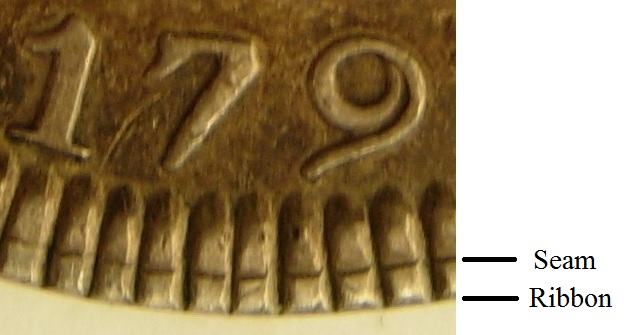
Once again the answer is yes but with qualifications. First, if the coin remains in the holder you look for several things that may have happened which are still visible. One is the trace of an edging ribbon. A Sheffield coin was cut out of a strip of metal that had three layers. The top and bottom were thin silver and the core off metal. So when a blank was cut - the edge was exposed and had to be covered in some manner. Some of the methods do leave traces. The most common method after about 1785 was the ribbon method in which a thin silver ribbon was rolled onto the edge and folded over slightly onto both faces. This was usually done as the blank was edged before the coin was struck. The final strike of the faces welded down the edges of the ribbon that overlapped. Here is what that looks like on a near MS example of a 1791 Sheffield plate counterfeit from Birmingham, England.

What-Is-Wrong-With-NGC?--1829-Zs-Ao-8-Reales

This very visible seam is only observed on coins with virtually no wear. But there has to be a seam. As time past the forgers got better at placing the seam RIGHT AT THE CORNER of the coin.

There are other signs. The principle used in the Sheffield process was that silver and copper have the same properties of malleability. When three silver layers are welded together (usually by heat) they can then be rolled and drawn and the three layers will expand at the same ratios. That is why it took many years of experimenting with alloys to produce a white core that would be satisfactory as a Sheffield layer. If the three layers do not deform at identical rates one layer thins or cracks.

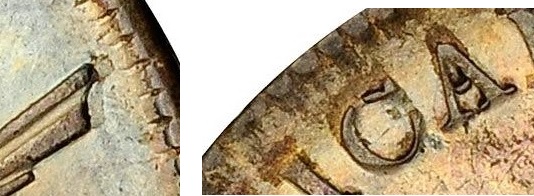
I believe this effect (indicating a poorly matched metal sandwich) occurs on the Ponterio copy. Note the areas on the outer flow side of high struck features. The silver plate seems to thin and the effects of oxidation cause a subtle change in toning. See below:
What-Is-Wrong-With-NGC?--1829-Zs-Ao-8-Reales

So yes, it may be possible to find clues while still encapsulated.

Removal would provide the ability to test the coin using SG. That would prove what the coin is. There is NO TPG that offers SG testing on a routine basis - yet it takes only a minute or two per coin to complete.

I do not suggest removal at all. I think that part of the value of this example is the ERROR of encapsulating the coin in the first place.

Valued Member
Germany
194 Posts
 Posted 01/31/2014  05:33 am  Show Profile   Bookmark this reply Add dosmundos to your friends list Get a Link to this Reply

Thanks a lot, Bob, you have completely answered all my questions!

I was not aware of the fact that Sheffield plates are still out there in almost uncirculated and still perfectly plated condition.
Pillar of the Community
United States
1962 Posts
 Posted 01/31/2014  12:53 pm  Show Profile   Bookmark this reply Add realeswatcher to your friends list Get a Link to this Reply
Bob, good post... a couple brief points:

-- Great point about how Riddell in some instances enumerated identical die pieces separately based on intrinsic content - that never occurred to me. I've thought before that some of those plates looked like exact matches... but had just figured I was missing something b/c of the picture quality. that explains that!

-- The (extreme) toning shadow revealing a plated coin's true nature (core) is very interesting... I do think one has to be careful using that blindly, though, b/c what you're theorizing is really just an exacerbated version of what toning shadow is to begin with - different toning around the peripheral raised detail due to altered metallic structure in that area from the strike - augmented here by the additional variable of a plated core planchet. But yeah, if the shadow is going to be THAT coppery in appearance, that's certainly distinguishable from normal shadowing and could serve as a good indicator.
Pillar of the Community
swamperbob's Avatar
United States
5362 Posts
 Posted 01/31/2014  2:46 pm  Show Profile   Bookmark this reply Add swamperbob to your friends list Get a Link to this Reply
Dosmundos You say:

Quote:
I was not aware of the fact that Sheffield plates are still out there in almost uncirculated and still perfectly plated condition.

Not only are MS examples of Sheffield Plates out there - quite a few are found in TPG slabs. That is the problem we will face in every case where the owner refuses to believe what we are saying about their coins preferring to rely on TPGs who are very adept at grading coins but not at authentication.

realeswatcher You make a very valid point when you say
Quote:
I do think one has to be careful using that blindly

I completely agree that shadow toning can not be used in isolation but at times right at the base of the numerals or letters there are breaches in the plate that can expose the underlying metal. It provides not only a supportive clue but the potential location of absolute proof of an off metal core.
Pillar of the Community
colonialjohn's Avatar
United States
1757 Posts
 Posted 01/31/2014  3:38 pm  Show Profile   Bookmark this reply Add colonialjohn to your friends list Get a Link to this Reply
Bob - as I start looking at AU and UNC Sheffields I am also noticing the silver peeling occurs at times on the rim area - this may be due to the fact that it is a higher stress area or from your seam analysis method the seam winds up near the corner of the coin with time due to better counterfeiting techniques? - I have noticed this occasionally in some auction house lot viewings on TPG pieces for Portraits. Since we are also talking about Cap and Rays how extensive is Sheffield plating in C&R's or is this strictly (primarily) reserved for Portraits? Just curious ...

John Lorenzo
United States
Pillar of the Community
swamperbob's Avatar
United States
5362 Posts
 Posted 01/31/2014  3:51 pm  Show Profile   Bookmark this reply Add swamperbob to your friends list Get a Link to this Reply
John - Sheffield plate examples are quite common in certain types and may indicate a common origin. These are primarily the pre-1840 dates. Over time there is a shift away from Sheffield to electroplates and solid alloys like German silver.
Pillar of the Community
swamperbob's Avatar
United States
5362 Posts
 Posted 02/13/2014  02:01 am  Show Profile   Bookmark this reply Add swamperbob to your friends list Get a Link to this Reply
The 1829 Zs AO has re-appeared on ebay.

http://www.ebay.com/itm/400663190161

I presume that Bruce Raplee feels justified in re-posting the coin since Mike Dunigan approved of it.

I have written today to NGC to see if they will reply to me.

I tried to write to Bruce but ebay would not allow me to write to him. I presume I am blocked. Could someone else try to ask Bruce a question to see if it goes through.

Also if you agree with me the coin is a counterfeit would you please report it.

Pillar of the Community
MathieuMa's Avatar
France
1591 Posts
 Posted 02/13/2014  04:24 am  Show Profile   Bookmark this reply Add MathieuMa to your friends list Get a Link to this Reply
swamperbob : message me / mail me what you want me to send to him - I'll do it.
I'm reporting it as well.
Pillar of the Community
tokenmast's Avatar
United States
648 Posts
 Posted 02/13/2014  09:04 am  Show Profile   Bookmark this reply Add tokenmast to your friends list Get a Link to this Reply
Reported

wow very nice! I like it.

Remember to buy the slab, it certainly adds value to this one.
Pillar of the Community
United States
1962 Posts
 Posted 02/13/2014  10:42 am  Show Profile   Bookmark this reply Add realeswatcher to your friends list Get a Link to this Reply
Yeah, saw it reappear (real or CC, he's still wacky at that price)...

But Bob... you've proven the point about the pieces created from these dies for anyone who cares to listen. There is, however, no point in hunting individual pieces from two-bit flipper dealers. You could attempt to convince him until you're blue in the face, but as soon as heard Dunigan says fine, that was the end of the conversation on that end b/c that's good enough for him (and what he wanted to hear anyway).

The only sensible path is to cut the head off the snake (get it, snake, like on the Cap & Rays? hehe.... heh) and convince the "recognized authorities" like Dunigan, Ponterio and the like and have them spread the gospel from there. Even contacting NGC... no point in that, as they are not (as you're aware) in any way expert on these and will only defer to Dunigan etc. anyway.
Pillar of the Community
swamperbob's Avatar
United States
5362 Posts
 Posted 02/13/2014  1:44 pm  Show Profile   Bookmark this reply Add swamperbob to your friends list Get a Link to this Reply
That is my next move to try to speak with or write to Dunigan. I will start with him since I know he collects high grade countereits. Now I just have to get him to listen to the proof or to read it.
Pillar of the Community
colonialjohn's Avatar
United States
1757 Posts
 Posted 02/13/2014  3:13 pm  Show Profile   Bookmark this reply Add colonialjohn to your friends list Get a Link to this Reply
Bob - you should realize after the GNL BOOK comes out like the British counterfeit halfpennies and farthings the counterfeits will probably be worth MORE than the regals - who would not want to own a Riddell counterfeit as an association piece for their collection ... or a AU or Mint State Sheffield ... like my recent NGC Eric. P. Newman Sheffield in MS61for a Zacetecas KM-111.5 - an INCREDIBLE coin! In the recent World Sale --- Heritage - LOT 31661. Auction:3029.

JPL
Pillar of the Community
MathieuMa's Avatar
France
1591 Posts
 Posted 02/13/2014  4:39 pm  Show Profile   Bookmark this reply Add MathieuMa to your friends list Get a Link to this Reply
MS61 - with silver peeling away - ... but there is a nice sticker on the box !
http://coins.ha.com/c/item.zx?saleN...&lotNo=31661

Are you the one which bought it ?
Pillar of the Community
swamperbob's Avatar
United States
5362 Posts
 Posted 02/13/2014  4:53 pm  Show Profile   Bookmark this reply Add swamperbob to your friends list Get a Link to this Reply
John have you been able to get the XRF to test the coin itself? I ask only because I would not have spotted the dies in this case as counterfeit - there are actually none of the normal clues present.
Pillar of the Community
colonialjohn's Avatar
United States
1757 Posts
 Posted 02/13/2014  5:12 pm  Show Profile   Bookmark this reply Add colonialjohn to your friends list Get a Link to this Reply
Mat - Yes I purchased this coin ... like Gord Nichols (GNL co-author) I wanted a Sheffield in an a NGC holder as a souvenir. The added EPN Collection sticker is an added bonus. It's an INCREDIBLE coin as on the obverse there is a red/blueish hue with the debased copper host and the reverse with a loop is amazing. Use the ZOOM features on the Heritage site to appreciate this MONSTER counterfeit. It will always be one of my prized contemporaries. Maybe Newman knew this was a counterfeit as to why he probably owned the piece. The piece is actually MS65 in my opinion but downgraded for probable reasons of this peeling?!

Bob - No - there is no way to XRF through plastic TPH as it distorts the detector. Remember I am at Kearfott now and no longer at EDAX I may have problems giving accurate Pt/Au readings with the 15 year old devices here at my current company. However we can do SEM/EDS analysis which gives both surface organic contaminants and ONLY a generic alloy conclusion with readings only 1.0% and higher ... such is LIFE <BG>.

John Lorenzo
United States
  Previous TopicReplies: 66 / Views: 9,706Next Topic
Page: of 5

To participate in the forum you must log in or register.


Disclaimer: While a tremendous amount of effort goes into ensuring the accuracy of the information contained in this site, Coin Community assumes no liability for errors. Copyright 2005 - 2026 Coin Community Family- all rights reserved worldwide. Use of any images or content on this website without prior written permission of Coin Community or the original lender is strictly prohibited.
Contact Us  |  Advertise Here  |  Privacy Policy / Terms of Use

Coin Community Forum © 2005 - 2026 Coin Community Forums
It took 0.39 seconds to rattle this change. Forums


