| Author |
 Replies: 28 / Views: 9,884 Replies: 28 / Views: 9,884 |
|
Pillar of the Community
United States
3253 Posts |
For you ancients experts who may not visit the Metal Detecting forum, and have an interest in dipping into the Bigfoot-like debate over the possibility of pre-Columbian trans-Atlantic exploration of the Americas, your expertise is needed in the attribution of three coins of Carthage pulled from the cold soil of Canada by our forum friend Leslie Sarkany. Here's one: 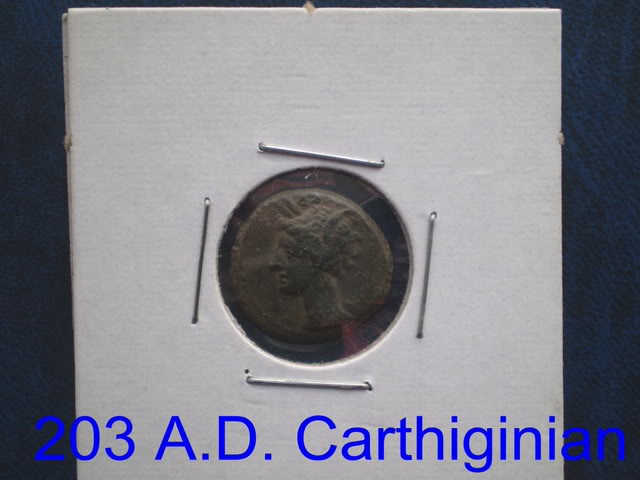 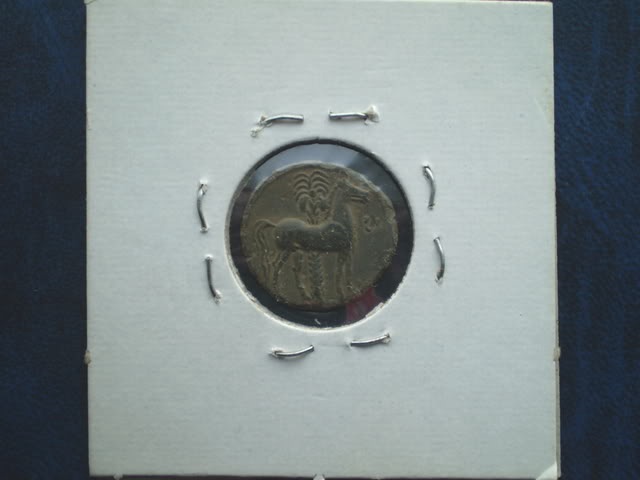 And the other two await your august opinions on this thread: https://goccf.com/t/164805 |
|
|
|
Pillar of the Community
Canada
4227 Posts |
I'm from NS and I've never seen one (Carthaginians or Big Foot)! Seriously, what a great find that makes you wonder...
|
|
Pillar of the Community
United States
5155 Posts |
It could have been deposited by a collector at a later date if not....HOLY SHEKEL! Call the news, call everyone!
|
|
Pillar of the Community
United States
842 Posts |
There was without a doubt European visitation of the Americas before Columbus. Leif Ericson landed in North America in Newfoundland almost 500 years before Columbus was even born! The Norse had a few small settlements here but they were not permanent. Anthropologists currently believe that they were nothing more than small camps used by the Norse when logging timber or other natural resources in the area, but the fact remains is that Europeans were here long before Columbus. The interesting thing is that no one knew or believed anyone else came before him until the 1960's, and even then it took a few decades to convince the historical community to the point that it was taught in public schools. My point is that other cultures could have *easily* made it here even before good ole' Lief. I wouldn't be surprised if in the future we discover ancient settlements dating back to the time of the Romans. If these coins are the real deal (I know hardly anything about Carthage so I can't say) they could be the missing link that leads us to an incredible, history-rewriting discovery. Where abouts did he find them? Another possibility is that the Norse had them and lost them. It's a stretch I know but being the oldest European civilization we know to make it to North America makes them the prime candidate since they are closer to the Carthaginians in the historical time scale.
I am super-excited by this!. I can't wait to see what others have to say.
|
|
Pillar of the Community
United States
870 Posts |
Quote:
There was without a doubt European visitation of the Americas before Columbus. Leif Ericson landed in North America in Newfoundland almost 500 years before Columbus was even born! Yep. Not even really debated anymore. :)  Now as far as Carthaginians; they were excellent mariners and it is certainly possible but without more evidence, you simply have to go with the most likely explanation that they were deposited by somebody else afterwards. Perhaps Vikings, or Spaniards, perhaps a modern collector. Who knows. certainly an interesting mystery. Edited by MartiVltori
12/15/2013 11:01 am
|
|
Pillar of the Community
United Kingdom
3626 Posts |
Lovely coin. It would be interesting if more coins turned up.
|
|
Pillar of the Community
United States
842 Posts |
I'm studying to become an archaeologist. I call dibs on the site if he finds more!
|
|
Moderator
 United States
23731 Posts |
This coin looks too good to have been buried in the damp soil of Canada. I think it's more likely that it was dropped by a collector or even seeded in the ground so that it could be found and cause a bit of a stir.
For a time I was the Harbor Master in Yarmouth MA. on the Bass river there is a large rock that has ancient Runes carved on it. It's rumored that Leif Ericson sailed up the river and the runes were left by him.
|
|
Pillar of the Community
United States
5010 Posts |
it's a great lookin' coin also. however it got there, it's got a great story...i wish it could tell it.
|
|
Pillar of the Community
United Kingdom
4208 Posts |
Someone in canada wont know how do clean roman coins like that unless they've had access to them from Europe and a coin left somewhere like canada wont come out looking like that and would likely show signs of corrosion. I think thats a desert found coin which has been planted. My major issue is how it came out looking like that. Lets not forget, silly things turn up all over the place. I have an ancient egyptian coin dredged from the harbour of the cornish village of Boscastle.
|
|
Pillar of the Community
United States
842 Posts |
To play devils advocate... How would we know what it is supposed to look like? I mean, no one can say for sure just based on it's condition. We have no data on what coins buried in Canadian soil for two thousand years should look like.
This is fun to think and debate about! Though I know it is most likely planted or lost by some careless collector it's still super cool to imagine all the possibilities.
|
|
Pillar of the Community
United Kingdom
946 Posts |
I remember, over a year ago, on Forum, a member posted a link to a website that had an awful lot of "stories" on ancient Greeks visiting north America, as "ancient coins" had been found by river banks etc. The "ancient coins" quoted in that website were *drum roll* ALL FAKE. http://www.gloriafarley.com/chap11.htm |
|
Bedrock of the Community
United States
10045 Posts |
I'm sure that soil chemistry plays a large role in preservation, such as ph and elements present in the water like sulfur. That said, the OP's coin looks a little more like one from an arid climate--am I seeing some 'desert patina'?  |
|
Bedrock of the Community
United States
10065 Posts |
One of my college professors said that during a visit to a museum in Egypt, that one of the exhibits proudly displayed was a boat said to be used by the ancient Egyptians to trade with (now Latin America) Indians. I never looked into this, and do not know the legitimacy of their claim. But my professor said they talked about it as a factual event as if everybody knew this had happened. It would help explain some of the cultural parallels. I sometimes see pressure in our US society to keep certain knowledge non-wide spread. The mystery aspect makes too large of a market for money makers to ignore. And besides the potential for making money, sometimes actual facts tend to hurt currently widespread/esteemed, but faulty ideas. edited to make sense! Its late and I'm tired  Edited by Earle42
12/15/2013 11:40 pm
|
|
Moderator
Australia
16991 Posts |
Quote:
To play devils advocate... How would we know what it is supposed to look like? I mean, no one can say for sure just based on it's condition. We have no data on what coins buried in Canadian soil for two thousand years should look like. The climate in Nova Scotia is not too dissimilar to the climate in Britain and Europe, and the geology is much the same. I don't see any reason why "Ancient Nova Scotian bronze coins" would look any different to European ones. And European ones, freshly dug up, typically look like little green rocks. They need work to make them look like coins. As for the "rewrite the histories" crowd, extraordinary claims require extraordinary evidence, and a couple of coins wrenched out of their archaeological context by a metal detectorist isn't going to qualify. There are many logical reasons why this coin could not have been dropped by a passing Carthaginian, some of which have been mentioned already. One not yet mentioned is this: bronze coins rarely circulated beyond the city of issue. They were issued as token currency, exchangeable for silver only on the word and promise of the city government and the moneylenders operating under city license. They were worthless beyond the regions of the city's control, and doubly worthless when trading with barbarians. The circulation of bronze coins needs all the trappings of civilization that a full-fledged colony would bring, and we would see the evidence easily: ruins, graves, pottery shards by the bucketful. When Phoenician traders visited Cornwall, England to trade for tin, they left precious little evidence behind that they were there. They were also equivocal with their Greek customers when it came to describing exactly where the tin came from, lest the Greeks go looking for it themselves. But there is enough evidence, from both the on-the-ground archaeology and the historical writings, to put their presence there beyond doubt. To the best of my knowledge, no Phoenician bronze coins have ever been found in an archaeologically correct context in Cornwall. Why not? The Phoenicians did not come to settle; they came, traded, and went away again. And bronze coins would have been useless, except perhaps to explain to the more thickheaded locals what they wanted the tin for. Don't say "infinitely" when you mean "very"; otherwise, you'll have no word left when you want to talk about something really infinite. - C. S. Lewis
|
|
Pillar of the Community
 United States
3253 Posts |
Hey, guys, I was just looking for some coin identification!
|
| |
Replies: 28 / Views: 9,884 |







 Posted 12/15/2013 10:14 am





