| Author |
 Replies: 16 / Views: 7,134 Replies: 16 / Views: 7,134 |
|
New Member
United States
5 Posts |
Hi there. I recently found this coin that obscures much of the design on both sides. You can't even distinguish the date. It looks kind of like something splattered in the middle of the die. The splattering radiates outward from the center. Might it have been struck in grease? The reeding(?) along the edge looks fine although there is a very slight variation in edge thickness to my eye. Can anyone offer any insights? Thanks! 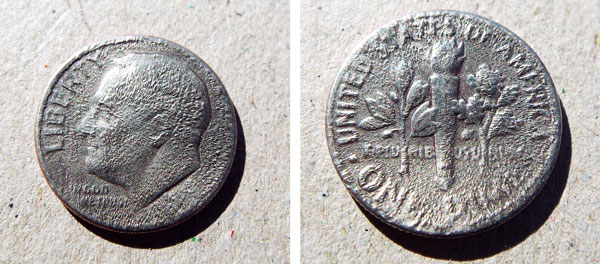 Edited by dime_dame
02/03/2014 4:09 pm
|
|
|
|
Moderator
 United States
14463 Posts |
I would guess someone dipped it in acid to try and clean it.   |
|
New Member
 United States
5 Posts |
What's really interesting about it is the splatters appear to be raised as if the die itself was pitted. Would dipping it in acid obscure the grooves on the edges at all?
|
|
Rest in Peace
United States
4078 Posts |
This is a dipped coin in some sort of cleaner/ acid or?
Fuzzy317 is in the know!
Welcome Dime Dame, let the CCF help you and ourselves.
|
|
New Member
United States
5 Posts |
Wouldn't acid cause pitting on the coin, rather than raised blobs?
|
|
Bedrock of the Community
United States
12437 Posts |
I can't tell you exactly what caused your coin to look like that but I can tell you that there is nothing in the minting process to give a coin that kind of rough surface. |
|
Rest in Peace
United States
7075 Posts |
Yes, acid would cause pits IF it was dripped onto the coin.
Something bad happened to this coin and I don't think it happened at the mint. I agree with the others that it was dipped into something acidic.
What do the edges look like?
|
|
New Member
United States
5 Posts |
The edges are perfect, no irregularities in the grooves. Could it have been melted with a torch?
|
|
Pillar of the Community
Canada
532 Posts |
looks like someone dipped it in nitric acid for a bit and decided not to refine it.
|
|
Rest in Peace
United States
1943 Posts |
Whether it was acid damage, heat damage or damaged some other way it is still unfortunately a damaged coin and is not an error coin. Sorry. |
|
Bedrock of the Community
United States
62064 Posts |
Probably weighs less than a normal dime. Looks acid dipped to me.
|
|
Bedrock of the Community
United States
17884 Posts |
Quote:
Wouldn't acid cause pitting on the coin, rather than raised blobs? Get enough pits, and what isn't pitted are seen as raised blobs. Quote:
Would dipping it in acid obscure the grooves on the edges at all? No. |
|
Bedrock of the Community
United States
62064 Posts |
On copper cent the rim is an area removed. When the cent shrinks it shrinks in thickness and width equally. 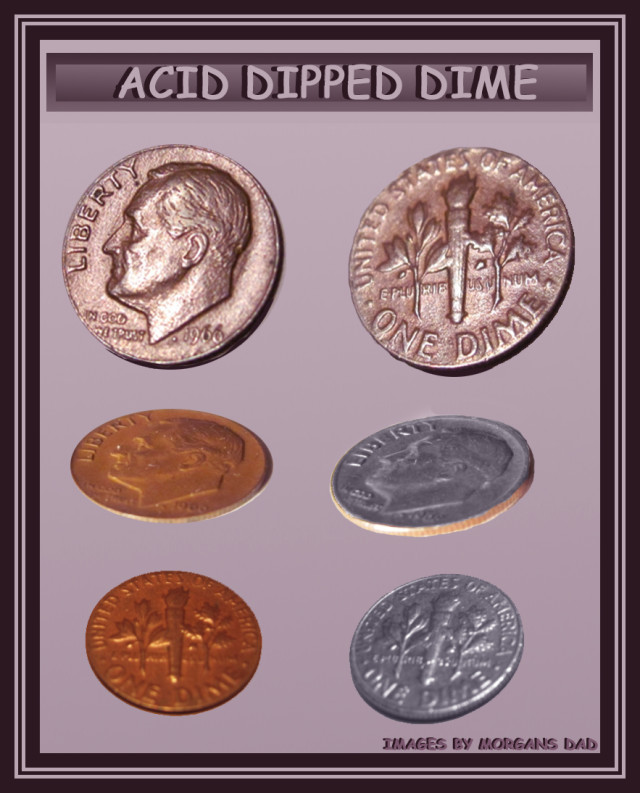 So on a dime it looks like it will remove the reeding. |
|
New Member
United States
5 Posts |
Thanks for your help, everyone!
|
|
Pillar of the Community
United States
1137 Posts |
Well, at least it is still worth 10 cents
|
|
Bedrock of the Community
United States
17884 Posts |
Quote:
So on a dime it looks like it will remove the reeding. No because it attacks both the peaks and valleys of the reeding. The diameter decreases but the reeding remains. Think of those pieces that have been soaked long enough that the edge starts looking like a cream filled cookie with the clad layers extending out past the copper core. The reeding is often lost on those very thin clad layers through wear, but if you look inside the grove you will find that the protected copper core will still show the reeded edge. It is the same process as with the obv and reverse, the fields and devices are attacked evenly and so the details remain all the way down to paper thinness. Same with the reeding. |
| |
Replies: 16 / Views: 7,134 |






 Posted 02/03/2014 4:17 pm





