| Author |
 Replies: 8 / Views: 804 Replies: 8 / Views: 804 |
|
|
Pillar of the Community
United States
914 Posts |
Notice that the 5 has an italic styled font to the top portion. 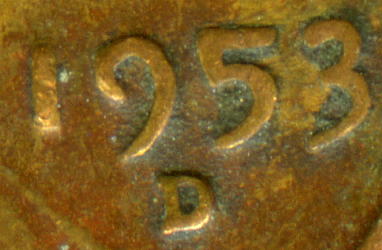 Here's a normal example for comparison. 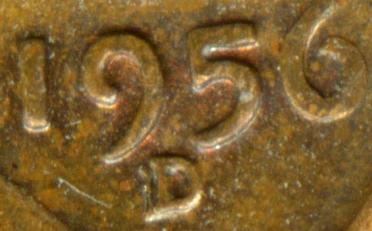 What would you make of this? Thanks! Edited by Vaslin
07/12/2007 12:45 pm
|
|
|
|
Valued Member
United States
214 Posts |
Not sure but looks like it could have been mashed a little, but I am sure the expert can tell you. What I find kind of interesting is the D in the 1956 example penny. That looks to be double to me ?
|
|
Moderator
 United States
6563 Posts |
Actually I think the D is a RPM and not a Double Die
|
|
Pillar of the Community
United States
1952 Posts |
your 56 is a very nice example of the 1956D-1MM-001
on your 53 I don't see anything but a ding on it. and it also looks like it could be a normal circulated cent. the numbers get a fatter look or they spread out when hit and that is what I see
Gary
|
|
Moderator
United States
6563 Posts |
gary could you elaborate on a 1MM please? Such as the technicaly difference from this and a DD or RPM? Or is it just a variety of those
|
|
Pillar of the Community
United States
7629 Posts |
1MM refers to the listing system I developed. The 1 stands for 1 (or one) cent, noting the denomination on the coin. The MM refers to this being MintMark doubling, or a repunched mintmark (RPM). The die number, 001, refers to the specific die used to create this particular repunched mintmark. A doubled die is completely different - they are made int he hubbing process that creates the dies and usually involves much more of the design. A repunched mintmark involves only the mintmark. Since the two were placed into the die separately until 1990, the processes, thus the doubling one or the other would show, are completely unrelated. And yes, it is possible to have a repunched mintmark and a doubled die on the same face of the same die. In this case the die gets a dual die number for both the doubled die and the repunched mintmark.
To answer the original question in this thread, the 1953D coin is damaged - a large but flat hit deformed the digit. Another important thing to note is that it is not useful to compare number and letter devices in two different years of coins - the design was changed frequently. Just look at the last digit on a 1915, 1925, 1935, 1945, 1955, and 1965 cent. The style of 5 used is different for every one of these years. In order to accurately compare an oddity on any given coin it must be compared to another coin of the same date and mint of issue.
|
|
Pillar of the Community
 United States
914 Posts |
Doh! Sorry, I shouldn't have posted my RPM, it was the only 195X cent that I had previously scanned. I was mainly curious about the '5' on the 1953.
I agree gary, I was attributing the strange 5 as a die chip in just a very interesting spot, but there doesn't look like any real damage on it. The extra part of the five is the same smoothness and height of the other numbers. No real damage is visible other than normal wear.
|
|
Pillar of the Community
United States
7629 Posts |
To piggyback my last post and to give more clarity, if we were talking about a nice S/S repunched mintmark on a 1945S War Nickel, we might be talking about 1945S-5MM-001. If we were discussing a heavy doubled die on the reverse of a 1950D quarter, we might be discussing 1950D-25DR-002. |
|
Pillar of the Community
United States
914 Posts |
Thanks copper!! I always appreciate your insight.
I was despirately looking everywhere for a 1953 to compare it to, but I forgot it at home. Yea, it is definitely smashed a little bit, but with the amount of metal visible, some extra metal had to be available, otherwise the 5 would be thinner than the other numbers. A die chip (which is very common in this decade) does answer the question well.
|
| |
Replies: 8 / Views: 804 |
|







 Posted 07/12/2007 4:09 pm





