| Author |
 Replies: 53 / Views: 5,321 Replies: 53 / Views: 5,321 |
|
Valued Member
United States
156 Posts |
At first glance, many U.S. collectors might pass this up simply based on appearance. but as the old adage goes "Appearance can be deceiving". The first time I caught sight of this, my heart rate just raced. A quick review of a RedBook should give you some sense of my excitement.  Type II obv. Type II obv.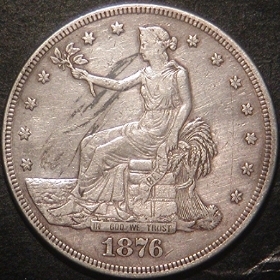 Type II rev. Type II rev.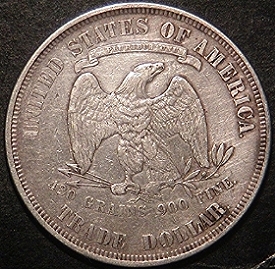 Edited by judd1552
08/04/2014 9:33 pm
|
|
|
|
Pillar of the Community
United States
7379 Posts |
Nice pick-up Am assuming you got it for a good price. Of course I'd never ask what you paid for it  |
|
Pillar of the Community
Canada
5417 Posts |
 You're right I would've passed this one up on first glance. |
|
Pillar of the Community
United States
6370 Posts |
Do you think that it could potentially be a proof that was circulated and harshly cleaned? If not, you are the envy of the forum right now. Great buy! You should send it in to a TPG to see what they say. |
|
Pillar of the Community
Australia
539 Posts |
I don't have a RedBook but I am interested as to what is special about this coin. could you explain? |
|
Pillar of the Community
United States
1512 Posts |
Is that the one listed as 'extremely rare'? Nice one!
|
|
Valued Member
 United States
156 Posts |
"I don't have a RedBook but I am interested as to what is special about this coin. could you explain?" There are two basic hub designs which were used to strike the U.S. Trade dollar series for circulation coins(1873-1878),and collector coins(Proofs of 1873-1885). The production year 1876 was the transitional year for use of these basic designs. It is an established fact that very few extant(less than 12)circulation coins struck in 1876 at Philadelphia have been reported with the combination of the Type II obverse and Type II reverse. The overwhelming number of surviving Trade dollars struck in 1876 at Philadelphia have been seen with either the die combination of TY.I obv./TY.I rev. or TY.I obv./TY.II rev. The following chart shows the additional diagnostic markers which assist in identifying hub type: 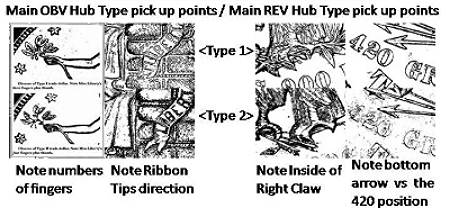 Edited by judd1552
08/05/2014 9:33 pm
|
|
Moderator
 United States
23522 Posts |
Quote:I don't have a RedBook but I am interested as to what is special about this coin. could you explain? It was the first usage of new hub types for both obverse and reverse ("Type II"). The old Type I remained in use that year, and of the combination possibilities, the coins with both faces being Type II are by far the rarest. With that said, I believe the Proofs for this year used that combination, so the possibility exists that this coin is an impaired Proof. |
|
Valued Member
United States
156 Posts |
"Do you think that it could potentially be a proof that was circulated and harshly cleaned?"
Even though it is documented that some 1876 Proofs were struck with the II/II combination, this coin is absolutely not a Proof
There are enough protected areas within the design (of the obverse in particular)of a Proof that even a harsh cleaning would not destroy the deep reflectivity in the protected areas. This coin has no evidence of mirrored surfaces anywhere.
|
|
Valued Member
United States
231 Posts |
I may be seeing things but isn't that an S mmark under the N in "grains"?
|
|
Pillar of the Community
United States
6370 Posts |
I see the S too, but I thing it's well-placed PMD as it looks too angular to be an S. |
|
Valued Member
United States
231 Posts |
I'm just going by Occam's Razor. Is it more likely an S mmark with the type 2 OBV and REV of which there are many out there or a P of which there are just maybe a handful? Definitely needs to be examined by a third party. I'm really sorry but I'm going with the S mmark.
|
|
Valued Member
United States
231 Posts |
I take it back. It's in the wrong spot for an S mmark. Should be more to the right. Once in a lifetime purchase.
NICE!!
|
|
Valued Member
United States
156 Posts |
you guys crack me up. I'll post an enlarged view of the area that you're so skeptical about.  Edited by judd1552
08/05/2014 10:44 pm
|
|
Pillar of the Community
Canada
5417 Posts |
I see a "S-like" like shape in that general area but I think it's just Pareidolia. |
|
Valued Member
United States
156 Posts |
For the skeptics... 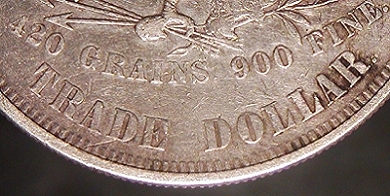 |
| |
Replies: 53 / Views: 5,321 |




 Posted 08/04/2014 9:41 pm





