Coin Community Family of Web Sites Join Thousands of Coin, Bullion, & Money Collectors
Specializing in Modern Numismatics Royal Estate Auctions - $1 Coin AuctionsCoin, Banknote and Medal Collectors's Online Mall Join Thousands of Coin, Bullion, & Money Collectors 300,000 items to help build your collection! Vancouvers #1 Coin and Paper Money Dealer Royal Canadian Mint products, Canadian, Polish, American, and world coins and banknotes.


Username:
Password:
Save Password
Forgot your Password?


This page may contain links that result in small commissions to keep this free site up and running.

Welcome Guest! Registering and/or logging in will remove the anchor (bottom) ads. It's Free!

1776 And 1787 8 Reales Genuine Or Not?

To participate in the forum you must log in or register.
Author Previous TopicReplies: 34 / Views: 8,404Next Topic
Page: of 3
Valued Member
RockyRoad's Avatar
United States
63 Posts
 Posted 11/09/2014  7:39 pm Show Profile   Bookmark this topic Add RockyRoad to your friends list Get a Link to this Message Number of Subscribers
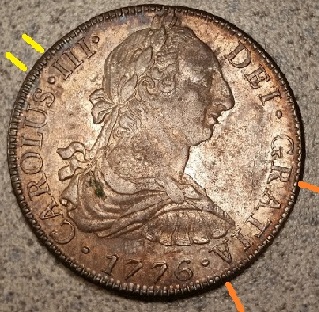
Hello to all from a new kid on the block. I've tuned in from time to time when the discussion involved counterfeit 8 reale pieces and learned a lot. Just finished a first read of Bob Gurney's book. An absolutely outstanding piece of work. Kudos to the authors and everyone who contributed to it. I have just purchased two 8 reale pieces and after applying the tips in Bob's book have come to the realization that I may be in waaaay over my head. I would appreciate having the community take a look at the photos and render an opinion. This is my first time posting any pictures and I hope they are of sufficient detail. I am especially concerned about the diagonal marks on the 1776 piece as they look very much like the photo example in the book where Bob talks about the single die edging device used to edge the bullion pieces that were struck in the 20th century.
The 1776 piece weighs 26.93g and the 1787 weighs 26.99g. I do not have a triple beam balance scale so am unable to conduct an SG test at this time. I hope to remedy that soon. Any help will be appreciated. Thank you.

1776 coin:
1776 obverse
1776 reverse
1776 edge 1
1776 edge 2
1776 edge 3
1776 edge 4
1787 coin:
1787 obverse
1787 reverse
1787 edge 1
1787 edge 2
1787 edge 3
1787 edge 4
Edited by RockyRoad
11/09/2014 7:42 pm
Pillar of the Community
nlp coins's Avatar
United States
2373 Posts
 Posted 11/10/2014  08:59 am  Show Profile   Bookmark this reply Add nlp coins to your friends list Get a Link to this Reply
I wouldn't be able to help with the authenticity but the coins look exceptionally nice to me. No red flags for me other than the fact there are numerous copies. Hopefully, one of the more knowledgeable members can chime in. nlp
Pillar of the Community
MathieuMa's Avatar
France
1591 Posts
 Posted 11/10/2014  2:46 pm  Show Profile   Bookmark this reply Add MathieuMa to your friends list Get a Link to this Reply
Agreed, they look both very nice.
There is this diagonal line from the edging process ... Do you have two design overlaps on the rim, at the exact opposite from each other ?
Pillar of the Community
colonialjohn's Avatar
United States
1757 Posts
 Posted 11/10/2014  4:06 pm  Show Profile   Bookmark this reply Add colonialjohn to your friends list Get a Link to this Reply
Speaking of looks while doing the GNL Counterfeit 8 Reale book I was indirectly alerted to a reference Bob Gurney used called "Coin Chemistry" by Weimar White who talks about toned coins being attacked from the atmosphere - the author I am assuming likes his coins WHITE like his last name (LOL) - many do - but many pay big premiums for toned coins (nothing wrong here - I personally like or should I say LOVE toned Ag coins) ... my point! ... in his book he talks about how coins tone due to the two most common air contaminants to a coin ... chlorine from the air and handling (even on the edges it makes it s way to the surface of the coins - wear cotton gloves!) and sulfur being an air pollutant present in some percentage whether you live in the city or country. Anyway the color transformations on a coin generally go as follows: white > yellow > red/blue > black on Ag pieces like here. Try this experiment ... stick a white or near UNC and untoned 90% silver coin in a 400* oven for 10 minutes, 30 minutes, 2 hours - wrapped in aluminum foil. Watch the color changes. This is one way to induce rainbow toning. Not so succesfulk with sufur ointment which does turn the coin black. A large DOSE of sulfur makes the coin bypass these median colors of yellow, red and blue.
I use this color scheme to chase down counterfeits in silver - if in yellow, red, blue or black its unlikely an off-metal counterfeit. For Sheffields the underlying copper will impose generally a high dose of reddish color masking the light red and blues from silver. I have seen this only on rare occasion as so few Sheffields so far have been located in MINT STATE with silver peeling being present whether in raw or in a slab.

John Lorenzo
Numsimatist
United States
Valued Member
RockyRoad's Avatar
United States
63 Posts
 Posted 11/10/2014  7:08 pm  Show Profile   Bookmark this reply Add RockyRoad to your friends list Get a Link to this Reply
I have looked diligently for the two overlapping edge die couplings and believe that the 1776 has them at 180 degrees. They seem to be well done. One at the T in GRATIA and the other between the dot and the first numeral I. As to whether one of them is on top of the other I am having a difficult time discerning that.
The 1787 looks like it has two circles adjacent to each other at the first 7 in the date but at 180 degrees the edge damage is so severe that I can only approximate the positions of the design elements. It could be there or not. I am hoping that someone will be able to pick out the couplings or the suggestion of a coupling from the edge pics. I could then examine that area more closely and report back. It seems that damage in these critical areas would be another way for a forger to conceal his mistakes.

I am new to forums so if I make mistakes in posting please feel free to educate me in the proper way to do things. Thanks to all.
Pillar of the Community
swamperbob's Avatar
United States
5362 Posts
 Posted 11/10/2014  8:33 pm  Show Profile   Bookmark this reply Add swamperbob to your friends list Get a Link to this Reply
Rocky Road - I am glad you enjoyed your first reading of the book. The issue, as you have pointed out, is not a subject that is simple. It is complex but not impossibly so.

I have looked at the two coins and in general I would classify them as "suspect" until more definitive data is available.

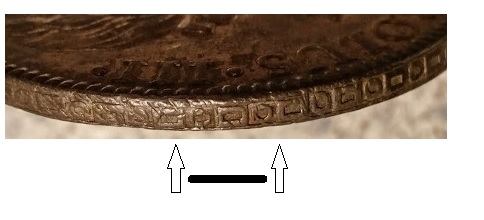
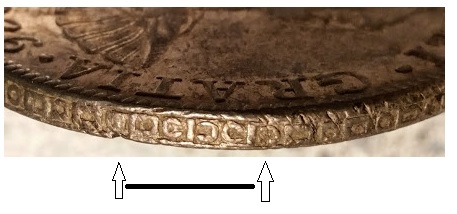
In the case of the 1776 one reason for suspicion is the edge as has been pointed out already. Not only does it have what I call grip marks that cover HALF of the circumference while the other side is pristine, I am also concerned that the overlaps on the edge are NOT opposite one another and that they are of different lengths. Following is a mark-up of where I see the overlaps and where each starts and ends. It would take a microscopic exam to be 100 % sure but if the laps are where I indicate the chances of the coin being real drop to about zero.

1776-And-1787-8-Reales-Genuine-Or-Not?

Here is lap one as I see it:

1776-And-1787-8-Reales-Genuine-Or-Not?

Here is lap 2:


I would normally classify and bid on this coin as a class 2 silver forgery but I also know that the TPGs would definitely slab the coin as genuine. Such is the state of the art. I would prefer to KNOW for sure.

Specific gravity tests (while they should be done) will likely remain inconclusive since the diagonal grip marks are associated with a Class 2 variety that was made AFTER 1870 and they were all 900 fine silver.

An XRF test accurately performed in a laboratory like RTI International or a similar certified facility capable of testing gold concentrations to 20 ppm might prove beyond doubt that the coin is a late date silver replica.

I would not resort to that step yet - I would concentrate on establishing the ends of the overlap first. The damage on this edge is no so ban that a clear answer would be impossible to arrive at.

The 1787 Mo is of course the much discussed porthole keyhole variety which I am concerned is a Class 2 forgery as well. This view does not sit well with a lot of people so I think we need scientific proof on this one. I could not locate the second overlap because the area needed is not shown clearly in the pictures. The first overlap runs from between the first and second ordinals to the space between the you and the S of Carolus. This means that the other lap should be under ATIA.


1776-And-1787-8-Reales-Genuine-Or-Not?
Pillar of the Community
swamperbob's Avatar
United States
5362 Posts
 Posted 11/10/2014  8:35 pm  Show Profile   Bookmark this reply Add swamperbob to your friends list Get a Link to this Reply
Sorry the picture got placed at the bottom. The system does not seem to place pictures where the cursor is anymore.
Valued Member
RockyRoad's Avatar
United States
63 Posts
 Posted 11/11/2014  4:34 pm  Show Profile   Bookmark this reply Add RockyRoad to your friends list Get a Link to this Reply
Swamperbob - Thank you for your analysis. I will take another photo of the 1787 edge area that you need to see and post it ASAP.

I will try to locate a resource to look at the 1776 edge laps under higher magnification.

Not being familiar with the keyhole/porthole issue I went back to an earlier conversation in this forum to educate myself. After examining my 1787 again it was clear to me that the castle windows fit the description perfectly.

It's been my experience that here in the northwest, coin shops and even local coin shows rarely see any Spanish colonial coinage let alone have someone proficient with the type. My education has mainly derived from books, studying the seller photos on ebay, examining my own small collection and reading past posts in this forum. Gaining access to a binocular microscope, acquiring the equipment to perform SG tests or sourcing a testing lab for scientific analysis of residual gold content is to put it mildly, overwhelming. Not out of reach perhaps, but it will take some time.

I'll get that photo posted as quickly as my IT department (my wife) can manage it. Thanks again.
Pillar of the Community
swamperbob's Avatar
United States
5362 Posts
 Posted 11/11/2014  10:22 pm  Show Profile   Bookmark this reply Add swamperbob to your friends list Get a Link to this Reply
It must be difficult for a collector of Mexican coins in the Northwest. Those states were not around when the US used these coins routinely (until 1857) so natives will have no experience and all examples in that area came from collectors not circulation.

But don't let that discourage you at all. Keep plugging and remember that no coin collection worth having was built in a day.
Pillar of the Community
jfransch's Avatar
United States
1801 Posts
 Posted 11/12/2014  11:43 am  Show Profile   Bookmark this reply Add jfransch to your friends list Get a Link to this Reply
RockyRoad,
Welcome to the world coin forum and happy to see you have joined us in the graduate school level classes in Spanish Colonial 8 Reales that take place on this website on an ongoing basis.
Your two coins are beautiful and would have an honored place in most fine collections. Clean, problem free strikes, nice tone, no significant post strike damage. As to the question raised here.."are they real or are they class 2 (as Bob calls them) counterfeits, I think the jury is still out. I was at Bob's presentation at the USMexNA convention in Arizona (great job!) and have followed all his posts here for years. Have read and then re-read his book and he makes a great case, but not all experts are in agreement. Send these coins to NGC or PCGS and my guess is they will come back slabbed just fine (if you get one back noted as a class 2 counterfeit it would probably be worth more than a real coin since it would be a unique slab designation) One of the joys of collecting these coins is the ongoing evolution of information that is occurring. Enjoy your coins, start collecting 8s and try to look at a many as you can to gain a feel for them. But be forewarned, they can become addictive.
Pillar of the Community
jerseyben's Avatar
United States
1211 Posts
 Posted 11/12/2014  11:50 am  Show Profile   Bookmark this reply Add jerseyben to your friends list Get a Link to this Reply
jfransch: I do not believe any of the TPG's make a designation as to class 1, 2, or 3 counterfeits at this time. IMO, they will either slab it as genuine or send it back as questionable authenticity.

To take it a step further. After reading everything posted above, why should the OP send the coin in to a TPG at all? Everything he needs is right here at his fingertips. It has been proven with examples in past posts that sometimes the TPG's slab counterfeit coins as genuine (regal). So, whose opinion should someone value more? The author of the book on counterfeit 8R's or a TPG?

Just my 2 cents...
Pillar of the Community
jfransch's Avatar
United States
1801 Posts
 Posted 11/12/2014  4:13 pm  Show Profile   Bookmark this reply Add jfransch to your friends list Get a Link to this Reply
Jerseyben,
sorry you misunderstood my comments, I am not telling the OP to send them in,(I am no proponent of the TPGs), I was commenting on what would happen if he did, that they would come back slabbed as real coins most likely. My comment about the class 2 designation was purely tongue in cheek, I am well aware that the TPGs do not designate coins that way, hence my comment "it would be a unique designation"
But as to your comment about "all he needs is here", not all experts are buying into everything in Bob's book. He lays out a great case but there are experts, and I do not mean local mom and pop coin stores that see 1 Spanish colonial coin a year, that question Bob's premise of the class two silver forgeries. I see reason to suspect these coins but I would suggest the OP learn everything he can and seek additional opinions before making a final determination.
Pillar of the Community
swamperbob's Avatar
United States
5362 Posts
 Posted 11/12/2014  8:16 pm  Show Profile   Bookmark this reply Add swamperbob to your friends list Get a Link to this Reply
I know that we discussed this very point with Jay Turner the NGC finalizer at the USMNA meeting and he was very concerned about my theory.

So far only ICG (the 4th "best" TPG approved by ebay) has begun encapsulating counterfeits - I keep asking them if they are interested in dividing "counterfeit" into something more descriptive - at least into contemporary and Numismatic. They seem interested but lack the technical capability and more importantly the financial incentive to do so.

So when a designation by Class will be available may not be in the very near future.

Regarding Class 2 - I agree that the decision of the experts is still out. That does not mean however that any number of experts (who are in the coin business) will ever convince me that I am wrong about these coins as a group unless their reply is based on solid science and historic evidence. I first heard this story from someone who had absolutely nothing to gain financially. So far most of the push-back has come from bigger US dealers who stand to loose a very great deal of money if a large number of their sales are found to be counterfeit.

I got a far more favorable response from the Mexican dealers and from individual collectors at the meeting several of whom said they have always wondered how these 8Rs could still be so common. For people who have wondered this my theory makes sense to them. They (collectors) also like the "acid test" of making gold the criteria for the final decision. It becomes purely scientific and unbiased.

I also know that based on XRF tests done to date that the number of gold bearing Charles IIII 8Rs is well BELOW half of the examples tested. The same results do not occur when you sample Go, Do, Zs or Mo Cap and Ray coins made before 1840. Even the Ferdinand VII coins have gold.

So why do some of the big dealers favor giving a pass to the CAROLUS coins which do not have gold? I of course am testing only coins I own or have access to and I have never before reported the macro-results of my XRF tests to anyone. I clearly recognize that the threat that potentially over half of the Charles IIII 8Rs of Mexico City may not quite be genuine represents a serious threat to those who have sold them. Perhaps their response is due in part to the fact that their preliminary tests show NO GOLD as well. Even though they use only handheld XRF testers - they should be finding coins that contain OVER 1/10th percent of gold (the limit of their guns). I have gotten tests ABOVE 2% for coins I believe are real.

People that have the most to lose would be expected to complain the loudest. I would prefer that thousands of XRF tests are done. Let the results prove that I am correct or incorrect.

I also recognize that I am not one of the moneyed elite and that my "proof" can and may simply be ignored by experts whose credibility and pocketbooks might suffer. All I have ever wanted is a fair hearing of the evidence and a decision based on scientific and historical fact and not "credentialed or institutional expertise" which is based on a hidden agenda. In numismatics "opinions" have been paraded as fact for far too long.

I am not one of the people that takes the short cut and says if the coins contain the correct amount of silver and look good they can simply be treated as real. That position was taken as early as 1960 by dealers who knew about the silver forgeries but simply could not tell them apart from the genuine item.

NOW WE CAN TELL.

Remember a couple things - proving the world was round and not located at the center of the Universe was a theory discredited by thousands of experts who had NO scientific proof. The status quo held sway for centuries. The experts in fact killed the proponents of that theory originally.

I would personally advise caution on the part of collectors. Buy coins that DO NOT look like Class 2 varieties - pretty simple. If you want to really be safe have your coins tested and return ALL of them that do NOT CONTAIN SUFFICIENT GOLD as a trace contaminant.

Then you are safe no matter what.

Another thing I also agree on is that the TPGs will slab these coins as genuine at present. Of course they also slab as genuine coins found in Riddell's book (see the 1829 Zs discussion) and Sheffield Plate coins. We know that happens.

The reason TPGs do this is simple and logical. TPGs lack precision of expertise that someone who has devoted decades to only one type of coin develops. Their authenticators are good perhaps great or even the best in the world but they are faced with hundreds of different types of coins a day and they have only seconds to determine if they are real and to assign a grade. When I worked for ebay as an authenticator I typically took up to 20 minutes to study a coin I was not overly familiar with before making a final vote. On disputed issues I sometimes spent longer. That can only be done using UNPAID experts. The TPGs also lack many of the scientific tools needed to make an informed decision about a coin in person. Remember that as a rule of thumb - THEY NEVER EVEN WEIGH COINS. They are trying to do their best while still turning a profit. A specific gravity test takes about 2-3 times as long as a grader is given with each coin. SG is NEVER tested either. XRF tests to a 20PPM level take hours to run and nearly an equal number of hours to fully interpret. That is why XRF tests are costly.

So the TPGs face the double edged sword of corporate financial reality - they want to do it right but they also MUST NOT spend more than they take in. They are also influenced, as we know, by the big dealers who submit most coins (grade-flation proves this)-

The TPGs DO NOT "defecate where they eat".

I on the other hand have no such concerns - being retired and inherently independent of outside pressure - I say exactly what I see as correct and to heck with whose delicate feelings are hurt, whose toes get stepped on or whose OX gets gored. That may not be politically correct or even nice but as someone who got a 3-5 years left to live - death sentence 16 plus years ago - I really do not care.
Pillar of the Community
jfransch's Avatar
United States
1801 Posts
 Posted 11/12/2014  8:53 pm  Show Profile   Bookmark this reply Add jfransch to your friends list Get a Link to this Reply
Bob
I am one of your supporters as you know, I think there is just cause to be suspicious of many of the Carlos 8 reales. I am not 100% convinced of some of your edge issues but I was impressed with the book and with your presentation. Also not so sure about the XRF results as we are seeing them currently. I have an 1811 LVO Zacatecas, full weight, I am sure it is legit and XRF shows 98% silver with no gold or platinum showing at all. Who would make a counterfeit of that coin for the silver market and who would make a contemporary of the coin with that high of silver content. (And no, the coin is not a numismatic forgery and has been examined by multiple serious collectors that all agree it is a true example of the type)
As the XRF machines get more precise and as importantly more dealers and authenticators get access to the higher end machines this could definitely become a true indicator. Until then, "we pays our quarter and we takes our chances" when we buy these Carlos coins that demonstrate anything less than a perfect edge. My goal is to have a full set of regals and a full set of class 2s.
Pillar of the Community
swamperbob's Avatar
United States
5362 Posts
 Posted 11/12/2014  9:49 pm  Show Profile   Bookmark this reply Add swamperbob to your friends list Get a Link to this Reply
jfransch Thank you for your support - it is appreciated.

Your 1811 is exactly the kind of coin that needs to be studied in great detail to see where it belongs. In the book, I mentioned that I have intentionally not included many of the war time issues because their manufacture is far from straight forward or clear.

A coin from 1811 coming from Zacatecas with an XRF test result of NO GOLD means one of three things. (1) Someone in 1811 operating in a known crude setting, in a mint that made very crude coins, using only a crucible parting procedure, could divide the gold and silver to a level that was NOT humanly possible before 1870; (2) That the silver used in the coin did not come from a Zacatecas mine directly; or (3) That something is wrong with the XRF test results.

The first point actually rules itself out.

Since Zacatecas was a provisional mint could they have used melted down European silver - like a silver service or some other source of silver for their early coins? Even a melt of worn silver coin from Europe would cover this problem BUT only for a limited number of coins.

I think the sourcing of the silver (during emergency conditions) is what really needs to be ascertained.

Of course the easiest thing to question is the XRF test results you received. You indicate 98% silver no gold. What type of XRF was used? That result sounds too imprecise to be accurate. What was the last 2% composed of? The newest generation of XRF which has a wider range of elements (Sodium to Uranium) now achieve results that numerically add to 100%. Earlier machines often missed the identification of many light elements like Silicon or Aluminum.

Also in Zacatecas Platinum should DEFINITELY not occur. Pt is a contaminant of the mines located in Columbia and vicinity. It was usually placer mined in any event and could not be recovered from native Spanish American ores until the last half of the 19th century. I have not seen it (Pt) occur very frequently at all.

John Lorenzo's theory that gold and platinum can both be used as marker elements has now been disproven on several fronts. First and most importantly the patio process used mercury amalgamation for extraction and Pt does NOT amalgamate with mercury. In that respect Platinum and Iron should not be found in silver alloys from the 19th century unless it is added to the alloy after the filet is cast. Secondly the recent 2009-2014 tests performed on Zacatecas ores (core drillings of the vein in and around the Zacatecas mines - shows abundant GOLD but not Platinum. Finally re-tests I have done on some coins using the newest XRF apparatus at RTI demonstrate that some earlier machines (including the one Lorenzo had access to) had a tendency to report false positives for Pt - there is now a way to scrub the data using a computer analysis of the data that was not available until about 6 months ago that seems to have eliminated the false readings of Pt and As seen in many earlier tests.
Valued Member
RockyRoad's Avatar
United States
63 Posts
 Posted 11/13/2014  12:11 am  Show Profile   Bookmark this reply Add RockyRoad to your friends list Get a Link to this Reply
Swamperbob - here is a new photo of the 1787 edge. I don't see anything that resembles an overlap at the ATIA point. I do see what looks like two circles next to each other just under the first 7 but 180 degrees from there I see nothing but a damaged mess. It will take a more experienced eye than mine to distinguish what may have been there before the damage occurred.

jfransch - Thank you for the warm welcome. I should have joined this forum some time ago before embarking on my Spanish type sets.(Phillip V through Ferdinand VII.) and then deciding to reach back in history beyond my Capped Bust half dollar collection with a Spanish portrait year set. A lifetime endeavor but it seemed more interesting to me to collect the circulating coinage of the day than break the bank in trying to find the seldom seen early federal issues. Based on mintage numbers I'm not sure too many people even saw much federal coinage in daily commerce until many years after the turn of the nineteenth century.

Not sure how interested members will be if I rattle on about these 2 coins but they are a grade departure for my portrait collection. My original goal was to have a high VF to XF set as I enjoy coins that show some circulation wear while still showing most if not all of the design elements. To me, coins that have traveled through commerce possess an intimate connection to history. MS coins that spent their life in a bag in a vault do not. My capped bust collection mirrors these goals.

1787 ATIA edge
Edited by RockyRoad
11/13/2014 12:22 am
  Previous TopicReplies: 34 / Views: 8,404Next Topic
Page: of 3

To participate in the forum you must log in or register.


Disclaimer: While a tremendous amount of effort goes into ensuring the accuracy of the information contained in this site, Coin Community assumes no liability for errors. Copyright 2005 - 2026 Coin Community Family- all rights reserved worldwide. Use of any images or content on this website without prior written permission of Coin Community or the original lender is strictly prohibited.
Contact Us  |  Advertise Here  |  Privacy Policy / Terms of Use

Coin Community Forum © 2005 - 2026 Coin Community Forums
It took 0.53 seconds to rattle this change. Forums