| Author |
 Replies: 16 / Views: 4,005 Replies: 16 / Views: 4,005 |
|
Valued Member
United States
68 Posts |
The coin in the center is a (1998-P) found in pocket change. What could have turned it so black? Environmental damage, most likely, but what sort of environmental damage? This photo was taken after I soaked it in soapy water over night; rubbed it with a cloth; scrubbed it with a nylon toothbrush; and finally, in desperation, dipped it in a silver tarnish remover. These measures barely made any difference to the coin's appearance. Odd. Details are surprisingly sharp, to my eye. So I doubt it was in circulation constantly since 1998. My guess is it lay somewhere for a long time, untouched by human hands but in contact with whatever substance turned it this color. 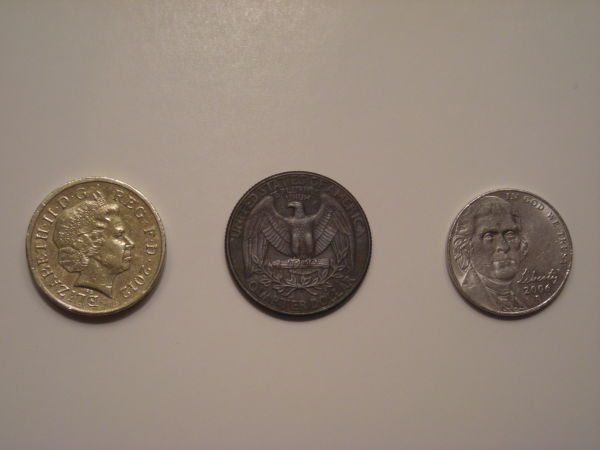 |
|
|
|
Pillar of the Community
United States
1158 Posts |
It's obviously had some environmental reaction and you did a whole lot more damage to it on top of that. Why so much effort for a coin worth $1.00 in Mint State?
|
|
Rest in Peace
United States
7075 Posts |
An acetone soak might get the black stuff off -- but I wouldn't count on it.
I have a brown quarter. It is -- I am sure -- worth exactly a quarter, but I wanted to try acetone on coins that had no premium. After a brief soak, there was no change. It makes me think it's been painted.
People do weird stuff to coins.
Then again, metal changes color....
|
|
Rest in Peace
United States
4078 Posts |
Quote:
It makes me think it's been painted. If it was, "painted" the acetone would have taken it off. |
|
Valued Member
 United States
68 Posts |
tkbslc: Respect, mon (as our Jamaican friends say), but I don't believe I damaged this coin a whole lot, or even a little, if you accept the ANA definition of improper cleaning. As I recall, the ANA defines improper cleaning as moving metal on the coin. None of the measures I used moved metal. What about the tarnish remover? Even that is OK per the ANA. You'll recall that there was a huge controversy about dipping when the ANA was debating its position on coin cleaning. In the end, the definition was written in such a way as to exclude dipping from the list of forbidden practices. I view that decision as pandering to coin dealers who have huge inventories of dipped coins. Nevertheless, that's where the ANA landed on the issue. I have opinions on dipping which we can get into at another time if that discussion would add any value for this forum. |
|
Pillar of the Community
United States
1911 Posts |
As far as I am aware, it is never a good thing to "clean" a coin, so I am not sure what others on the forum would say about your process. I am definitely waiting to see what they all say.
|
|
Pillar of the Community
United States
937 Posts |
In my book ALL cleaning is to be avoided. In this case you started with a coin worth exactly face value, no more. You, therefore, cannot reduce its value, only damage it further. As it is your coin you can do what ever you want.
But what do I know?
|
|
Rest in Peace
United States
4078 Posts |
Quote:
This photo was taken after I soaked it in soapy water over night; rubbed it with a cloth; scrubbed it with a nylon toothbrush; and finally, in desperation, dipped it in a silver tarnish remover. These measures barely made any difference to the coin's appearance. Odd.
This is not considered cleaning? Give me a break. Not being an ANA member. Your source of information may be correct but, why do the top TPG"s say detailed or cleaned coin? IMHO |
|
Valued Member
United States
68 Posts |
Of course I'd never clean any collectible coin. I worked on this common piece as an experiment, to see what would happen if I stayed within the ANA boundaries. Tkbslc said I'd inflicted a whole lot of damage, but I must respectfully disagree. Everything I did was in bounds, including dipping, as I interpret the following passage from The Official 2015 ANA Grading Standards, 7th Edition (Whitman Publishing LLC, Atlanta), page 38: "When a coin has been polished, whizzed, artificially retoned, or in any other way changed from its original natural appearance and surface, it must be so stated in a description [by the seller or grading company]... The simple dipping (without abrasion) of an already Uncirculated or Proof coin to brighten the surface does not have to be mentioned unless such dipping alters the appearance from when the coin was first struck; for example, in the instance of a copper or bronze coin in which dipping always produces an unnatural color completely unlike the coin when it was newly minted." This passage is silent as to silver coins. My conclusion is that it's OK to dip silver as long as it doesn't violate the standard defined above. I did no more than most dealers would do. |
|
Bedrock of the Community
United States
11951 Posts |
When metal detecting I have many coins with color like the one posted.
From being in the ground or at salt water beaches, I have seen them
black, grey ...and a sort of rust color.
My guess this coin has seen some time in the ground.
|
|
Valued Member
United States
68 Posts |
It looks to me like what you have is a coin that has been chemically anodized using sulfur. Most likely mixed with sodium hydroxide and given an electric charge while immersed. With silver coins you can get some nice rainbow tones. Most cleaning methods employed will give you little result. You need a chemical wash like "Greased Lightning" to remove the anodizing. Even then, the sulfur has likely bonded with the surface, and it will retain a grey tinge.
|
|
Valued Member
United States
68 Posts |
Silver Handle: Quote:
It looks to me like what you have is a coin that has been chemically anodized using sulfur. Is this perhaps is an attempt to produce rainbow toning which didn't work out as the coin doctor hoped it would? |
|
Moderator
 United States
23522 Posts |
Dunno. I've seen this color on Quarters often enough to think it's a reaction to something they regularly come into contact with in the environment, perhaps a dirt bath. There's a little too much brown in the color (assuming the white balance is good) for me to think it's late-stage toning.
|
|
Pillar of the Community
United States
2077 Posts |
Tarnish remover does alter the surfaces so it should never be used on any coin considered collectible. This coin is really just pocket change so if it gets ruined, just spend it. I don't think it will have any impact on the field of numismatics.
Once a coin is lost on the ground it can be subjected to all sorts of chemicals. Whatever is on/in it, it's there to stay. Worth 25 cents with or without it.
|
|
Valued Member
United States
68 Posts |
Quote:
Is this perhaps is an attempt to produce rainbow toning which didn't work out as the coin doctor hoped it would? Possibly, or attempt at aging perhaps. Regardless the coin will only be worth face from here on out. |
|
Pillar of the Community
United States
8533 Posts |
Spent time on a saltwater beach.
Oregon coin geek.....*** GO BEAVS ! ! ! ***
|
| |
Replies: 16 / Views: 4,005 |










 Posted 11/10/2014 12:19 pm


