| Author |
 Replies: 17 / Views: 2,845 Replies: 17 / Views: 2,845 |
|
Pillar of the Community
Canada
1505 Posts |
Is it possible that this coin was flattened in the mint, if that is what the issue is?  Or is it clearly PMD? The flattened characteristics are the same on each side and the elevation of the rim is just about gone.If it is PMD, it definitely was not a coin on a train track. A vise would not produce that kind of pressure IMO. so, what could it have been? the weight is 4.3 grams diameter is uniform 26 mm thickness is uniform 1.03 mm   |
|
|
|
Pillar of the Community
Canada
2430 Posts |
 PMD PMD if you are looking for opinions and off to work and can't chat now if you are looking for a friendly debate. |
|
Pillar of the Community
Canada
2531 Posts |
Someone's pocket piece, maybe? It has that kind of hairlines.
|
|
Pillar of the Community
 Canada
5419 Posts |
PMD............. a vise may not do it ........... but a bearing press or similar tonnage press would . I am too busy making money right now ...........sorry I too cannot have a friendly debate. !  ! |
|
Pillar of the Community
 Canada
1505 Posts |
Darryl, I am most certainly NOT looking for any argument! am honestly just wondering if there is another possibility than PMD. And if there is, what could it be? It is easy to say PMD, as it most certainly does look like it and probably is. Or basement job , etc, etc., . If it is PMD, than how, by what method, did it get to be that way? As kids we put pennies on the train tracks. But they were flattened and bent on the ends and were very thin. This coin is not bent and is uniformly reduced and enlarged in all directions. AND, the surfaces and legends on both sides are uniformly expanded without distortion. the thickness is equally reduced. I measured it. I know very little (close to nothing) about metal and its properties under pressure. I looked at this coin for some time and I believe the pressure had to come from both sides at exactly the same time. but, I am probably wrong. If you would use a vise, I do not think it would look like that. Perhaps a very simply explanation? |
|
Moderator
United States
14463 Posts |
it looks a bit like road rash. Maybe was in a parking lot or on a sidewalk. |
|
Pillar of the Community
United States
2775 Posts |
Kind of reminds me of coins hammered between two pieces leather. Flattened but details remain.  Thanks, Doug. |
|
Pillar of the Community
Canada
2632 Posts |
...lol 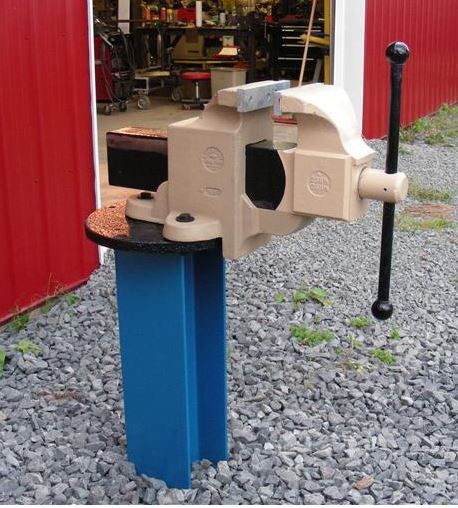 |
|
Bedrock of the Community
Australia
21789 Posts |
If it has been flattened under great pressure, the diameter should be slightly greater than normal.
The ring tone should also be slightly lower than normal.
|
|
Moderator
Canada
10473 Posts |
Quote:
Perhaps a very simply explanation? 47P7 If you are going to dive into error coins, then I highly recommend taking some normal coins, and conducting some of your own garage experiments. Take two coins, stack them on a piece of metal, and then do your best "ring-the-bell-at-fairground-game" swing with a 10 lbs sledge hammer. Also, put coins in vices between pieces of metal, pieces of hard wood, pieces of hard leather... observe your results... There is no substitute for hands-on learning when it comes to errors. Usually, anytime I examine a potential error, the first question I ask myself is not "what did this?" Rather, I ask myself, "Knowing the blanking process, the rimming process and the striking of the coin with three dies, and the limitations within the striking chamber, is this something that could have been created at the mint?"The first question I would ask you is: is the diameter of the coin consistently 26 mm when you measure it all the way around the coin? Then, I would want you to answer these questions: Look at the reverse at 9 o'clock, near the rim. How can the striking press create denticles, and then flatten them out, with small depressions (as if from an impact) all in a single strike? Look at the rim, where it is raised between 11 and 12 o'clock (reverse), and flattened from 1 to 2 o'clock (reverse) or vise versa on the obverse. The raised rim, means the collar die was engaged (i.e., not broadstruck), so how do you explain the flattened part given that the highest points on the dies, are the fields? These features could not have been possibly produced at The Royal Mint in England - therefore you are left with only one alternative - PMD. How it got that way, is moot, unless you really like to figure out how creative some folks got with their coins... "Discovery follows discovery, each both raising and answering questions, each ending a long search, and each providing the new instruments for a new search." -- J. Robert OppenheimerContent of this post is licensed under a Creative Commons Attribution-NonCommercial 3.0 Unported License. See: http://creativecommons.org/licenses...0/deed.en_USMy eBay store
|
|
Pillar of the Community
Canada
3234 Posts |
Thanks SPP ..another lesson and details again well explained..and completely new to me. BTW..I've got to get me one of these "little vises"...  Talk about back door jobs..  |
|
Pillar of the Community
Canada
2632 Posts |
|
|
Pillar of the Community
Canada
1505 Posts |
Pennyman, is that a vise in the Vise Museum or in your back yard?
SPP,
Just because I happen to come by a few interesting "error" coins, authentic errors or not, I am NOT diving into these. I would not purposely acquire these. These usually come with other coins in a lot.
I have my hands full with other interesting stuff and prefer real varieties.
It is unfortunate, but I can not re-create this as you suggest.
Could have done so in my shop 20 years ago. But today I do not have the equipment. Not everybody has a machine shop at their disposal.
Your explanation is very interesting and you are most likely correct in most, maybe all aspects of it. You know your metals, your coins and their characteristics when subjected to certain conditions like pressure, shock etc.
I re-measured the diameter again with an electronic caliper: 25.98 to 26.09 mm.
I sure would love to see any example that someone actually made with a vise or a sledge hammer or another pressure device. Perhaps before and after pictures would be great.
There is always talk about someone's previous personal workshop or basement experience using any of these devises and processes and what "magnificent" results they can produce looking like "whatever", but usually like the posted subject.
But to this day I have yet to see real pictures posted of the results.
Has anyone ever seen any pictures, or perhaps still has the "result" of such experiments?
|
|
Moderator
Canada
10473 Posts |
I have a friend, who collects "garage job" errors, so all my experiments are now in his collection. I messed around with coins to learn, but I never documented the entire process with pictures, I just filed the information inside my head... have you tried searches on this site?
"Discovery follows discovery, each both raising and answering questions, each ending a long search, and each providing the new instruments for a new search." -- J. Robert OppenheimerContent of this post is licensed under a Creative Commons Attribution-NonCommercial 3.0 Unported License. See: http://creativecommons.org/licenses...0/deed.en_USMy eBay store
|
|
Pillar of the Community
Canada
1505 Posts |
No, I have not.
SPP, basically I just wanted to know if there could be technically or realistically a way that it was done at the mint.
But then the vise job etc. came into play. hence further questions.
You were not the only one who said VJ. but you were the only one with an explanation, or several different suggestions.
So perhaps others still have their "evidence"?
I do have a few other "odd" coins for some time, and some which came in the same lot. Might post after taking pictures.
|
|
Pillar of the Community
Canada
3234 Posts |
pennyman007..That was one cool story..and don't you just love the photo with his 2 boys sitting and claiming it as their toy horsey.. Thanks for that fun link.. ..and great story.. |
| |
Replies: 17 / Views: 2,845 |







 Posted 12/01/2014 7:37 pm





