| Author |
 Replies: 27 / Views: 5,287 Replies: 27 / Views: 5,287 |
|
Valued Member
Canada
270 Posts |
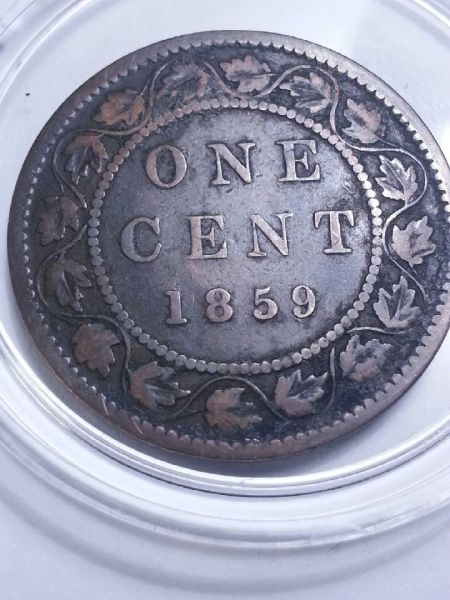
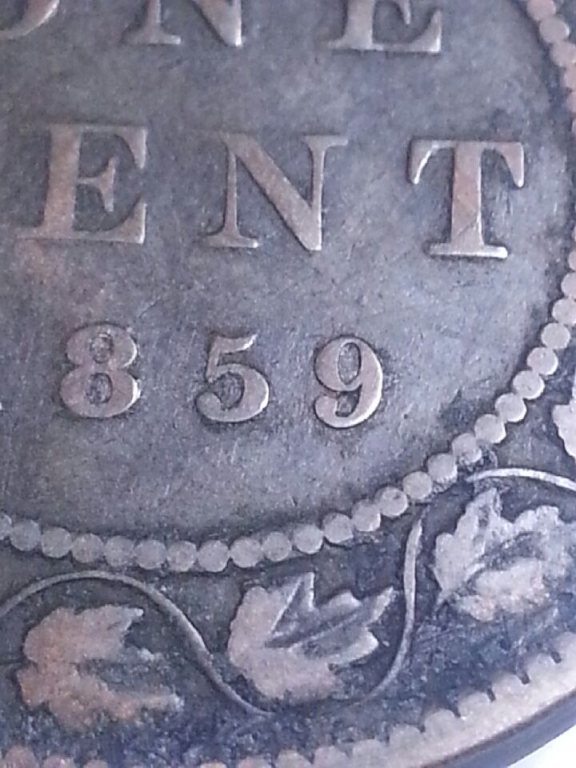
Hi all! I am very excited to be a new proud owner of a '59 variety king!; The 1859 Canadian cent. I'm really happy with condition and I'm just getting into the variety guessing game! It is definately an early style, narrow 9. It also has a very clear double punch 5, and the alignment is equal â†'â†'. But the exact variety leaves me stumped. Any guesses would be greatly appreciated!! Does it appear to have a near 9? I have my fingers crossed on a rare variety, let's all figure this one out!! 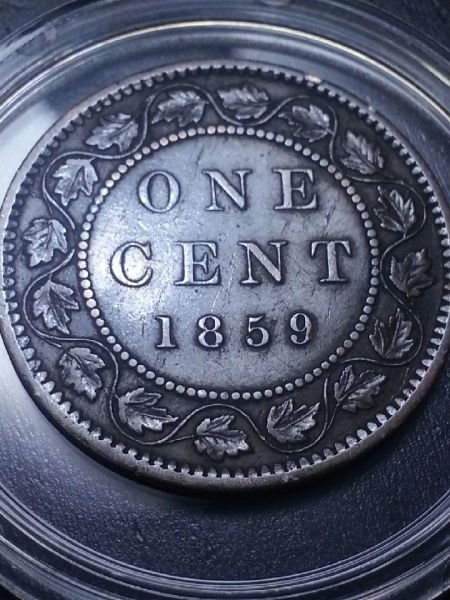 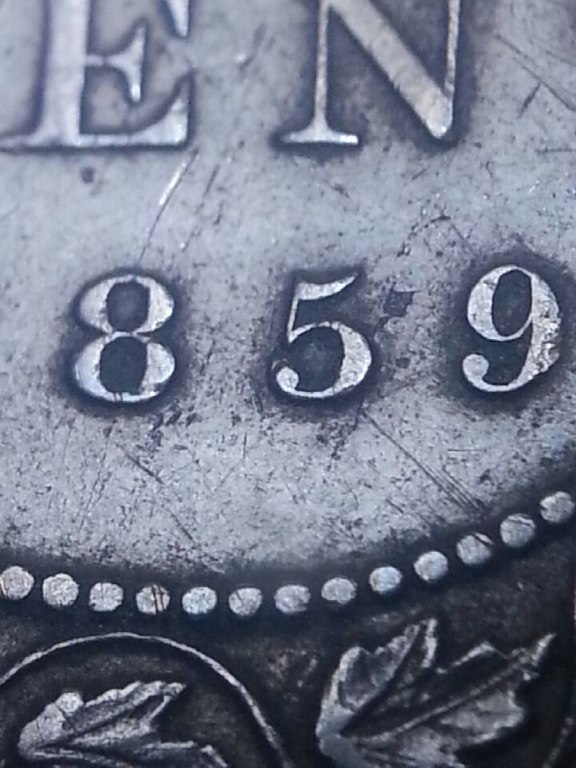 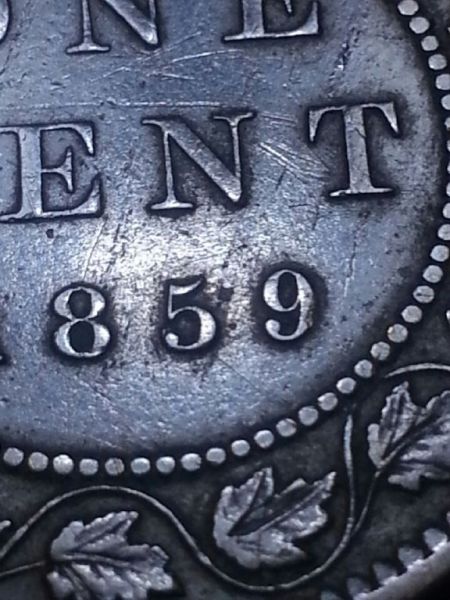 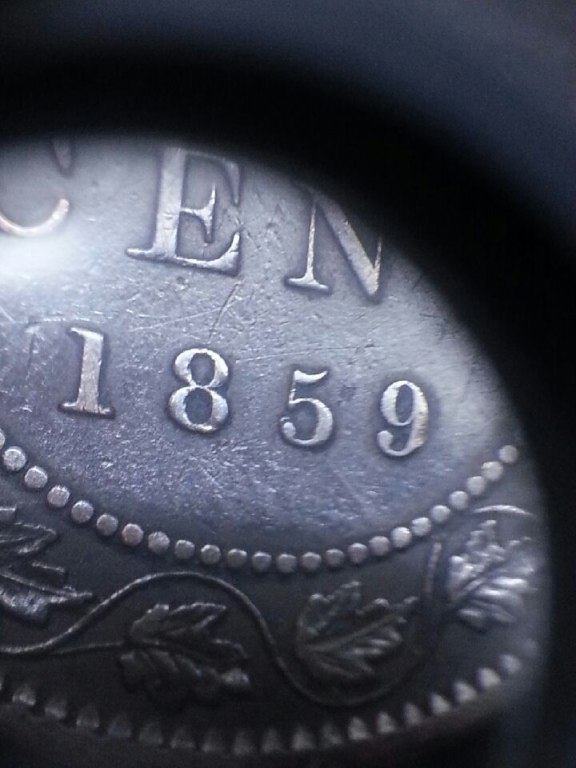 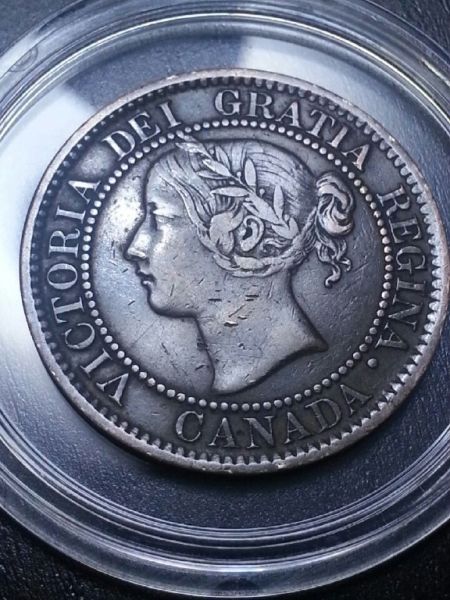 Edited by UncleLuc
01/09/2015 02:39 am
|
|
|
|
Pillar of the Community
New Zealand
1679 Posts |
Cheers Don
Vickies cents and GB Farthings nut.
"Old" is a figure of speech and nothing more
|
|
Valued Member
 Canada
270 Posts |
Well I do appreciate the advice, but I'm looking for more of an advanced reference or variety ideas. I'm well aware there are quite a few in this year.
|
|
Pillar of the Community
 Canada
5646 Posts |
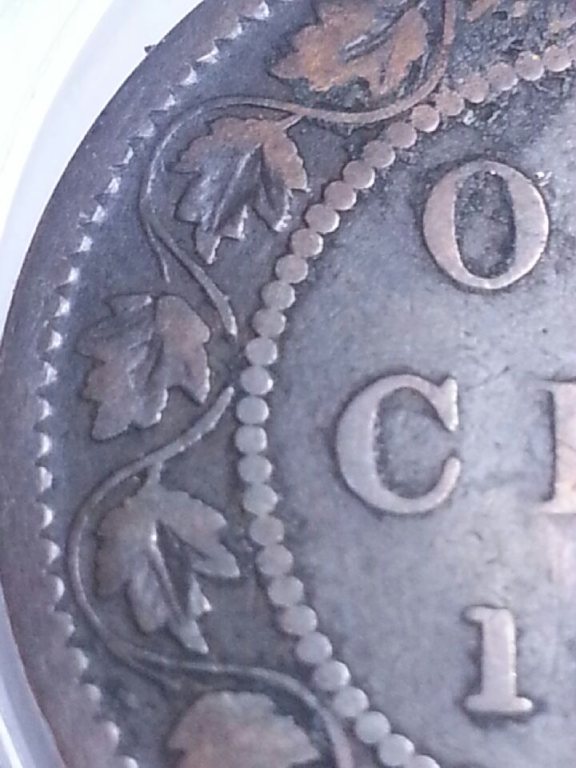
Luc: There is no better "advanced reference" than Dr Haxby's site for specific die tracking. Your coin is one of the many repounched 5's that are evident for the year and I couldn't tell you more without it in hand. Based upon the vine break at leaf 2 and the quite wide break at 7 (all '59's have a break at 7 with the later working dies having larger gaps) your coin is rather late in the striking cycle. Yours is not what others call a near 9. In my mind, there is no suck thing since a 'near 9' is no harder to find than a low 8 or high 9 or far 9. The 9's were handstruck and eyeballed as to placement from 1-2 feet away so they can be anywhere.
|
|
Pillar of the Community
Canada
638 Posts |
Your coin looks like the DP5 on page 298 of Charlton Standard Catalogue 65TH Edition
MG
|
|
Valued Member
Canada
270 Posts |
Actually thats a pretty good site, I just wasnt sure how to use the platform at first....not bad once you get into it. mine definately has, Narrow gap loop 7 Intact stem 10 wide gap loop 12 Double 9 inverted? Double 5 I also have a different 1859 that is in worse conditon that I am also trying to decipher...I came across a seriously good collection that I am slowing going to buy out... last run included; 2x 1859 1 Canada 1 cent 2x 1799 Brittania pennies 1797 2 pence 1933, 44 & 45 Republica Portuguese silvers 1945 Mercury dime high MS 1940 & '57 Canadian 25 cent 1944 & 45 10 cent 1917 one cent in a high MS! I barley scratched the surface of it and I have the exclusive buying rights of the entire collection! Exciting stuff! Edited by UncleLuc
01/09/2015 5:09 pm
|
|
Pillar of the Community
Canada
5646 Posts |
I don't think that it is p 298. The other markers aren't there including the width & type of the vine breaks at 2 & 7. There are quite a few repunched 5's with the 59's and only 2 of the many were put into Charlton as examples.
|
|
Valued Member
Canada
270 Posts |
Would better pictures of the entire vine help?
|
|
Pillar of the Community
United States
840 Posts |
Examine Obverse 52 / Reverse J11 on the Haxby site
and see if the other characteristic die-markers are
evident.
doug
p.s. Dr. Haxby's site is the most complete and extensive
study of the 1859 narrow 9 vickies.
doug
|
|
Pillar of the Community
Canada
5646 Posts |
No, larger pics wouldn't do any good. All of the Provincial cents of 1858 & 1859 will have a vine break at 12, except the very first 3 working dies made in 1858. Then the hub broke (the hub is what is pressed into the working die blank to make the working die)at leaf 12 so every die made thereafter has the same break at 12. Then the hub chipped & broke off at leaf 7, coming off in small pieces as the hub made more dies in 1858 and into 1859. The break at 7 started very small and then got gradually wider. By the time that the break at 7 was fairly wide, the hub had the vine break at leaf 2, again in pieces chipping away gradually. You have to view the vine breaks on the coin as to how wide it is between the full, undamaged vine since the hub didn't break off parts cleanly and remnants are still there on the hub to make weak impressions. Yours is a very wide gap at 7. It is impossible to have a narrow break at 7 and any break at 2, since 7 was already wide before any break at 2 ever happened. Again, there are any number of repunched 5's for that year and yours isn't in the 65th Charlton. I am very familiar with the people who wrote that large cent variety section and the coins put there are specific. Any coin that you have that doesn't match in every way with the photo does not carry the premium that the one that is listed does. It can't be a coin that "looks like one" or "kinds looks like one"; it has to be exact. Regardless, any repunched digit that can be seen with the naked eye is a keeper, but you just can't go by any listed Charlton pricing or Trends for one that is "close". If the coin is basically undamaged (and yours has some gashes) and essentially not drastically cleaned, then you will get a small premium for it.
Edited by okiecoiner
01/09/2015 7:56 pm
|
|
Valued Member
Canada
270 Posts |
Im still not sure on the exact variety and still I continue to search..is there a variety that exists with a rarity that could over-shadow a less than perfect condition grade? I ask because I have another '59 large cent, and have no clue as to its variety, although I can tell its not the same. Pictures in the next post.... Any guesses on coin #1 or coin #2 would be greatly appreciated!! Keep em commin!!
|
|
Valued Member
Canada
270 Posts |
|
|
Pillar of the Community
New Zealand
1679 Posts |
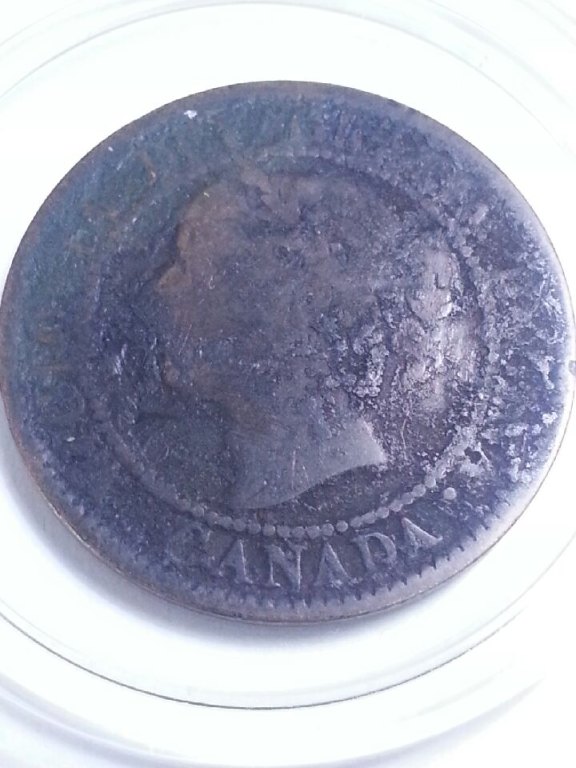
Due to the condition of the OBV of this coin it is impossible to even guess the identification.
cheers Don
Cheers Don
Vickies cents and GB Farthings nut.
"Old" is a figure of speech and nothing more
|
|
Valued Member
Canada
270 Posts |
Seconds looks like a 9 over 8 to me...any thoughts?
|
|
Pillar of the Community
Canada
5646 Posts |
No, not a 9/8. Any worn Vicky cent, and not just the 1859's, will appear to have thicker letters or font just because the design is narrower on the top than it is on the base. As the thinner part wears down, the letters appear fatter, in this case the 9 starts looking like a bold 9 or the bigger-font 9 used on the 9/8's. The hub itself is slightly tapered so that it moves easily up when it strikes the working die blank. Because of that, the indent into the working die is also slightly tapered, with the widest part being what will be the fields, allowing a crisp stike onto the planchet from the working die and not catching. You have to be really careful when ID'ing computer coin photos on well-worn or damaged coins.
|
|
Valued Member
Canada
270 Posts |
I can just almost clearly see an 8 under the 9 in the second set of pics...am I just seeing things? Could it be a 9/9 or inverted 9?
|
| |
Replies: 27 / Views: 5,287 |







 Posted 01/09/2015 03:53 am