| Author |
 Replies: 37 / Views: 7,477 Replies: 37 / Views: 7,477 |
|
|
|
Pillar of the Community
 United States
616 Posts |
UPDATE:
I recently reached out through other numismatic outlets and I was contacted by a fellow collector stating that he had the exact 1971-S Proof nickel with the same raised extra design element with a slight curve, firmly struck in the field of the second U in UNUM, that runs parallel to the left upright exactly like mine!
His exact words were "When you look at your coin you are also looking at mine."
He said that he discovered it about 10 years ago and out of the few people that saw it, most stated that it was just a retained lamenation peel, to which he strongly disagreed. Because he thought that the anomaly was just too perfectly symmetrical and clearly well struck into the field, thus leading him to believe that it was produced by a defective working die that was discovered early in the run, replaced and the majority of the coins it struck were then destroyed. And for nearly a decade he has been looking for a second example from this limited run to prove his theory!
What do you guys think?
Is this theory plausible?
|
|
Pillar of the Community
United States
1249 Posts |
Neat and with his looking exactly the same I would say it wasn't lamination . I look forward to an update if you get it attributed or whatever happens next.....  |
|
Bedrock of the Community
United States
17884 Posts |
Quote:
Because he thought that the anomaly was just too perfectly symmetrical and clearly well struck into the field, thus leading him to believe that it was produced by a defective working die that was discovered early in the run, replaced and the majority of the coins it struck were then destroyed. And for nearly a decade he has been looking for a second example from this limited run to prove his theory!
What do you guys think? Sounds like what I sugggested. |
|
Pillar of the Community
United States
616 Posts |
Your right Conder101, a hubbed through scenario would explain their existence. But when the hubbed through incident occurred, was it isolated to just one defective working die being produced or could it (unknown object) have stuck to the hub and produced multiples? (I have a general understanding of how the master to hub to working die process works, but it does get confusing when you factor in the positive/negative relief factors throughout the entire process. Like a struck through working die would produce a depressed anomaly {- relief}, whereas a struck through hub would produce a raised anomaly {+ relief}. Right? I still have much to learn before I will be able to fluently comprehend the process.)
I'm just baffled as to why there has not been more of these blatantly obvious PROOF error nickels discovered in the last 40+ years!
My only explanation is the fact that they were proof strikes or that QC at the mint must have been much better in the early 70's than in recent years.
Case in point, the hubbed through/damaged dies for the 2004-D Wisconsin High/Low Leaf variety that the mint failed to notice until an estimated 20,000 coins had already left the mint!
IMHO, these two known Proof nickels exhibit the same type of error as the highly popular Wisconsin High/Low Leaf variety quarters, but due to the higher minting standards and supposed hands on inspection of proof coins, very few examples escaped the mint.
Also, I'm not familiar with the types of tools or items the mint uses to polish or repair the dies, but would it be possible for one of these to create a gouge or a dent on a working die, as symmetrical and perfect like the one seen on these two nickels?
|
|
Moderator
 United States
23522 Posts |
A polishing tool could conceivably create the damage, but it's being used by someone giving the die the utmost of care, and damage wouldn't be missed. Likewise, the chances of a strikethrough greatly lessen as you go back through the die/hub process due to QC. Especially Proofs. So the likely scenario is a single die strikethrough. The origin of what struck through, though, will likely remain elusive.
|
|
Bedrock of the Community
United States
17884 Posts |
Quote:
I'm just baffled as to why there has not been more of these blatantly obvious PROOF error nickels discovered in the last 40+ years! Because it probably was a one time anomaly that created a single defective proof die. Then consider that proof die life was probably less than 10,000 coins (today it is closer to 3,500.) Then also consider that the proof coins ARE inspected. The bad die was probably found fairly quickly and pulled along with all the specimens from that die they could find. That would mean that a very few coins actually got out. Say 100 got out, they made 3,220,733 sets. That's 1 coin in every 32,200 sets or .003% of the mintage. Anyway who was looking at the reverses, they were all looking for the missing S nickel. If the S was there they ignored the coin any further. (As a rule most collectors only bother looking for what has already been discovered and reported.) |
|
Moderator
United States
23522 Posts |
Quote:
(As a rule most collectors only bother looking for what has already been discovered and reported.) That's important. The collectors who discover the new varieties are the ones who question everything. There's a narrow line between being inquisitive and being disagreeable (I'm not good at that differentiation  ) but the only way to see what's outside the box is to look outside the box. |
|
Pillar of the Community
United States
616 Posts |
So to whom could I send this discovery coin for attribution? More importantly, would anybody attribute this coin with only two known examples? Of course my opinion is going to be heavily biased, simply because I possess one of the two known coins, but I'm thinking that there has to be some numismatic importance to this coin for all of the reasons you mentioned in great detail in your last post....It is a major error on a proof coin, that has tremendous eye appeal as well as the undeniable "wow factor"! (for lack of a better word).
I guess what I'm asking is,
Would this coin, if sent to the right person for attribution, generate enough buzz in the numismatic world to aid in locating any other examples of this coin that might have escaped the mint?
And do you think, if the coin was attributed and more examples were found and also attributed, would it become more desirable to collectors?
|
|
Pillar of the Community
United States
616 Posts |
This thread died back in February and I never got a response to my last question. Can anyone recommend a error coin/variety specialist that I could send this proof nickel to for possible attribution? I would like to send it in to TPG for grading and encapsulation ASAP. Thanks!! |
|
Pillar of the Community
United States
1781 Posts |
Send to Mike Ellis at CONECAonline.org
|
|
Pillar of the Community
United States
616 Posts |
Thanks Ken, I'll send Mike an email and see if he would be available to identify and attribute it for me!
|
|
Pillar of the Community
United States
616 Posts |
UPDATE! I finally got my proof nickel attributed, however, the results beg more questions than answers! The good news... It's a DDO / DDR, officially attributed as WDDR-004, paired with WDDO-004. The not so great news is... The extraordinary naked eye visible anomaly found inside the second U in UNUM on the reverse of this GEM Proof coin, is STILL unexplained and simply reduced to a "very unusual" die marker for this particular variety. It has to be the most profound die marker known for a variety in any denomination. (In my opinion, more so than the very widely spread RPM die marker on the 1960-D Small over Large date variety LMC - WDDO-001.) Is there any way to solve the mystery behind the origin of of this unique "die marker" that immediately grabs your eyes the moment you begin to examine the reverse of this GEM Proof Nickel? Below are the attribution listings and descriptions for the 1971-S WDDR-004 and WDDO-004. 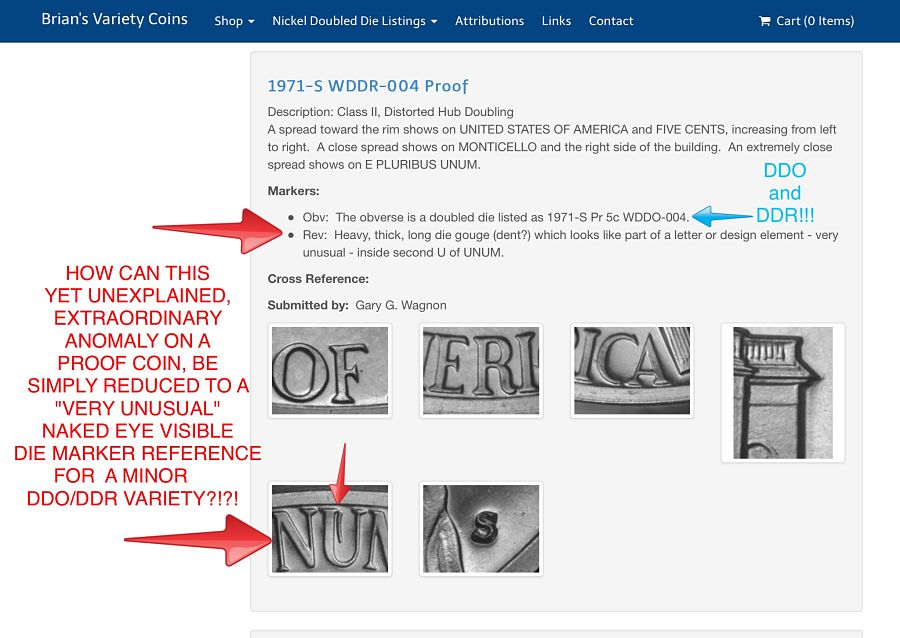 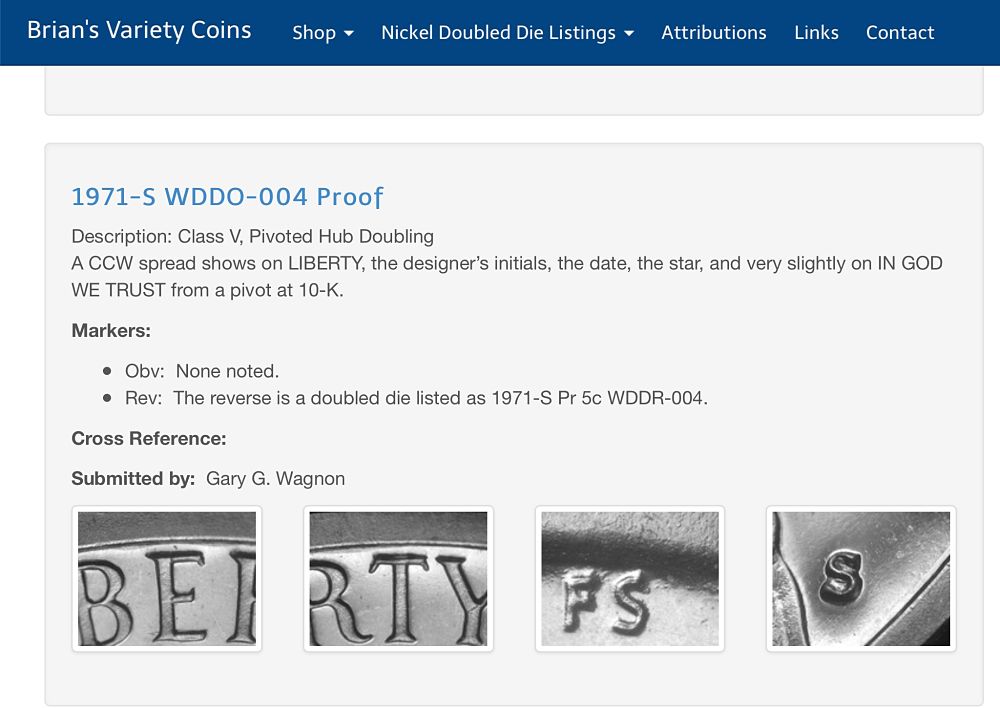 What do you guys think? I would like to get as much input on this enigmatic proof nickel as I possibly can. So any and all input would be greatly appreciated. Thanks in advance. |
|
Valued Member
United States
62 Posts |
Hello was reading through this, and it found it very interesting. Hoping you're still around. Is there any update?
|
|
Pillar of the Community
United States
616 Posts |
Yeah I'm still around, just been busy trying to practice medicine in a totally corrupt healthcare system during a "plandemic" is all.. Anyways, I now know of 12 examples of this proof variety coin but it appears that the experts in the field of error and variety coinage aren't impressed with this naked eye visible anomaly on an already dual variety proof coin.  But I figure one day when the right person finds one, it'll finally get the attention it deserves.  |
|
Bedrock of the Community
United States
10065 Posts |
First I have seen this thread as well.
Its a good read with a disappointing ending.
I will contrast it with something I know well. Former president of PCGS Ron Garth once found a 1972-D half where the designer's initials were polished off of the die. So PCGS started to slab them as No FG and now money is made from a common non-mint-error occurrence. The sad truth is now all the companies slab a lot of them where the FG is actually visible and people have been taken for thousands (literally).
Sadly in cases like the 1972-D Kennedy and your nickel, it seems all about who finds the coin for it to be recognized.
|
| |
Replies: 37 / Views: 7,477 |






 First Page


 Posted 02/17/2015 12:36 am





