| Author |
 Replies: 14 / Views: 2,432 Replies: 14 / Views: 2,432 |
|
|
Pillar of the Community
Hong Kong
1270 Posts |
|
|
|
|
Pillar of the Community
United States
4883 Posts |
Well, certainly not a "fly by night" sort of seller. I'm hardly any sort of authority on these, but the fleur de lis kind of look like little saguaro cacti to me. A bit oversized and not quite right. I also don't like the appearance the dentils present.
Might depend on where the bidding goes as to whether you want to play. If it's a modern forgery, it's worthless, if it's some sort of contemporary counterfeit rather than the real deal, it'd still be cool.
Colligo ergo sum
|
|
Pillar of the Community
 Hong Kong
1270 Posts |
A digression, LC, English is not my mother-tongue, can you tell the meaning of "fly by night"?
I don't want to bid this coin. I have a coin of same year but looks completely different from it. I want more thoughts about this coin.
|
|
Pillar of the Community
United States
1391 Posts |
Fly by night, like an owl. A person who evades responsibility when others aren't looking. A business without an established reputation, like can quickly close down business leaving a buyer with out recourse.
|
|
Pillar of the Community
United States
4883 Posts |
Quote:
A digression, LC, English is not my mother-tongue, can you tell the meaning of "fly by night"? It's actually in Webster's Dictionary, defined as "not reliable or well established, esp. in business, and primarily interested in making a quick profit" or "not lasting; impermanent; transitory." The expression dates as far back as the late 18th century. Edit: allranger touches on the main deraugatory implication of this term, that such a business may well provide substandard products or services, then suddenly disappear with customers and/or creditors "left holding the bag" Colligo ergo sum
Edited by Lucky Cuss
03/28/2015 7:10 pm
|
|
Pillar of the Community
United States
1761 Posts |
Not everyone yet is GNL educated? Would you agree Hong Kong?
No harm here ... nobody knows everything ...
LOL
JPL
|
|
Pillar of the Community
United States
1156 Posts |
My 1787 PTS PR 8 reales shows the same elongated fleurs-de-lis. This one was purchased from Stuart Rubenfeld and is in an NGC holder (for what that's worth). Before I got it slabbed I measured it at 26.67g and specific gravity of 10.34. I have two examples of the 1788, one with the long and one with the short fleurs-de-lis. ~jack 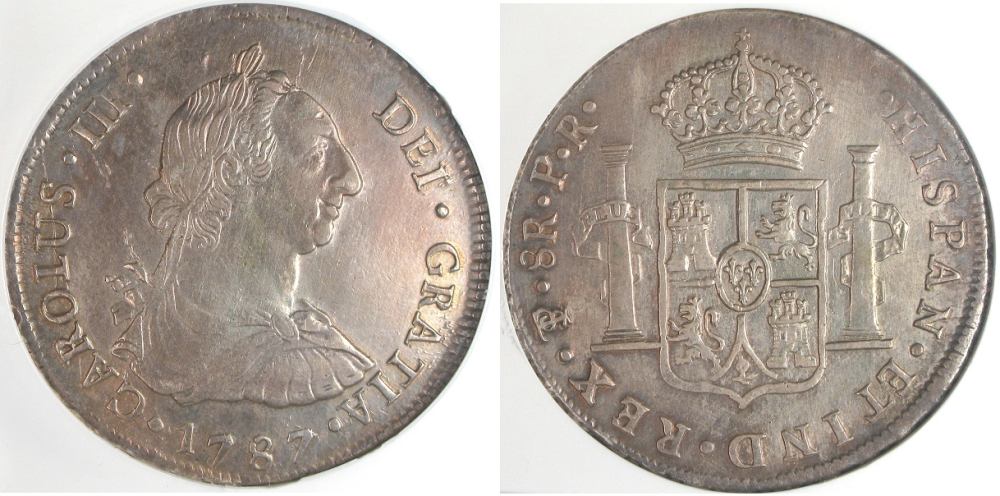 |
|
Pillar of the Community
Hong Kong
1270 Posts |
English learning is my additional gain from this coin forum. LC and Allranger, thank you your explanation. John, what do you imply? I don't understand. Jgenn, your example looks very nice. But I don't know why coins with the same year from the same provenance have so difference design - fleur de lis. Here's my coin: 41.8-42.0 mm (size slightly larger than most of the Spanish colonial 8R), 26.92 grams, S.G. two times measured, 10.22 (84%) and 10.147 (81%) 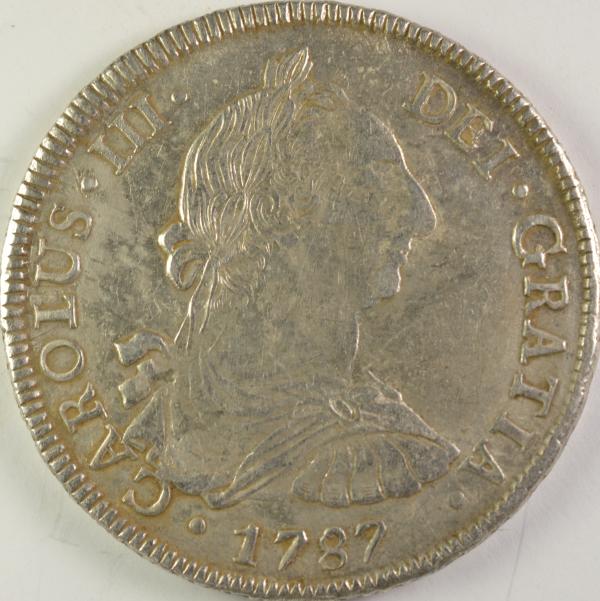 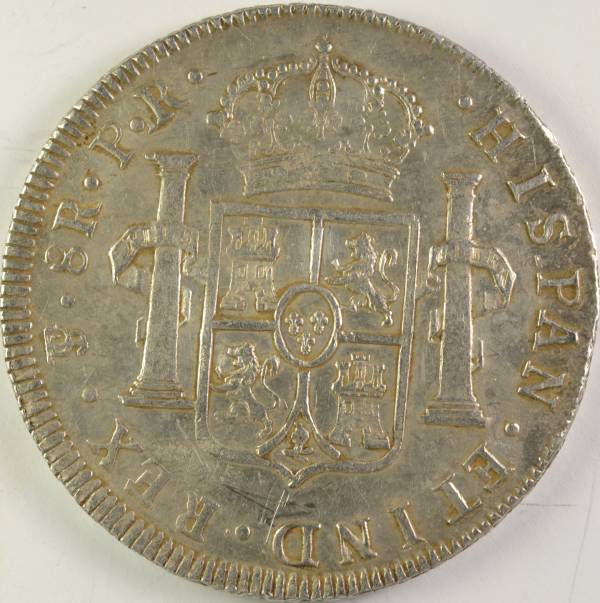 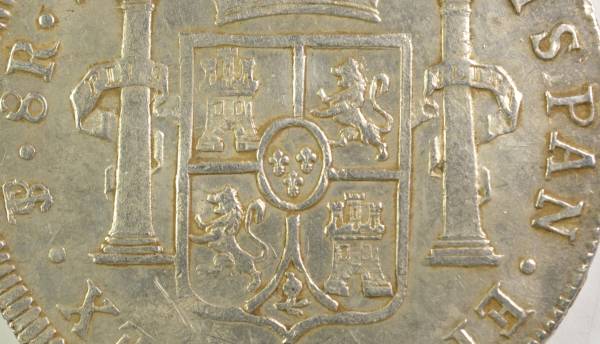   Which version (w.r.t. fleur de lis) is the original? Who can comment on these two coins? |
|
Pillar of the Community
United States
1156 Posts |
My coin has several suspicious attributes, mainly its colorful toning and the way the denticles are smashed all along the rim. I don't think it had two opposite edge overlaps either, but I failed to photograph the edge before I sent it in for "certification". It's in an XF details slab so I would be willing to crack it out if it would help determine another Type II diagnostic feature.
~jack
Edited by jgenn
03/29/2015 02:17 am
|
|
Pillar of the Community
United States
1156 Posts |
Here's my 1788 with the longer fleurs-de-lis. It's in an XF40 NGC slab attributed to the Eric P. Newman collection. 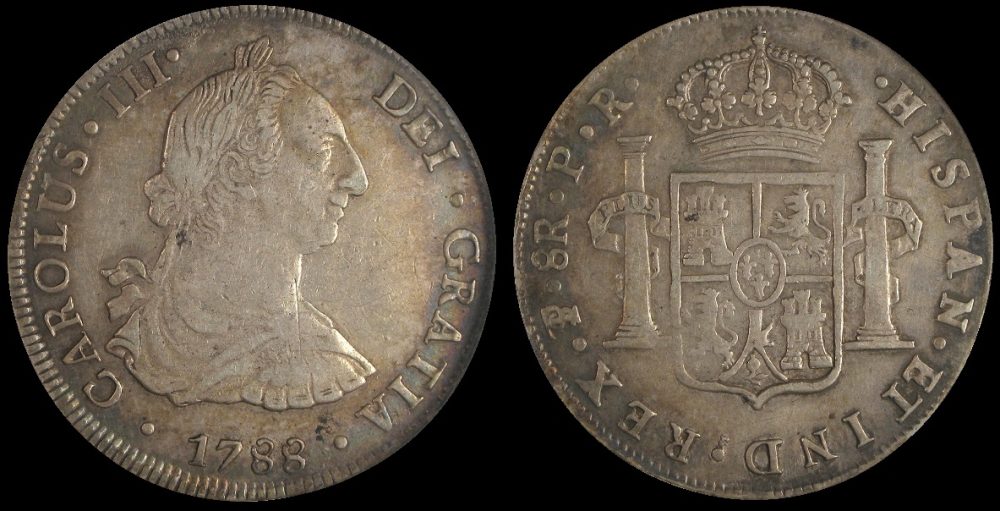 |
|
Pillar of the Community
Hong Kong
1270 Posts |
The 1788 specimen looks worse than the 1787. The letters are not as clear cut as it should be. The denticles on the reverse side looks odd to me. But I still think it is of sufficient silver. Are both 1787 and 1788 class 2 CC? Would swamperbob like to give your comments? 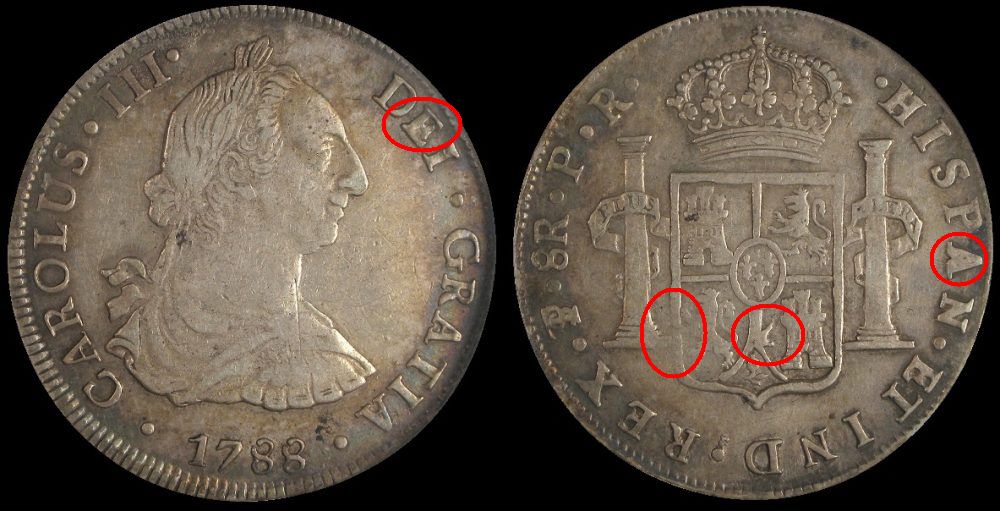 |
|
Pillar of the Community
United States
1156 Posts |
 It's likely that all of the coins pictured here are Class II restrikes. |
|
Pillar of the Community
United States
5362 Posts |
Bolivia as one of the larger producers of silver coins was an obvious target for forgers. That said I have never been able to identify a "standard" matrix for Potosi die tools agianst which I feel comfortable in identifying counterfeits. There seem to be several overlapping styles including the "Broken Castle" that I discuss in the book and which I have covered on the forum. Until I can assemble a fully tested set and determine which set or sets is standard I can not be sure. I am still buying up odd looking damaged Potosi coins for testing. Here is an example I just bought. 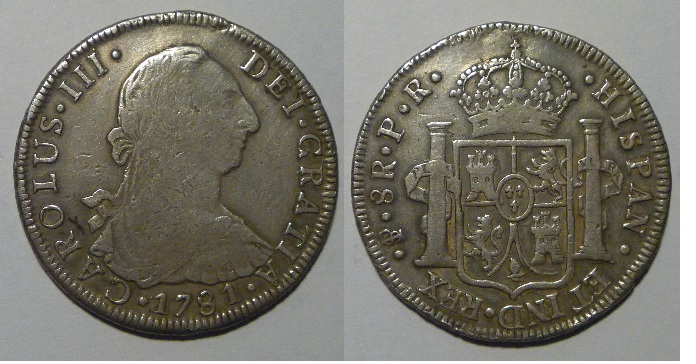 The anomalies are almost too numerous to mention. Note the odd fleur-de-lis. So how many lillies were there? |
|
Pillar of the Community
Hong Kong
1270 Posts |
Quote:
The anomalies are almost too numerous to mention. Note the odd fleur-de-lis. Also I see the key hole windows from your coin. I remember Bolivian 8 Reales are not the target for imitation to produce for the China market, isn't it? |
|
Pillar of the Community
United States
5362 Posts |
Yes, the Bolivian issues were particularly unpopular in China so Class 2 Silver counterfeits would have no ready market where the makers could produce a profit. The reason any coin is forged is profit. So you need to look for both a market and a margin.
It is much more likely that the target for a large scale counterfeit production operation would have been the US or other locations where these would pass as dollars at face value. A forger could make a profit making a coin from 70-80% silver if he had a ready market to dispose of them at face value. A 70% coin will pass for silver without suspicion until it is checked using Specific Gravity. The 70% figure is actually seen in some of the very successful counterfeit types among the Cap and Ray coins. The market for those coins was the US and huge numbers still exist pointing to a massive production.
The Bolivian issues short in total silver could have been dumped in the same market.
That is what I suspect happened with regard to all of these very odd Bolivian coins. The US and Canada were starved for silver coinage in the early post colonial era and England is known to have dumped many counterfeits into Canada. Both markets would have readily accepted a slightly low value coin if it meant keeping business going.
That is my current theory and I am still gathering data. I now have several dozen examples that can be tested and I plan to do so when time and resources permit.
My book focused on the Mexican issues made for China and elsewhere because those were the most obvious and of course most numerous. Bolivia is my next target.
|
| |
Replies: 14 / Views: 2,432 |
|










 Posted 03/28/2015 11:15 am


