Coin Community Family of Web Sites Join Thousands of Coin, Bullion, & Money Collectors
Join Thousands of Coin, Bullion, & Money Collectors Shop for APMEX Bullion on eBay!300,000 items to help build your collection! Specializing in Modern Numismatics Royal Canadian Mint products, Canadian, Polish, American, and world coins and banknotes. Coin, Banknote and Medal Collectors's Online Mall Vancouvers #1 Coin and Paper Money Dealer


Username:
Password:
Save Password
Forgot your Password?


This page may contain links that result in small commissions to keep this free site up and running.

Welcome Guest! Registering and/or logging in will remove the anchor (bottom) ads. It's Free!

Coin Edges

To participate in the forum you must log in or register.
Author Previous TopicReplies: 10 / Views: 21,495Next Topic  
Valued Member

Australia
432 Posts
 Posted 11/20/2007  10:22 am Show Profile   Bookmark this topic Add Zaggy to your friends list Get a Link to this Message Number of Subscribers
OK, this may seem a simple question to some, BUT is there some manner of specific terms used to describe the different edge finishes on a coin?

Some coins feature V shaped 'cuts' around the edge at a constant separation, others will have groupings of these V cuts. Other coins may have 'raised blocks' or other types of finishes. So, are there terms for these? Links or Anything? :)


Thanks
Pillar of the Community
Peter THOMAS's Avatar
Australia
2830 Posts
 Posted 11/22/2007  03:55 am  Show Profile   Bookmark this reply Add Peter THOMAS to your friends list Get a Link to this Reply
G'day, if I understand correctly, the the "continuous marks", as on Oz 5, 10, & 20-cent coins ? That is a "reeded edge".

Where the reeding in non-continuous, as on the Oz $1 coin, it is described is "interrupted reeding".

It is generally thought that reeding was introduced to discourage "clipping" of gold and silver coins.

Often, in older times, instead if reeding, a text would be inscribed on the edge of the coin. For example, early British Crowns (5 shillings) 1818~; and French gold coins of the Napoleonic era. Spanish pieces-of-eight had a funny geometric pattern.

Some people called a reeded edge a "milled edge", but that is a misunderstanding.

See the CCF Glossary for more detail.

Peter in Darwin

Valued Member
Australia
432 Posts
 Posted 11/22/2007  06:00 am  Show Profile   Bookmark this reply Add Zaggy to your friends list Get a Link to this Reply
Thats it, reeded edge! Perfect!
Moderator
Learn More...
Sap's Avatar
Australia
16808 Posts
 Posted 11/22/2007  06:05 am  Show Profile   Bookmark this reply Add Sap to your friends list Get a Link to this Reply
Coinage issuers have long realised that placing an intricate, difficult-to-replicate pattern around the rim of a coin helps prevent the two scourges of trustworthy coinage: clipping and counterfeiting. I shall attempt to summarize the various edges you might find on coins.

A plain edge has no marking of any kind on the edge, applied with a simple, flat collar die. In modern times, almost without exception, only base-metal coins had this kind of edge. Australian bronze coins and American cents and 5 cents have plain edges.

A grooved edge is plain, but has a deep score or groove halfway across, all the way around the rim. The initial reaction of someone seeing such a coin for the first time is "it looks like two coins glued together". The 2 eurocent is an excellent example of this feature.

A reeded edge has fine serrations like a file, all the way around the rim. Normally the reeding is vertical, but some early experiments had slanted reeding. Most modern silver and gold coins world-wide, and most of their cupronickel successors, have this kind of edge, also popularly known as a milled edge or filed edge.

A security edge is a combination of grooved and reeded edge; often the furrow of the groove is decorated with a pattern (dots, lettering or some such) to make it even harder to duplicate. Hong Kong and India are traditional users of this kind of edge, though the high cost of applying it and the removal of precious metal from circulating coins have largely rendered this kind of edge obsolete.

An inscribed edge has text around the rim. On older coins (like Maria Theresa thalers, US gold coins and British crowns), this text was placed on the collar die. Modern versions (like the USA Presidential dollars) tend to use a second stage in the minting process to add the edge inscriptions.

A decorated edge is similar to the inscribed edge, but patterns and symbols instead of letters are used. This term could be applied to the circles-and-rectangles pattern applied to Spanish "portrait" dollars, and to the recurring stars seen on many of the 2 euro coins.

An interrupted reeded edge has alternating sections of reeded and plain edge. The 1 euro and Australian $1 circulating coins are classic examples of interrupted reeding. The Australian $2 also can be considered to have interrupted milling, though the spacing is different.

An indented edge is a plain or milled edge with several indents or notches regularly spaced around it. This type of edge has recently come into fashion; the 20 eurocent and new New Zealand 20¢ coin have this kind of edge, also known as "Spanish flower".

A herringbone edge is a specific kind of decorated edge, and resembles an early attempt at reeding; the pattern on the rim forms a series resembling interconnected arrows, or a "fish-bone" pattern. The Spanish "pillar dollar" of the early 1700's is a classic example of this kind of edge.

A serrated edge is the term usually applied to ancient Greek and Roman coins with v-shaped notches painstakingly carved into the coin at regular intervals. Apparently a very crude attempt at applying something resembling a reeded or security edge.

Polygons like the Australian dodecagonal 50¢ coins and British 20p and 50p coins, and scalloped coins like the Hong Kong $2 coin are normally considered to be different shapes, rather than having a "12-sided edge" or "scalloped edge". Such coins normally have plain edges; reeding or other patterns aren't easily applied to odd-shaped planchets.
Don't say "infinitely" when you mean "very"; otherwise, you'll have no word left when you want to talk about something really infinite. - C. S. Lewis

Pillar of the Community
Metalman's Avatar
United States
7123 Posts
 Posted 02/23/2008  8:43 pm  Show Profile   Bookmark this reply Add Metalman to your friends list Get a Link to this Reply
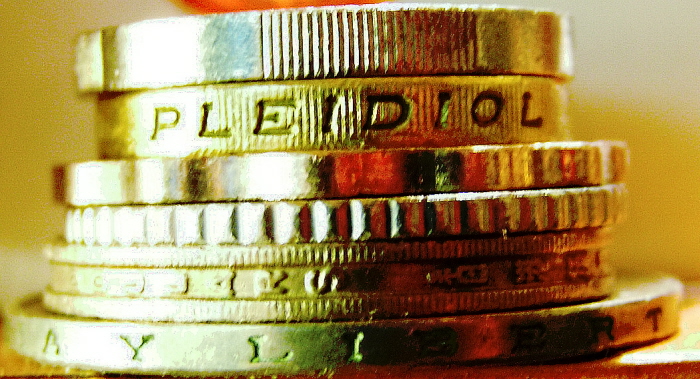
Not one of my best pictures but I had a thread that I started sometime ago concerning coin edges ,, here are a few of what Sap described .

Coin-Edges

Metalman
New Member
fixxation's Avatar
Ireland
2 Posts
 Posted 06/22/2013  06:18 am  Show Profile   Bookmark this reply Add fixxation to your friends list Get a Link to this Reply
Sap, Peter- thanks very much for this info. I know this thread is six years old at this point but still this is great info all the same.

I'm actually working on a website for showing all bullion coins of the world, and the user will need to select the type of coin edge when adding a coin to the database. Would you say that's a pretty concrete list of all the possible types of coin edging out there, can you think of any others?

Is there any chance of posting links to images of each the different edge types described above? Many thanks for your help!

Anthony
Moderator
Learn More...
Sap's Avatar
Australia
16808 Posts
 Posted 06/22/2013  07:11 am  Show Profile   Bookmark this reply Add Sap to your friends list Get a Link to this Reply
It's fairly comprehensive, though people are always inventing new edges for coinage. The 50 eurocent coin, for example; I'm still not quite sure how to classify it. It's either very coarse reeding, or very fine scalloping. Or a 21st century re-invention of the ancient "serrated edge". Another "strange edge" is on the 60 cent coin the Perth Mint put out for the "Road to London"; the coin is shaped like a postage stamp, and the edge is, well, shaped like postage stamp perforations. Again, I'm not quite sure what to call it.

In the pic metalman posted, many of these types are indeed illustrated; the 50 eurocent is the fourth coin down. From the top, these six coins are:

- I'm not sure what coin it is, but it's an interrupted reeded edge.
- British pound, one of the Welsh types, with a machine-cut (post-strike) inscription on a milled edge.
- Again I'm not sure, but it's scallop-shaped with a plain edge. As I said way back then, I don't classify "shapes" as different edges.
- A 50 eurocent, with it's weird milling-scalloping-serration.
- This one's easy - it's a Hong Kong $5, with a security edge with inscribed groove.
- A Mexican base-silver peso from the 1960s with a "classic" (die-struck) inscribed edge. The full inscription would read "INDEPENDENCIA Y LIBERTAD".
Don't say "infinitely" when you mean "very"; otherwise, you'll have no word left when you want to talk about something really infinite. - C. S. Lewis

New Member
fixxation's Avatar
Ireland
2 Posts
 Posted 06/22/2013  11:16 am  Show Profile   Bookmark this reply Add fixxation to your friends list Get a Link to this Reply
Wow, it certainly is comprehensive- had no idea there were this many ways to describe a coin edge. Thanks again for the info, this is definitely starting me in the right direction here.
Pillar of the Community
stud722's Avatar
United States
1088 Posts
 Posted 06/22/2013  11:17 am  Show Profile   Bookmark this reply Add stud722 to your friends list Get a Link to this Reply
Sap that is some good info. Thank you for sharing.
Pillar of the Community
SaintRidley's Avatar
United States
592 Posts
 Posted 06/22/2013  12:52 pm  Show Profile   Bookmark this reply Add SaintRidley to your friends list Get a Link to this Reply
I'd say the 50 Eurocent is milled/reeded scalloping, since it's basically a milled/reeded edge where the milling/reeding is all scalloped (compare the 20 Eurocent - it's as if they didn't put spaces between the scallops, really).


If that's not the term for it, well, I hereby declare it so.
Valued Member
Pheroow's Avatar
United Arab Emirates
283 Posts
 Posted 06/22/2013  1:10 pm  Show Profile   Bookmark this reply Add Pheroow to your friends list Get a Link to this Reply
Thanks for sharing!
I had this in mind but forgot it :D
  Previous TopicReplies: 10 / Views: 21,495Next Topic  

To participate in the forum you must log in or register.


Disclaimer: While a tremendous amount of effort goes into ensuring the accuracy of the information contained in this site, Coin Community assumes no liability for errors. Copyright 2005 - 2026 Coin Community Family- all rights reserved worldwide. Use of any images or content on this website without prior written permission of Coin Community or the original lender is strictly prohibited.
Contact Us  |  Advertise Here  |  Privacy Policy / Terms of Use

Coin Community Forum © 2005 - 2026 Coin Community Forums
It took 0.33 seconds to rattle this change. Forums