| Author |
 Replies: 22 / Views: 4,244 Replies: 22 / Views: 4,244 |
|
New Member
United States
36 Posts |
I am very new to ancients...but why do I see alot of Alexander the Great pieces? Are his coins very plentiful?
In my mind, it just seems like they would not be as available since they are older, and he is a big historical figure...
Thanks for any insight.
|
|
|
|
Pillar of the Community
United Kingdom
3626 Posts |
There are loads of his coins available, the life time issues are more expensive. There are also a lot of fakes around especially on ebay. If you want a particular coin and you are not sure, post a picture here. |
|
Pillar of the Community
United States
513 Posts |
Remember, a person's coin availability is going to end up being a function of how many they minted and how many of those were hoarded, either due to historical happenstance or sometimes if there was a change in the quality of silver used to make coins right after someone ruled.
Someone like Alexander the Great took over a huge area of land, so they really were making his coins all over the coin producing world for a while, and they continued to produce coins with his image after he died.
Also, I don't have any evidence for this, but it seems to me that him being such a historical figure may have saved some of his coins over the years. Maybe some were reluctant to melt down Alex as much as other silver coins? I don't really know about that one, but it's fun to think about. I know Augustus (another guy who there are a lot of coins around of, mainly because he ruled for so long) would give people old coins as gifts. What I'd do to get one with a provenance all the way back to then...
|
|
Bedrock of the Community
United States
11951 Posts |
That is interesting ....yes there does seem to be a lot of them.
I don't have many ancient coins in my collection ...less than 50.
But I have two Alexander the Great coins, and they are my favorites.
|
|
Pillar of the Community
United States
5155 Posts |
Here is my  LIFETIME LIFETIME Alexander III tetradrachm. 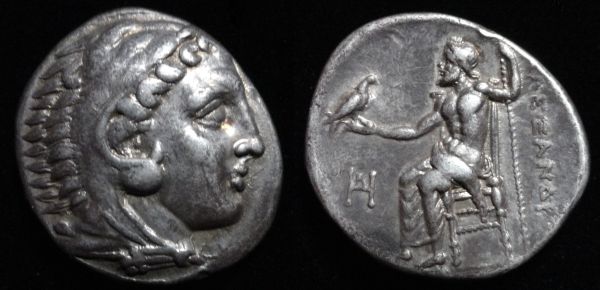 |
|
Moderator
 United States
23731 Posts |
Here is a posthumous issue struck between 315-294 BC (between 8 to 29 years after his death). 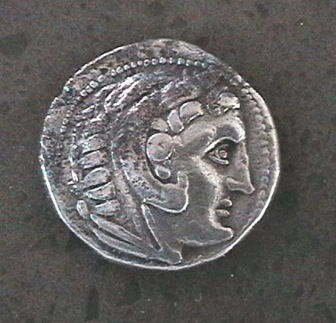 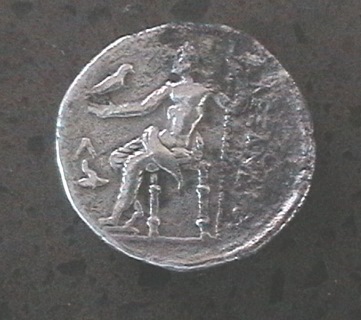 |
|
Valued Member
Canada
266 Posts |
Well, Alexander did obtain quite a bit of silver... ""Based upon the writings of such ancient authors as Arrian, Curtius, Diodorus, and Plutarch, the total booty captured between 333 and 330 BC has been variously estimated to be worth 180,000 to 400,000 talents or the equivalent of 270 million to 600 million tetradrachms"" and here is my tetradrachm in the name of Alexander from Babylon under Seleucus I  Edited by arnoldoe
04/09/2015 5:10 pm
|
|
Pillar of the Community
United States
3495 Posts |
The primary method of introducing 'coin' into circulation in ancient times was by making the payroll. Alexander needed a rather vast army of persons to administer an empire that stretched from the Indian Ocean to the Mediterranean Sea. Add to that the troops that were kept active continuously by his exploits and you have a very good reason for abundance of the lifetime issues.
The great secret to getting the troops to keep fighting on is to shower them with money. The Persian conquest probably gave Alex more silver treasures to melt down than he could ever use. It was important for him to have his beautiful face on the coins. Just to remind the boys who was buttering their bread for them.
|
|
Pillar of the Community
United States
5010 Posts |
i still don't have a coin from alex. I thought I did yesterday, but the coin I purchased was misattributed by the seller. not a big deal, I didn't buy it for the type, not because it was minted by alexander...but still kind of a bummer.
|
|
Moderator
Australia
16991 Posts |
The empire of Alexander the Great was the first large coin-using empire. They struck a uniformly designed coinage in numerous mints for quite a long time period (especially if you include all the posthumous types). As a result, the coinage as a whole is fairly common, even if specific varieties within the series are scarce.
A major factor in the question of the relative rarity of ancient coin types is understanding how those ancient coins have survived and how this is affected by the subsequent history of the empire that issued it. Most coins come from hoards; such coin hoards remained hidden until modern times because somebody buried them thousands of years ago and never came back for them. For example: early Roman coins are scarcer today than late Roman coins not simply because the earlier empire "was older", but because the early Empire was peaceful and prosperous for the people living in it; if you buried a stash of coins, chances were good that you'd live long enough to go back and retrieve it again. Someone living in the later Empire was much more likely to die in war, or have his property seized for political reasons, or have the territory in which his property was located invaded and annexed by barbarians - all of which were good reasons why a coin hoard would become forgotten and remain forgotten.
After Alexander's death, the Greek empire began to shrink and was soon divided into numerous smaller kingdoms constantly at war with each other. As with the Late aRoman period, it was a time of high probalility of people "losing" a coin hoard.
Don't say "infinitely" when you mean "very"; otherwise, you'll have no word left when you want to talk about something really infinite. - C. S. Lewis
|
|
New Member
 United States
36 Posts |
Thanks for all the great info everyone...love learning about this great hobby!
|
|
Pillar of the Community
Australia
1006 Posts |
The Macedonians conquered a massive amount of land with the majority of the mines in the area comming under royal control as had been the custom. Also do not forget that the Macedonians already had extensively rich royal mines around Amphipolis which was the primary international mint of the empire leaving very little logistical issues which would be encountered when transporting metals long distances. Also the mines around Damastion and Astibos in Northern Macedonian (called Paeonia) were exceptionally rich in terms of silver and lead with a lot of the silver transferred to Pella, Aegae and Amphipolis however some of it was coined in Damastion and Astibos (some in the South Macedonian style while others in the North Macedonian style.) The plundering of the Babylonian Treasury added significantly to their silver reserves although it was primarily gold in nature.
There was a massive mintage as the Macedonian Empire was international. It wasn't just Macedonia but now Macedonia, Greece, Thrace, Asia Minor, the Middle East, Bactria, Egypt and small parts of western India. There was now a need for an international currency and the Macedonian's produced it with the largest reserves of metals, the most mints and the most die engravers available at their disposal to facilitate the transfers of goods around the Empire.
Ancients are a great way to learn new things in terms of history, geography etc.
Edited by oh my florin
04/10/2015 03:03 am
|
|
Pillar of the Community
United States
949 Posts |
@arnoldoe
If it isn't considered too far afield for this thread, I have to ask about that image of the reverse on your coin. How were you able to keep edge to edge sharp focus in that shot considering the steep angle of the coin? F32 and tons of light? Tilt on the lens? Or did you rotate the image and squeeze it to simulate the effect?
Either way I really would like to know. It's a great shot.
|
|
Valued Member
Canada
266 Posts |
I put the coin on top of my couch with a window behind it + took the picture with an Iphone  Edited by arnoldoe
04/10/2015 1:21 pm
|
|
Pillar of the Community
United States
513 Posts |
lrbguy, you can also use a technique called "focus stacking" to get that effect. You need specialized software (there's a lot of it out there and most has free trials) and then you take anywhere from a few to a couple dozen pictures at different levels of focus and it stitches them together.
|
|
New Member
United Kingdom
25 Posts |
About 12 years ago I was bequeathed a few coins and amongst them this Greek Coin of Alexander with a date of 336 - 323BC. My problem is that my coin enthusiast friend would only rate it as 'probably' genuine. So, my question is, do you think that this coin is genuine? It would be nice to think it is! Can you advise me? 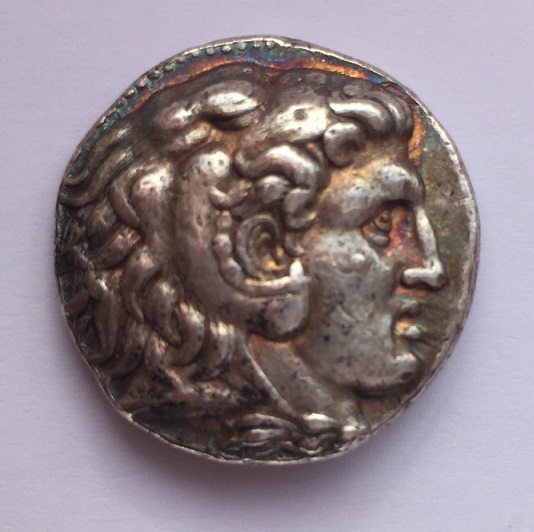 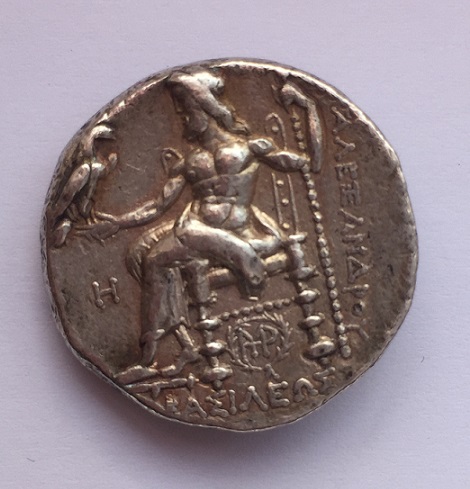 |
| |
Replies: 22 / Views: 4,244 |










 Posted 04/09/2015 12:29 pm


