1. More or less, yes, it is correct, except for the unfortunate answer to question 4 below.
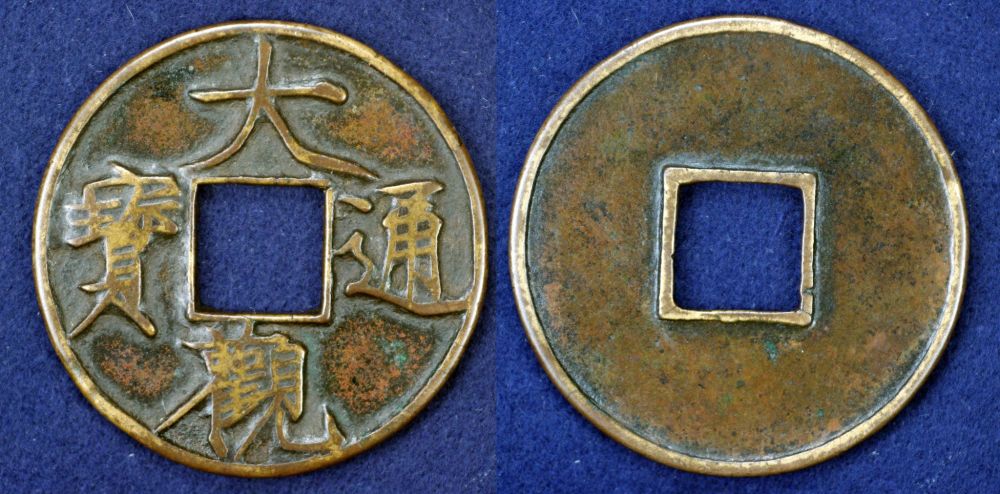
2. "1107" is the approximate date. "Sog Dyn" is short for "Song Dynasty", the era in which the coin was issued. The "Daguan era" is sometimes written "Da Guan", as these are the two characters used on the coin (at the two and six o'clock positions); this period actually extended from AD 1107-1110 and was the third period during the reign of the emperor Huizong.
3. Wikipedia gives you some history of the emperor himself
here. Huizong was one of the most artistically inclined of the emperors of China; aside from being a skilled poet, painter and musician, he was a master calligrapher and is said to have personally created the master coins from which his circulation coinage were copied and cast. The script on this coin is written in the "Slender gold" calligraphy style invented by the emperor himself.
You haven't told us how large your coin is. These coins come in several different denominations, distinguished only by size. The 1 cash is about 25mm across, 2 cash 30mm, 3 cash 33mm, 5 cash 35mm and 10 cash 42mm. The larger ones are rarer and worth more, as they were only issued for a few years; apparently, they were withdrawn because they were heavily counterfeited.
4. Here we come to the bad news - I'm fairly certain your coin is not genuine, and not a mediaeval counterfeit, either. It does not have what I would consider a genuine "patina", but looks rather more like the artificially aged pseudo-antiques that have been all too easily obtainable in China for decades now. To see examples of what genuine Da Guan coins look like and compare them with other fakes, check out the
zeno.ru pages for this type.
Don't say "infinitely" when you mean "very"; otherwise, you'll have no word left when you want to talk about something really infinite. - C. S. Lewis












 Posted 04/13/2015 09:42 am


