| Author |
 Replies: 22 / Views: 4,070 Replies: 22 / Views: 4,070 |
|
Valued Member
United States
123 Posts |
I had fun putting together this set of dimes from all the mints of the U.S. and Canada that made dimes. Of course Charlotte and Dahlonega aren't included because they didn't make 10-cent pieces. Manila by the same logic (their coins denominated in centavos). I also made the decision not to include European mints like Heaton (Birmingham) that made coins for Canada and Newfoundland. When I'm wealtheir I may include dime-sized coins from Charlotte and Dahlonega! 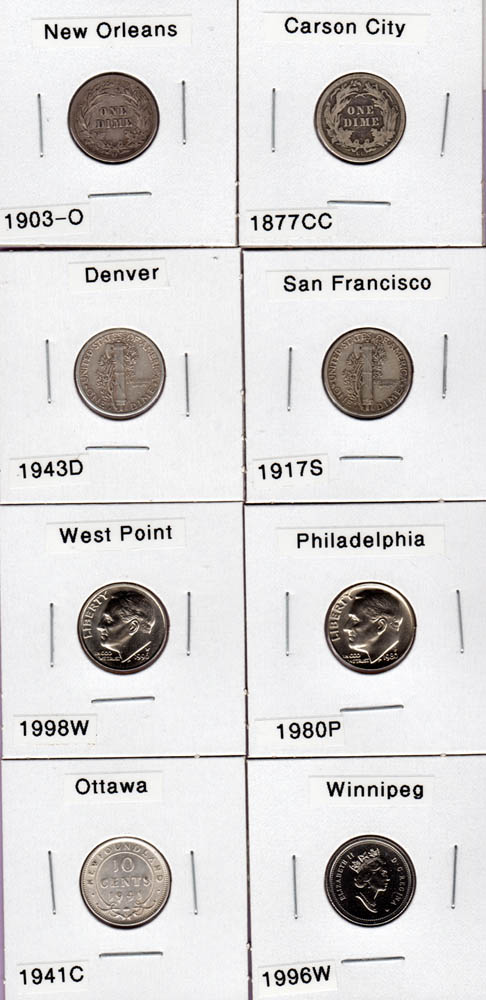 Edited by Stephen Z
11/24/2015 12:54 pm
|
|
|
|
Valued Member
 United States
123 Posts |
P.S. I put the side with the mintmark up, so some coins are showing the obverse and some the reverse.
|
|
Valued Member
United States
123 Posts |
Drat, I got the date labels switched for the 2 W mints in the first photo. I'm now posting the corrected photo. Six coins from the U.S., one from Canada, and one from Newfoundland. 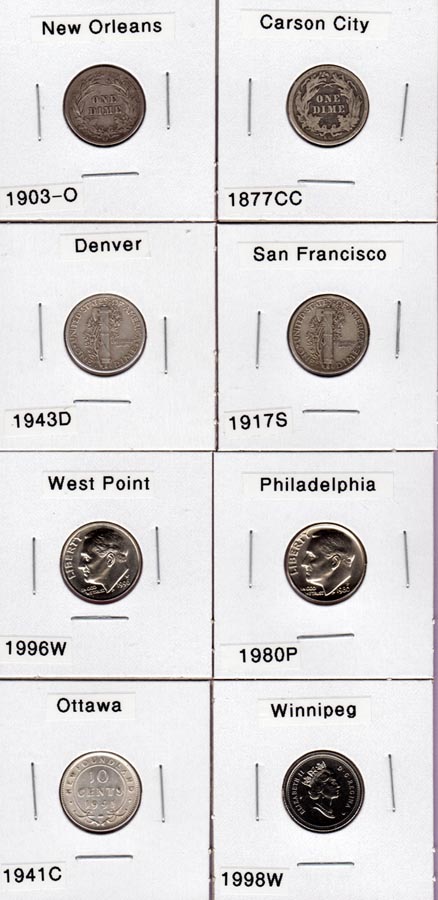 Edited by Stephen Z
11/24/2015 1:13 pm
|
|
Pillar of the Community
Canada
1747 Posts |
|
|
Moderator
 United States
195203 Posts |
Very nice theme set!  |
|
Pillar of the Community
United States
898 Posts |
I would include a centavos 10 coin. They're fun and have a great design. I like having mine.
|
|
Rest in Peace
United States
7075 Posts |
That's a great set! Thanks for posting the pics!
|
|
Pillar of the Community
 United States
5828 Posts |
Cool set |
|
Valued Member
United States
309 Posts |
Consider starting this dime collection with the coin Thomas Jefferson used as the basis of a tenth of a Frderal dollar, the half Pistareen of Spain. Five Pistareens to the Spanish Milled Dollar makes the half Pistareen worth ten Federal "cents" a coin TJ said was "perfectly familiar to us all. They circulated in colonial America before 1796 when the first Philadelphia mint Disme / dime came about. Extending the mint set back to Colonial America you ought to get half "cross Pistareens" from Seville, and Madrid which covers the waterfront after 1730.
|
|
Pillar of the Community
United States
4963 Posts |
I think you're talking about reales, which were valued at $0.125 USD. I don't believe Spain or its colonies ever produced a coin valued at $0.10 USD. The real was, however, the coin that inspired the American dime. Also, by the time the dime was introduced in 1796 it was known as a dime- the word 'disme' was/is only applied to the 1792 pattern.
|
|
Pillar of the Community
Canada
3049 Posts |
........you see when a mommy dime and a daddy dime really love each other ..............they mint something really special...
|
|
Pillar of the Community
United States
4963 Posts |
 You just made my day. Edited by Numisma
11/24/2015 11:58 pm
|
|
Pillar of the Community
United States
4337 Posts |
|
|
Moderator
United States
195203 Posts |
Quote:
Consider starting this dime collection with the coin Thomas Jefferson used as the basis of a tenth of a Frderal dollar, the half Pistareen of Spain. Five Pistareens to the Spanish Milled Dollar makes the half Pistareen worth ten Federal "cents" a coin TJ said was "perfectly familiar to us all. They circulated in colonial America before 1796 when the first Philadelphia mint Disme / dime came about. Extending the mint set back to Colonial America you ought to get half "cross Pistareens" from Seville, and Madrid which covers the waterfront after 1730. Quote:
I think you're talking about reales, which were valued at $0.125 USD. I don't believe Spain or its colonies ever produced a coin valued at $0.10 USD. The real was, however, the coin that inspired the American dime. Also, by the time the dime was introduced in 1796 it was known as a dime- the word 'disme' was/is only applied to the 1792 pattern. I believe Pistareen is correct, there are five pistareen to a dollar, so a half-pistareen would be equivalent to a dime. I do not think they were intended to circulate in the Americas, but did anyway. |
|
Pillar of the Community
United States
4963 Posts |
I just did a bit of research on this. Quote:
Pistareen (plural pistareens)
1.A Spanish silver coin worth two reals, used as common currency in the Americas in the 18th century. 2 reals = 4 to the dollar (official value) However, you are right in the fact that because of the debased silver content, they were only accepted for 5 to the dollar. Edited by Numisma
11/25/2015 2:40 pm
|
|
Pillar of the Community
United States
3229 Posts |
|
| |
Replies: 22 / Views: 4,070 |










 Posted 11/24/2015 12:57 pm


