Heritage Auctions - One of the highlights of our upcoming
2016 January 3 - 4 NYINC World Coins & Ancient Coins Signature Auction is a monumental example of the
Canadian 1870 No LCW 50 cent piece, one of the most coveted issues in all of Canadian numismatics. We wrote in the Belzberg catalog which had a piece certified Specimen 64, but
no mint State example, "Extremely rare in all grades, and a classic rarity in the Canadian 50 Cent series. Neither the Pittman nor Norweb collections had a Mint State example of this rare type...). PCGS has certified only three examples in Mint State — a 62, 63, and this 64+."
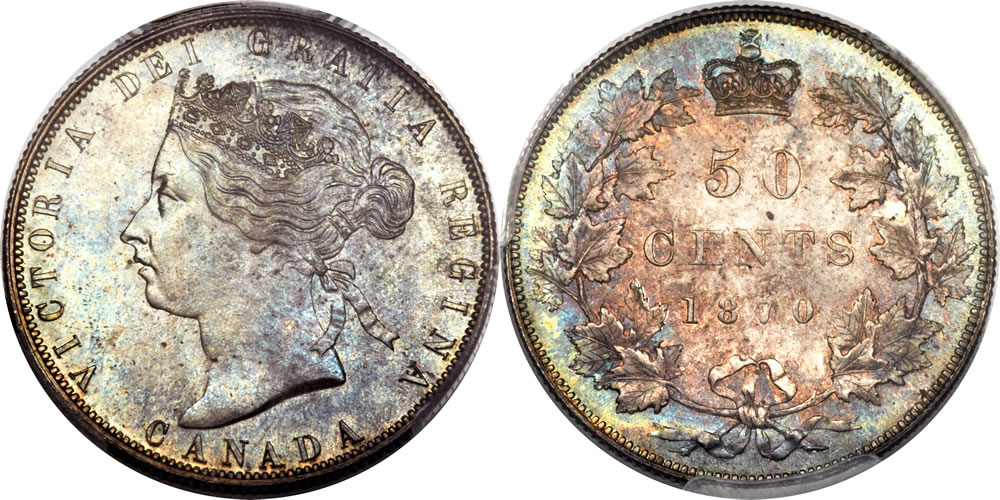
The Belzberg Specimen brought a strong $103,500 in January 2003 against a top estimate of $100,000. This incredible near-Gem coin is equally remarkable for its lovely original patina, with pastel lilac accented by dots of azure on the obverse. The reverse has more intense color, with a similar palette to the obverse around the periphery but vivid amber-gold predominating inside the wreath. The strike is quite sharp overall, although minor softness shows on the high points of the obverse hair. Neither that nor the few scattered contact marks detract from what must be far and away the most attractive and desirable business strike known—or imaginable—for this rare issue.
The 1870 Victoria 50 Cents were the first half dollars struck for Canada, only three years after the Confederation Act united four provinces into the Dominion of Canada. The various series issues were struck at
The Royal Mint in London or the Heaton Mint in Birmingham, the latter bearing the familiar H mintmark. As the Province of Canada issued no half dollars, new dies were needed when the denomination was introduced. The dies were, unsurprisingly, designed by Leonard Charles Wyon, who was born in 1826 in one of the houses of
The Royal Mint. The first-year 1870 half dollars were produced in two different obverse variants, with and without the designer's initials LCW on the truncation of the Queen's neck. The No LCW coins also lack a small shamrock behind the first jewel at the front of the crown, and other minor differences appear on that side as well.
This coin is now among the highlights of our NYINC auction, but it will continue to be a future cornerstone of even the most advanced Canadian collection for some forthright bidder. This is an opportunity that will almost certainly not be seen again soon.







 Posted 12/05/2015 2:08 pm





