Coin Community Family of Web Sites Join Thousands of Coin, Bullion, & Money Collectors
Shop for APMEX Bullion on eBay!Specializing in Modern Numismatics Coin, Banknote and Medal Collectors's Online Mall Vancouvers #1 Coin and Paper Money Dealer Join Thousands of Coin, Bullion, & Money Collectors Royal Canadian Mint products, Canadian, Polish, American, and world coins and banknotes. 300,000 items to help build your collection!


Username:
Password:
Save Password
Forgot your Password?


This page may contain links that result in small commissions to keep this free site up and running.

Welcome Guest! Registering and/or logging in will remove the anchor (bottom) ads. It's Free!

Double-Struck Mexico Coin?

To participate in the forum you must log in or register.
Author Previous TopicReplies: 12 / Views: 1,982Next Topic  
Valued Member
Stephen Z's Avatar
United States
123 Posts
 Posted 02/12/2016  05:57 am Show Profile   Bookmark this topic Add Stephen Z to your friends list Get a Link to this Message Number of Subscribers
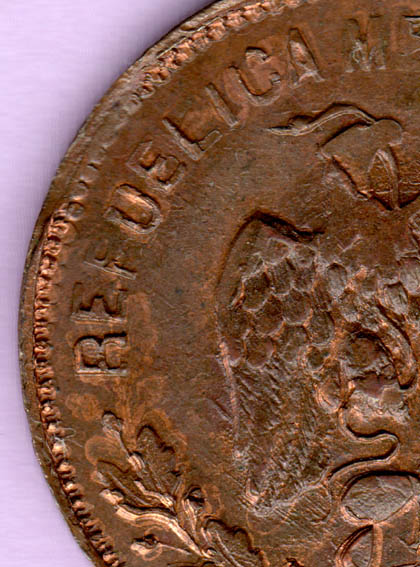
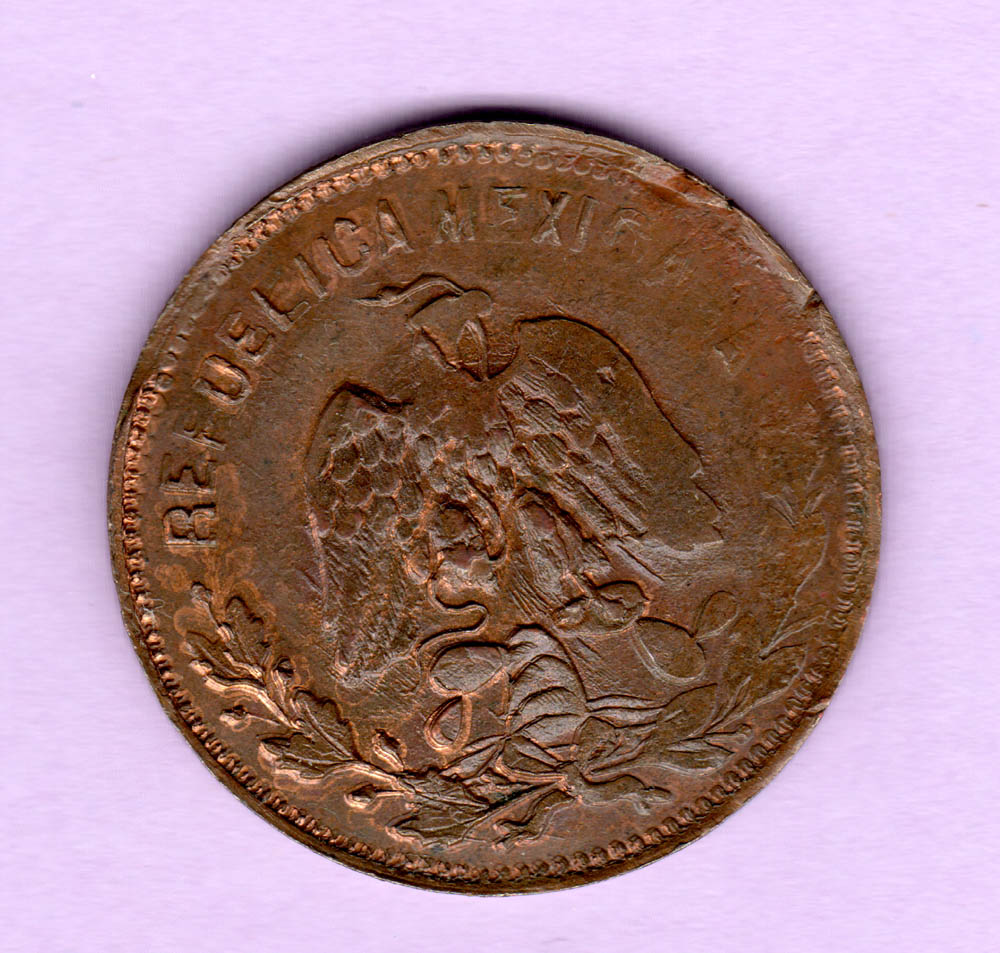
This Atlixtac coin from the Mexican Revolution seems to be double-struck. One thing that puzzles me is why there are two different colors in the copper--shiny, and dark. What's going on here?

Double-Struck-Mexico-Coin?

Double-Struck-Mexico-Coin?
Moderator
Learn More...
nss-52's Avatar
United States
54280 Posts
 Posted 02/12/2016  06:30 am  Show Profile   Check nss-52's eBay Listings Bookmark this reply Add nss-52 to your friends list Get a Link to this Reply
Perhaps is has had old dirt removed, revealing untarnished metal underneath.
Show your financial support of the Coin Community Family (click here)
See my topic on Mexican Numismatic Medals (click here)
Rest in Peace
moxking's Avatar
United States
17900 Posts
 Posted 02/12/2016  08:56 am  Show Profile   Bookmark this reply Add moxking to your friends list Get a Link to this Reply
Could you provide a photo of the other side? It would help, I believe.
Valued Member
dohcollector's Avatar
Belgium
464 Posts
 Posted 02/12/2016  12:00 pm  Show Profile   Bookmark this reply Add dohcollector to your friends list Get a Link to this Reply
looks like it was punçched then rotated 35 degrees clockwise and then punched 2 times again ?
Valued Member
Stephen Z's Avatar
United States
123 Posts
 Posted 02/12/2016  3:55 pm  Show Profile   Bookmark this reply Add Stephen Z to your friends list Get a Link to this Reply
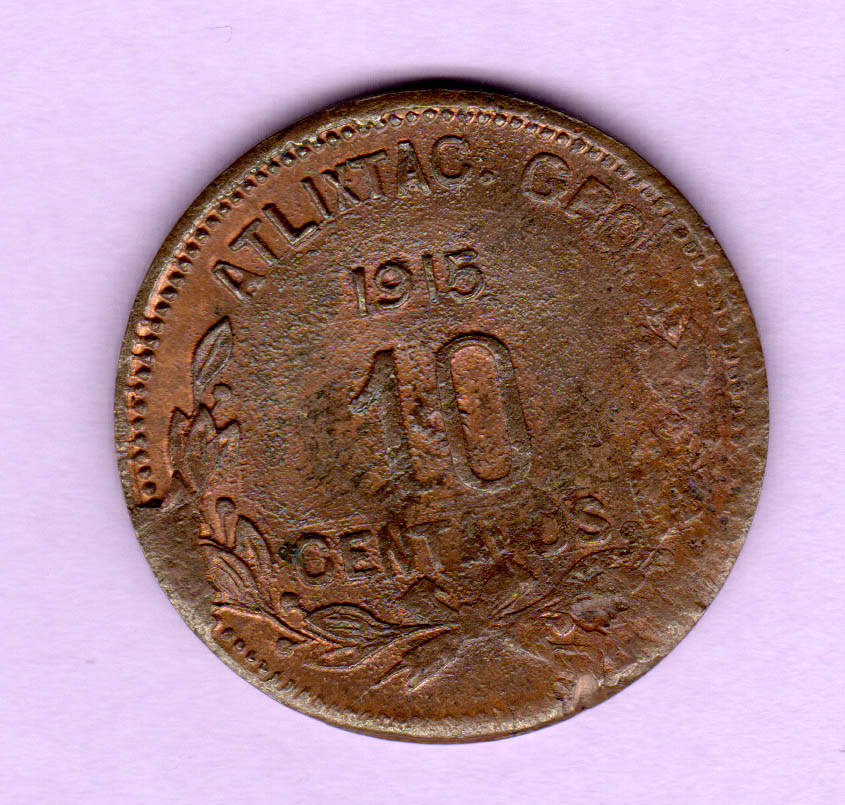
Here's the denomination side. It has some interesting features of its own, like that big edge Cud.

Double-Struck-Mexico-Coin?
Pillar of the Community
swamperbob's Avatar
United States
5362 Posts
 Posted 02/13/2016  12:40 pm  Show Profile   Bookmark this reply Add swamperbob to your friends list Get a Link to this Reply
The new picture shows corrosion - so I would think the coin was cleaned chemically. Based on the physical change in the surface hardness caused by two strikes - the difference in the preservation of mint luster could possibly be due to simple increased hardness.

Someplace in my collection I have a numismatic forgery of an 1899 centavo (fantasy new dies that are well done) that I purchased from Richard Long 15 or more years ago. The coin belonged to Virgil Hancock. The planchet used was a BU 1945 centavo and the color of the surface has toned to a similar two color appearance which allows the original host design to show nicely. I have never photographed that coin.

Regarding the strike it looks like a rotated in collar strike on the obverse (eagle side) but it appears to be a single strike on the reverse. Very odd for the impressions to be this far apart (angular displacement). It appears to indicate that the coin stuck to one die but then rotated 20-30 degrees before the second strike. That is a very loose chuck. Most in collar double strikes made on closed collar presses show equal rotation on both faces.

There are two fact that need to be confirmed in this case.

First that the original strikes were made in a closed chamber press.

Second that the dies for this coin have not survived.

I am suspicious of a forgery but await comment of people more familiar with this series.
Edited by swamperbob
02/13/2016 12:47 pm
Valued Member
Stephen Z's Avatar
United States
123 Posts
 Posted 02/17/2016  07:18 am  Show Profile   Bookmark this reply Add Stephen Z to your friends list Get a Link to this Reply
Thank-you, swamperbob and all who have commented. I learned a lot!
Pillar of the Community
United States
1962 Posts
 Posted 02/17/2016  5:35 pm  Show Profile   Bookmark this reply Add realeswatcher to your friends list Get a Link to this Reply
This piece is a fairly common type in not particularly attractive condition... whose oddities are not severe enough to make it numismatically "interesting" (AKA: worth a lot). Based on that alone, there is zero reason to suspect a piece like this as a modern numismatic forgery.

Aside from that, the weirdness of the piece seems to be fairly typical for this coinage. As is usually the case, a cursory look at other examples goes a long way towards helping you know what you're dealing with. I would guess that the metallic inconsistency and porosity present is "as struck"... just seems to be a fairly pronounced example of what other specimens present with:

http://www.ebay.com/sch/Coins-Paper...LH_PrefLoc=2

A lot of this Mex. Revolutionary era coinage is quite the mess... especially the Guerrero issues. Almost like with cobs, very few pieces appear exactly alike. There's a reason nicely/fully struck pieces in better UNC grades go so high.
Pillar of the Community
swamperbob's Avatar
United States
5362 Posts
 Posted 02/18/2016  02:13 am  Show Profile   Bookmark this reply Add swamperbob to your friends list Get a Link to this Reply
I agree that the series is a mess. That was one reason why I asked about the original dies. Restrikes from genuine dies are well known in some cases among Revolutionary issues. A restrike might be produced on an open collared press or with movable dies NOT in a standard chuck.

However, that kind of a series makes it rather easy to forge new examples at a profit.

These coins have about 8 grams of copper or less in them. That is under a quarter of an ounce each. Fabrication costs including materials would be about $1 each and sale price would be considered reasonable at what ? $5 or $10. That is far more than enough in a market where US quarter dollars, SBAs and Mexican 5 pesos are still being counterfeited - profitably.


Pillar of the Community
United States
684 Posts
 Posted 02/18/2016  4:02 pm  Show Profile   Bookmark this reply Add Westwood Arms to your friends list Get a Link to this Reply
This coin is GB 141, Gayton GRO 33 or 33 bis, Amaya A GO 1 or A GO 2. The difference between 33 and 33 bis and A GO 1 and A GO 2 is the thickness of the planchet. This looks like the thick planchet variety, so it would be GRO 33 and A GO 1.

The eagle side (obverse) dies were made in Tlaxco, three of them. The date side dies came from Atlixtac, I think five. The provisional mint was in a sugar mill.

I think the color variations of the coin pictured are not from cleaning but as a result of the different metals used to make the planchet. Gayton tried to address the different metals, but it is a rat hole. Brass, copper, even some kind of white metal was used to make the planchets, and they didn't mix them very well.

The Cud on the date side is common, see Amaya plate coin.

There are no reports of original dies surviving.
Pillar of the Community
swamperbob's Avatar
United States
5362 Posts
 Posted 02/18/2016  7:58 pm  Show Profile   Bookmark this reply Add swamperbob to your friends list Get a Link to this Reply
Good to know that the dies have not survived. At least you don't have to weed out a bunch of restrikes.

A replicated die pair made from an original copy is still very possible. This coin has striking characteristics (low in fill of die high points primarily) that seem to contradict the field impression overstruck on the first image. The first strike is absolutely leveled - but the eagles head among other places lack fill that should follow the high points of the first strike.

My most serious issue is the raised rim portions that have survived. The dentils and raised rim have the appearance of the perimeter of a typical electrotyped image transfer. Unlike impact transfer that often does better at the perimeter - electrotypes usually are weakest at the perimeter.

I am still suspicious that this could be a forgery. Make it for a buck sell it cheap for $5. It is a common coin noted for being crappy looking so how likely is anyone to have it graded or even checked by an expert?
Pillar of the Community
United States
1962 Posts
 Posted 02/18/2016  10:03 pm  Show Profile   Bookmark this reply Add realeswatcher to your friends list Get a Link to this Reply
Bob, I remember reading a post of yours some years back where you mentioned that either Hancock or Hubbard, as he got older, starting thinking everything was counterfeit...................

I would think that reverse is too smooth to be an electrotype, no?
Pillar of the Community
swamperbob's Avatar
United States
5362 Posts
 Posted 02/19/2016  02:02 am  Show Profile   Bookmark this reply Add swamperbob to your friends list Get a Link to this Reply
realeswatcher It was Virgil Hancock who was accused of calling too many coins counterfeits near the end of his career. I have also heard from some people in the know that it was more because in many cases he had no real facts to back up his positions. He just said they were fake with no explanation at all. It came to be believed that he was substituting guesswork for expertise. Some of his peers attributed it to his failing mental state.

I recall Virgil's column on counterfeits from over 40 years ago. I loved reading it. After he died I bought as many of the counterfeits from his personal collection as I could locate. This was partly because as a kid I really liked and appreciated his work on counterfeits, but I also really enjoyed his stories. In many cases, even back then, I wondered how he knew. He never supplied answers to the questions I had even when I was young. The book he produced with Larry Spanbaur in 1979 is interesting to read but it is a story book not at all a scientific approach.

I learned when I went to college that reasons others could view, test and verify were far more important than opinions stated by "experts". But I also realized that the facts were often more interesting in story form. I also learned that a conservative (cautious) approach is best until a scientific test can replace opinions. That is why I often express opinions couched in terms of alternative possibilities based on test results. It is also why I own many coins that I still classify as "suspects".

In this case, the coin in question is a common type - it is under the radar so to speak because it is thought of as too common to forge. Too low value to reap a big profit. That belief if generally held unfortunately makes it a perfect target. Forgers and counterfeiters want their work to pass undetected. Actually a better way of putting it as unnoticed. They do it by copying common not rare coins. Rare coin copies draw attention and usually fail. Someone recognizes what they are. A smart forger targets coins that generate a profit with little risk of discovery. Greed typically is what gets a forger caught. Just imagine the career of Mark Hoffman if he didn't get too big for his britches and try to go for the multi-million dollar score.

Regarding the reverse being too smooth for an electrotype. I would almost have to see the original being copied to say that. Electrotyping can, and usually does, create an exact replication of a design with every bit of damage visible. It will copy the die setting lines used by the die sinker. It can even copy erosion flow lines. However, it can also create a partial image or one that fades away to one side of the die. You see, electrotype replication is not a slam dunk process it is an art form. The technique itself was only developed after more than a decade of trial and error experimentation.

A damaged host obviously produces a damaged copy but so can a slight error in the alignment of the plates with relation to the target for deposition. A simple failure to stir the electrolyte frequently enough can result is a great plate build up on one part of the coin and virtually no transfer to another part. The solution containing the plating metal is denser before releasing the metal ions and considerably lighter (in density) after releasing the ions. If the electrolyte remains stagnant too long ion depletion results in the depleted electrolyte rising to the top. That is one reason a horizontal position rather than vertical was found to be most expedient to produce a uniform plate by 1844.

Too much or too little voltage across the plates can also effect the end result and quality of the copy because it effects the rate of deposition and in turn the stability of the metallic surface. One way causes the deposition to be too hard and brittle while the other fails to produce a solid surface which erodes easily.

So it is hard to say just why the reverse appears as it does. There are several viable possibilities.

The real problem with this coin, as I see it, is the relation of the two dies to one another while the coin was being struck twice. No one has responded to my question about how these coins were originally struck. That is a problem.

The use of close and closed collar steam presses occurred in Mexico in the last decade of the 19th century. Twnety five years later in 1915 I would expect proliferation of the technology. If a press was employed with a close or closed collar and well fitted chucks to hold the die - I can see no mechanism for producing the end result I see here. One side is double struck but restrained except for rotation. The other side shows no doubling of any kind. This is not a coin that fell away from both dies and rotated. It is not struck once in collar and the other out of collar.

It appears to me that the coin stuck to the reverse die possibly due to the presence of Cud that had formed at the edge of the die thereby wedging the coin in place against that die. When the cycle completed a second planchet did not feed in as it should have (perhaps the collar partially jammed which could account for that). The dies then came together with a 20-30 degree rotation of the free die ONLY.

Does that make sense to anyone? This is not a hand hammered coin. Or is it?

The only way it could happen is by postulating one chuck was looser than heck allowing the rotation of 20 to 30 degrees to occur in one press cycle. If that were the case (especially if the press was worn or poorly made) then I would expect to see large numbers of die rotation errors being sold. Not double strikes - just rotational errors. I noted exactly zero such examples in the process of assembling 10 examples made from this exact die pair as the Cud enlarged. Many of these auctions were from Stacks and Heritage. They usually mention rotation. In fact reference books should say that rotated dies exist. I did not find that either.

Forgers love double strikes. I think it is not only in their nature but due to the methods some employ to make small copper coins. These errors are often their undoing. They produce double and triple strikes that are difficult to reconcile with coining methods that should have been used.

You see if I was making these forgeries I would place my dies on the ends of steel rods that fit snugly within an enclosing tube. The anvil die is placed on a short rod and is positioned on a smooth rigid surface. The tube (often a hole drilled the diameter of the coin made in a large steel block) is placed over the anvil die vertically. The planchet (preferably hot) is dropped into the tube (hole in the block) and seated on the anvil die with a wooden dowel (like a loose fitting ramrod). Then the hammer die (mounted on a steel rod longer than the tube's depth) is set into the tube. Next you hit the top of the steel rod with an appropriately sized maul. One blow would normally be enough but sometimes two are needed. Because the dies are not restrained into a fixed alignment with one another a differential rotation often happens on a second strike - especially if the coin sticks to one die.

So how is that the forgers undoing?

Because predictable types of doubling occur depending on the press used. Some forms of double striking are really next to impossible to produce on some presses.

For example, on an open sided screw press the most common double strike involves movement that is NOT rotational but rather is a displacement - horizontally, vertically or both. These double strikes effect both faces and normally the displacements match.

In a close or closed collar coining press two types occur. The most common is the case were the double strike is out of collar because the collar itself fails to move into position on one or the other strike. One full impression and one partial impression results with an arc crossing both faces on the partial strike. This too tends to be of the same magnitude on both faces. The second type is less common but happens when the coin struck on the first impact remains in the coining chamber and simply rotates. This results in double strikes which are rotational only but they involve both dies. Flip over double strikes are rarer but they also do happen.

So if the counterfeiter is hand hammering his coins instead of pressing them - he can accidentally or by intent produce a single sided rotational double strike.


  Previous TopicReplies: 12 / Views: 1,982Next Topic  

To participate in the forum you must log in or register.


Disclaimer: While a tremendous amount of effort goes into ensuring the accuracy of the information contained in this site, Coin Community assumes no liability for errors. Copyright 2005 - 2026 Coin Community Family- all rights reserved worldwide. Use of any images or content on this website without prior written permission of Coin Community or the original lender is strictly prohibited.
Contact Us  |  Advertise Here  |  Privacy Policy / Terms of Use

Coin Community Forum © 2005 - 2026 Coin Community Forums
It took 0.42 seconds to rattle this change. Forums