| Author |
 Replies: 18 / Views: 3,861 Replies: 18 / Views: 3,861 |
|
Valued Member
United States
76 Posts |
Hopefully, someone will recognize this countermark...have googled endlessly with no matches...could be nefarious? 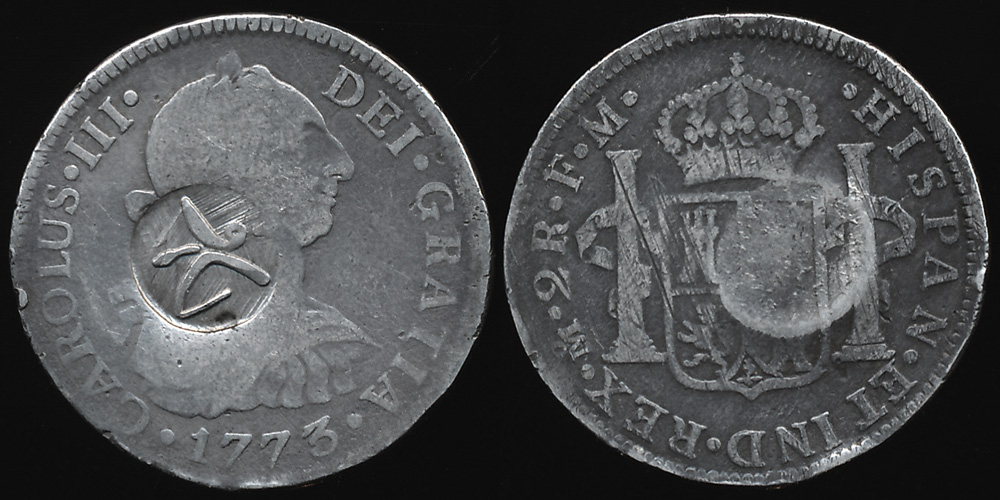 |
|
|
|
Valued Member
United States
309 Posts |
Looks like a Mexican Revolution insurgent counter stamp over the monarch. Various groups were fighting the Royalists and typically defaced the bust of the king with their initials. Many varieties exist. The little "o" above with two large initials looks like Spanish symbology for a place name.
|
|
Rest in Peace
United States
4078 Posts |
Very interesting information.
Thanks Pistareen.
|
|
Pillar of the Community
Austria
566 Posts |
This countermark does not look legit to me. I think, that this is a recently (last 20 years) made fantasy countermark. Just an opinion.
|
|
Valued Member
 United States
76 Posts |
Coinworldtv, you may be right...looks quite sharp...but, why a fake mark that isn't known to others? Fake marks are almost universally applied to increase a coin's value. That aside, it appears Asian or Mideastern in style. Perhaps a local mark from one of those areas...still a mystery. Thanks to all for your thoughts.
|
|
Moderator
 United States
34546 Posts |
I'm interested to hear swamperbob's thoughts.  "If you climb a good tree, you get a push."
-----Ghanaian proverb
"The danger we all now face is distinguishing between what is authentic and what is performed."
-----King Adz
|
|
Pillar of the Community
United States
1962 Posts |
Modern fake stamp, genuine host coin. Likely of the infamous type out of Spain the past 6,7 years or so.
|
|
Pillar of the Community
United States
1674 Posts |
That concave look on the opposite side of the stamp is typical of modern fake/fantasy stamps.
|
|
Pillar of the Community
United States
5362 Posts |
I agree it is a numismatic forgery. The percussive incuse mark on the reverse is typical of a Spanish Countermark of the type I illustrated in my book. Whoever said it dates to the last 10 years is about correct. Most of these were made for ebay types. The end of the punch has what appear to be saw marks on the field level at two angles. A hack saw powered by a human would be less likely to be as uniform as I see here. Two directions may have been to throw us off. I would expect a rocking cut if any - but the end of the puncheon should have been polished in any event before engraving. To me I wonder about an "Arabic" or other script from a place like Malaysia or one of the Islands. The Spanish have been experimenting with those marks applied to MTTs. The coin as a host is of course damaged beyond repair, however the punch forgery is worth documenting. I would peg value at silver melt for the coin plus $15 for the forgery as a maximum value. |
|
Valued Member
United States
76 Posts |
Swamperbob, your usual insightful input is excellent. Another member from outside directly noted to me that the c/m also looks like Java. An example at: https://goccf.com/t/64021 |
|
Pillar of the Community
United States
5362 Posts |
yugotex I had missed that post before but that one looks worse than this example. The reverse percussive mark is not present so it may have been hand hammered which may account for the double strike. The punches are not identical but both are meant to be the Java countermark. Krause specifically mentions only a Lima 8R as a host coin of the Spanish Colonial type. This is a Mexico City 8R so it would potentially be a rarer item.
There is really no end to these forgeries.
|
|
Pillar of the Community
France
1591 Posts |
Indeed a numismatic forgery. I call those the "melgar type" (from the name of the spanish guy which used to sell a lot of those on ebay). Some are fantasies, other are copies of mexican WOI stamps. You can recognize them with the strong pressure applied, the back of the coin often showing a grainy or odd pattern, and the surface of the stamp having parallel lines (as if a bar had been cut by a saw without being polished before being engraved). They even ruined some decent and scarce coins in order to create value . |
|
Valued Member
United States
76 Posts |
Excellent observations, your insight appreciated....yugotex
|
|
Pillar of the Community
United States
1962 Posts |
Yes, Bob and Mat... the ring that published their own book "legitimizing" their own fake stamps. Lots of exotic North African/Muslim world types in there in addition to the Mex. WOI stamps. Did either of you ever buy a copy of that opus? For giggles, you could check to see if it's in there...
|
|
Pillar of the Community
United States
5362 Posts |
I bought one of the Catalogo copies and traced it's origin to a store front copy center in Madrid. Like a copy facility in Staples in the US, the store caters to walk in customers.
There is literally nothing to publishing the "book" in this manner. You can buy one, but the cost is ridiculous for what you get. I got mine on the secondary market for a fraction of the "publication" price.
The copy I own of the "Catalogo", which is likely only one of many versions, does not have the Java stamp actually illustrated with the Java entry. The entry after an introduction describing the Island location in the Indian Ocean and naming the capital city; reads as follows "Dutch counter mark with legend in Javanese."
There is what may be a Java stamp shown on an MTT that is on a page titled Monedas de Austria. There are 12 MTTs illustrated on that one page (5.5" x 7.5") none of which are captioned or numbered so there is no link to the body of the book. There is one small picture with poor contrast of what may be the Java stamp on a late restrike of the MTT. The restrike is far too modern a coin to have a genuine stamp. The other 11 pictures are clearly Arabic stamp varieties.
I surmise that at the time my copy was run off (before 2012), the sales effort was directed at 8 reales types and not the MTTs with Arabic stamps.
|
|
Pillar of the Community
United States
1156 Posts |
swamperbob said: Quote:
Krause specifically mentions only a Lima 8R as a host coin of the Spanish Colonial type. This is a Mexico City 8R so it would potentially be a rarer item. FYI: Krause 6th edition (2013) lists the Mexico City 8 reales with VOC Java counterstamp as KM 184.1 Here is an example for your comments: 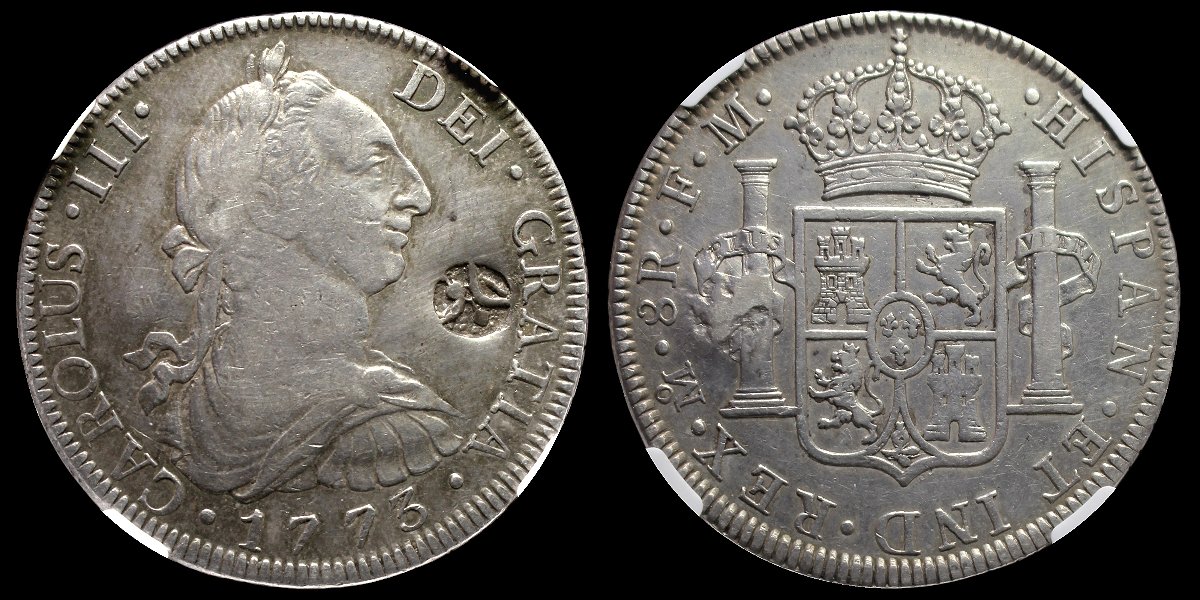 |
| |
Replies: 18 / Views: 3,861 |







 Posted 03/14/2016 3:36 pm





