| Author |
 Replies: 11 / Views: 9,354 Replies: 11 / Views: 9,354 |
|
|
Valued Member
United States
126 Posts |
Would someone please share with me why the color (or is it luster) of gold varies so much from coin to coin? Is it the purity? Finishing strike by the mint? Age? Time? Something entirely different?  A borrowed photo to illustrate the point. 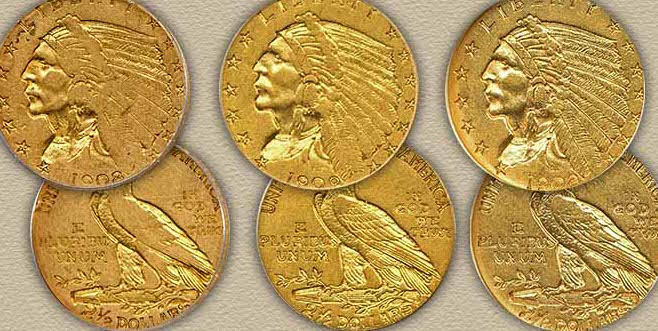 A borrowed photo to illustrate the point. |
|
|
|
Pillar of the Community
Canada
3692 Posts |
You're comparing apples to oranges in the first photo. The 2nd coin is .900 fine, third is .9999 fine, fourth is .9166 fine. Alloyed gold will be a different color. 22K is orangey, and gold is yet another color, more yellow. First coin I don't want to guess what it is, could be plated for all I know and I never trust that coin's design. Also, not every mint will coin their blanks using the exact same alloy. There's no "correct" alloy formula for karat gold, and people use what is best for their purposes.
Second photo is only a guess for me. They are all different grades, correct? When the surface of a metal (or anything) has scratches or pores the light will reflect differently, and not only that but it will tarnish in a different way. If you've ever seen old nickel-white gold it turns yellow around the parts that it is dinged/scratched/worn and every year or constant use they require a refinish and replating. So imagine a perfectly flat surface without pores or holes or bumps, if you will: the light will bounce off it in an equal fashion. Now imagine that it has irregular wear, like a road full of potholes. Gold is very soft and doesn't last forever. The secret behind a good finish is that the surface must be smooth and not rough.
|
|
Pillar of the Community
Canada
3692 Posts |
My best guess is that the $20 St. Gauden's has a higher concentration of silver mixed with presumably copper (most popular alloy metal for gold. That's what gives it a whiter appearance. The dies are perfectly polished. The Canadian coin is gold in a coin form. When I say gold I always refer to the pure element, that is, .999+ fine or 24 karat or "fine gold". Your guesses are pretty spot-on.
|
|
Pillar of the Community
United States
4333 Posts |
If genuine, the first coin is an American Buffalo, .9999 fine gold.
Libertad I did not realize the AGE contained silver, interesting.
When I listen to LED ZEPPELIN...so do my neighbors...
Roll hunting since '77
Dirt fishing since '72
Edited by fistfulladirt
04/18/2016 7:58 pm
|
|
Valued Member
 United States
126 Posts |
Thanks for the feedback. Quote:
Second photo is only a guess for me. They are all different grades, correct? Yes, that's absolutely correct. Quote:
If genuine, the first coin is an American Buffalo, .9999 fine gold.
I am assuming it is genuine, I borrowed the image. Not my coin. |
|
Valued Member
United States
61 Posts |
The Krug is gold and copper no silver content like the AGE mixture of gold silver and copper.
|
|
Pillar of the Community
Australia
3841 Posts |
My partial coin collection http://www.omnicoin.com/collection/gxseriesMy numismatics articles and collection: http://www.gxseries.com/numis/numis_index.htmRegularly updated at least once a month. |
|
Pillar of the Community
Canada
3692 Posts |
That's only a guess. Supposing you bought it for the reason of "diversifying", when you "melt" the St. Gauden's you lose that silver and only get the gold back from the refinery. Don't find this out the hard way by buying pounds of these coins.
I meant to say double eagle, not St. Gauden's. Same engraver though.
Edited by Libertad
04/18/2016 11:18 pm
|
|
Valued Member
United States
126 Posts |
Thanks for the link, gxseries. Here's an overlay of the Ternary plot of different colors of Ag-Au-Cu alloys with the above images. It's simply a ballpark type of generalization (no calibration, etc.), but I did find it interesting. 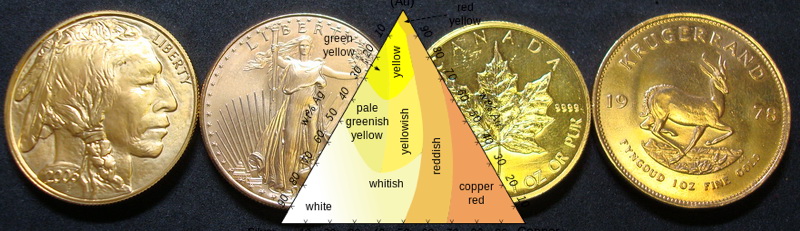 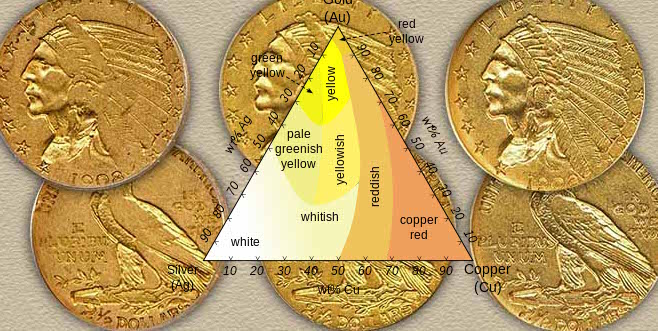 |
|
Valued Member
Canada
117 Posts |
I asked the same question before.
Those gold coins are not 100% pure gold, some of them contain silver and copper. Oxidation causes the color change as well.
|
|
Pillar of the Community
Australia
3841 Posts |
Precious metal alloys just make it more interesting.
This is often used in jewellery as well as in dentistry (for fillings - often palladium / gold alloy)
Might want to read more up on the internet as there's a mountain trove of information on such material.
My partial coin collection http://www.omnicoin.com/collection/gxseriesMy numismatics articles and collection: http://www.gxseries.com/numis/numis_index.htmRegularly updated at least once a month. |
|
Moderator
 United States
54297 Posts |
Quote:
a mountain trove That's a new on on me.  Show your financial support of the Coin Community Family (click here)See my topic on Mexican Numismatic Medals (click here) |
| |
Replies: 11 / Views: 9,354 |
|










 Posted 04/18/2016 7:31 pm


