| Author |
 Replies: 19 / Views: 5,626 Replies: 19 / Views: 5,626 |
|
Valued Member
Norway
89 Posts |
http://www.ebay.com/itm/European-No...121985720448An obvious fake, value $ 0.00, from a notoriously dubious seller. The usual warning signs are all there, yet the bids keep coming... (Keep in mind that an authentic speciedaler from that period (Christian IV) easily fetches US $ 3- 4000!)
|
|
|
|
Moderator
 United States
34540 Posts |
@diatonix, so that I can learn, can you please elaborate on the "usual signs"? I mean details of the coin as opposed to ebay feedback patterns or a history of selling fakes by this one guy. Thx "If you climb a good tree, you get a push."
-----Ghanaian proverb
"The danger we all now face is distinguishing between what is authentic and what is performed."
-----King Adz
|
|
Valued Member
 Norway
89 Posts |
This guy has a history of selling fake Scandinavian coins. Problem is, there is no longer any point in reporting it to ebay, they will do absolutely nothing. This means that counterfeit objects, of considerable value if they were authentic, are sold to inexperienced collectors, often at an unusually low price, due to absence of real connoisseurs among bidders. By "warning signs" I mean that seller does not accept returns, listings are private (which makes shill bidding less obvious), "Free USPS priority mail" from Latvia, Europe. Seller lives in Belarus and ignores questions. As to the "coin" itself: Sloppily placed and oddly shaped letters and digits, wrong details both in monarchs' portrait (f.ex. beard) and lion, porous surface and first of all: strangely irregular edge, lacking the typical 4 mint made indentations (at 0, 90, 180 and 270 degrees). Probably done in order to conceal parting line and reduce excessive weight? Closer inspection of the edge of an authentic specimen would show that the coin is not perfectly round but more like a polygon with appr. 30 angles. Edited by diatonix
05/15/2016 5:44 pm
|
|
Moderator
United States
34540 Posts |
Ok thanks! Some of these details (such as the mint-made indentations are new to me).
"If you climb a good tree, you get a push."
-----Ghanaian proverb
"The danger we all now face is distinguishing between what is authentic and what is performed."
-----King Adz
|
|
Bedrock of the Community
Australia
21789 Posts |
I am completely unfamiliar with these.
You may quite rightly assume that I also, could be easily fooled.
I would need a very good education on how to identify fakes with these.
|
|
Valued Member
Norway
89 Posts |
Edited by diatonix
05/18/2016 1:24 pm
|
|
Pillar of the Community
United States
5362 Posts |
I will start my comment with a preface. I am NOT an expert with regards to this exact type of coin. I am however, very familiar with the differences between contemporary counterfeits and numismatic forgeries. So starting from that basis, I will look at this coin from my own perspective and to determine if the origins can be determined. The problems with the auction itself are obvious. The seller is a known dealer in Numismatic Forgeries and the coin does not match the correct design. Returns are not allowed and the price is set VERY low. There is no way to spot shill bidding because the identities are private. Finally, Latvia is an outlet known for forgeries as is Belarus. When I first looked at the coin that began this thread - I wondered if the coin was actually a contemporary counterfeit. A contemporary counterfeit could easily be worth the current bid. Here is the coin: 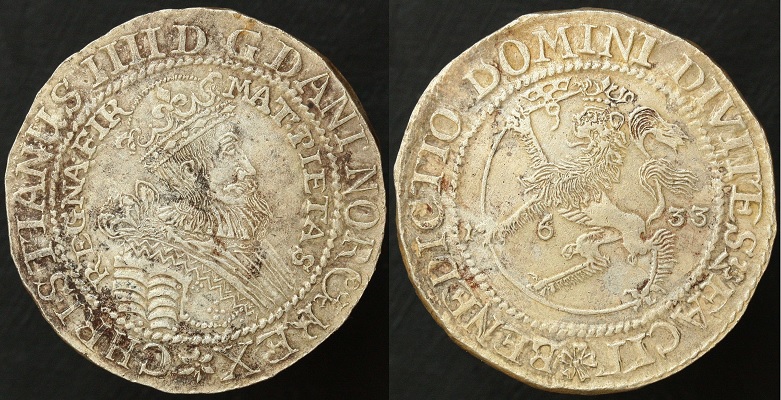 Below is a picture of a genuine example of a 1637 Speciedaler. 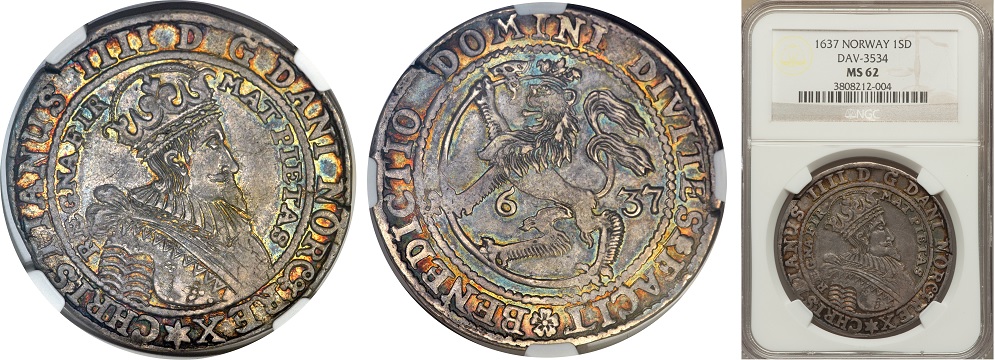 The rarity of a target coin is usually a red flag. Counterfeiters operating in the 17th century did not copy rare coins. That is a truth that applies to all counterfeiters. They target coins that are common in circulation so that they do not attract attention. So the first hurdle to over come with this particular coin is the apparent rarity of the variety. The question is were these coins common in circulation in the 1630s? I do not know the answer to that question, but I presume that a well informed collector of the coins of Norway would know. The next question to ask the expert is: How long did this coin remain as a common circulating coin? To rephrase the question: When would a 1633 Speciedaler attract unwanted attention in circulation? Lets presume for a minute that the coin was common when made. I think that is reasonable since Krause provides a mintage of 33,000 coins for 1633 (and a total mintage for 1631-1648 of 777,040 coins.) The country of Norway at the time was governed by the King Denmark and all of Scandinavia was unified. Trade was of particular importance and the Speciedaler was a generally recognized denomination internationally. Lets also presume that the coin as a type remained common until 1648. I think that is also reasonable because at that point the speciedaler was reduced in silver content by the subsequent ruler Frederick III. From my perspective this raw data appears to prove that the coin would definitely have been targeted for counterfeiting in the interval from 1633 to 1648 and perhaps beyond that date because it would have been traded at a premium because it contained more silver than the later issues. Therefore I think you have to look beyond the current price as a sole determinant. I believe it is appropriate to evaluate the coin in an attempt to determine when it was made and if there are any clues that would point to a numismatic forgery. In the comments made, there are references to two other coins being offered by the same seller and the inference that they were made in the same place. Here are the two coins: 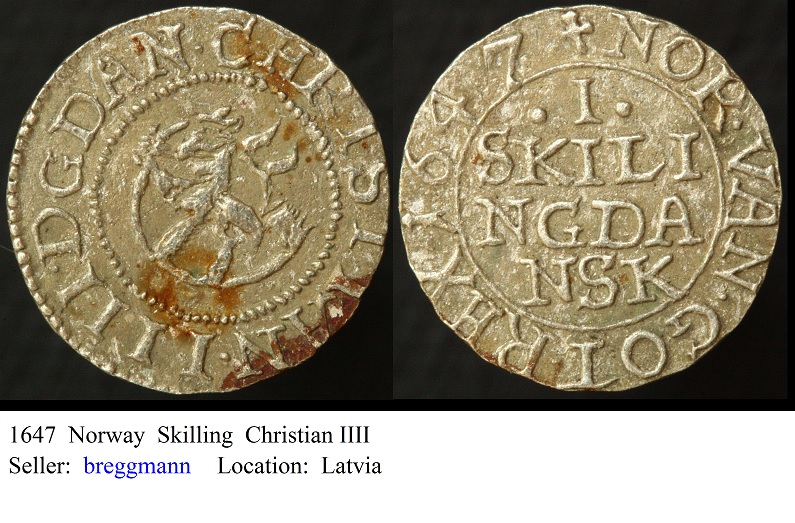 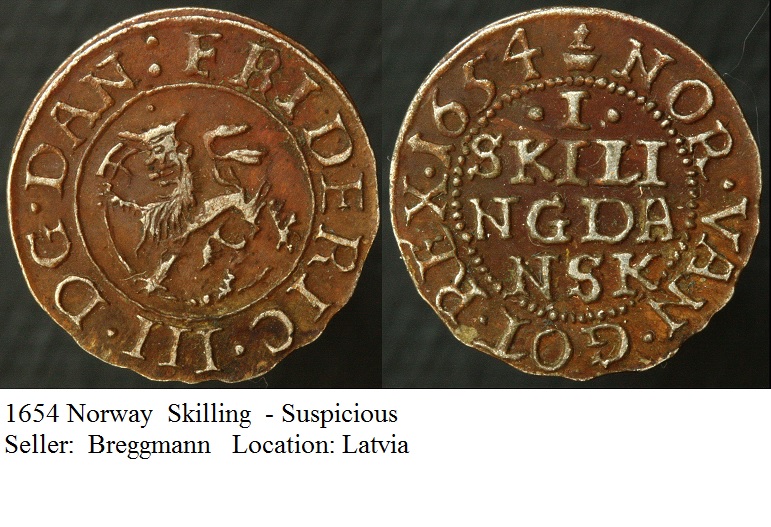 These coins are very small in comparison to the speciedaler. They are only about 1 gram in total weight. These two coins look modern to me on first view. I was able to match many of the fonts as well so that I am comfortable with the belief that they were produced by one manufacturer. The speciedaler shares virtually none of the traits that are common to the other two coins. Size may be an issue but a different die cutter could also be at work. Next I examined the methods used to make the three coins. The two skilling appear to be casts made from a hand engraved mold. There is no strike evidence. The speciedaler displays multiple impressions seen on rocker strikes. It is similar to what is observed on roller presses where multiple passes are required. Both are correct methodologies for the 17th century. Since the pattern used is not genuine someone cut dies to make the exemplar - so even if this coin is a cast copy what was copied was struck more than once. That process makes the coin appear old. If a forger went to these lengths to create a forgery of a counterfeit, I would likely pay the current bid or more just to see it. Because I do not know the accurate weight, because I do not have the density of the coin and because I can not examine the edge - I would classify the coin as fake for certain and possibly a contemporary counterfeit. If I was still a member of the Coin Watch Committee, I would vote to REMOVE the coin from ebay NOT because it was a counterfeit but because the coin was improperly described. I would allow a re-post if the seller agreed to two conditions to 1) describe the coin as NOT genuine and to allow returns if the coin proves to be a modern fabrication. |
|
Valued Member
Norway
89 Posts |
Many thanks for your comment, Swamperbob! There are, to my knowledge, no known contemporary or other historic counterfeits of this speciedaler. And even if there were such an interesting numismatic curiosity, it would most likely not, as if by chance, end up in the hands of a known crook such as Breggmann. It may be hard to judge from a photo, but apart from the surface being untypically grainy/porous I find its colour more than suspicious, I keep seeing similar strange colours (rust brown/gray, beige) in other fakes such as the ones from notorious Spanish "mint master" Nicasio: http://www.ebay.com/itm/14198116160...RK:MEBIDX:ITEdited by diatonix
05/19/2016 03:17 am
|
|
Pillar of the Community
United States
5362 Posts |
I agree that the Spanish coin is a modern numismatic forgery. It is quite typical of what I am used to seeing; as are the 2 Skilling coins. I will spend more time looking at the 1633 tomorrow to see if I can pick up any modern features. So far I have not.
Have you ever seen any modern forgery that uses the technique seen on the speciedaler (i.e. multiple impressions that stretch the design along a single axis) because I have not and I have examined thousands of modern forgeries. It really does not have the appearance that I am used to seeing in recent forgeries.
Of course I am primarily familiar with contemporary counterfeits from the late 1700s and early 1800s and recent forgeries of coins of those dates.
Do you know how long the 1633 remained monetized and where it circulated? Rocker or lever presses were used in colonial America for counterfeiting before 1700 and I understand the same form of simple press dates back far earlier in the UK and parts of Europe. The most recent examples I have seen using the same form of pressing were made in the 1870s in Mexico. If the 1633 circulated as late as the 1700s it is possible that the coin could have been made then.
I understand the difficulty believing a forger could sell a genuinely old contemporary counterfeit - but perhaps he bought it as a forgery and had no idea it was old.
Because the design is so crude, I have difficulty believing that anyone should believe the coin is actually genuine.
|
|
Valued Member
Norway
89 Posts |
I'm convinced that most of his coins are fake and that they come from the same source. Here is another example, again the same porous surface, same colour: http://www.ebay.com/itm/12198573433...RK:MEBIDX:ITHis "speciedaler" went very quietly without any sniping for US$ 630. So let's hope the winning bid was his own! Edited by diatonix
05/20/2016 2:45 pm
|
|
Pillar of the Community
United States
5362 Posts |
diatonix I have looked through his other auctions and I agree they are all forgeries. None seem to be counterfeit. I did notice a similar appearance including some of the same doubling that I noticed on the 1633 Speicedaler on a 1658 Polish coin: - http://www.ebay.com/itm/Silver-Coin...121986675682 The coin has stretch doubling that I observed on the 1633 coin. In this case the Polish coin is a fake - with extremely little doubt at all, so I will have to take another look at the others he offers.
|
|
Pillar of the Community
United States
992 Posts |
You can't cheat an honest man. The buyers of these are either going to knowingly sell them on and make money or are trying to get a rare coin for a bargain price.
|
|
Pillar of the Community
United States
5362 Posts |
Paxbrit You are right in the majority of cases. The one exception would be for those of us who collect contemporary circulating counterfeit coins.
|
|
Pillar of the Community
Norway
1358 Posts |
Så kult å se flere nordmenn her! These coins are obvious fakes when you look at them closely. Good of you to point out this guy and his shabby business - best to be aware before losing a fortune in a scam. And very bad of ebay not to take any action on something that's obviously a criminal act. Me no gusta. @swamperbob: this guy isn't selling contemporary counterfeit circulating coins (which indeed can be pretty cool and costly), but probably something he cooked up in his Latvian basement. That makes a heck of a difference to me. :) |
|
Pillar of the Community
United States
5362 Posts |
UltraRant You are absolutely correct. Contemporary Circulating Counterfeits which were originally made for circulation are much different than recently made Numismatic Forgeries intended to defraud collectors.
I personally collect Contemporary Counterfeit Mexican Eight Reales so I do understand the difference and in person I can usually tell the difference between the two types.
In pictures there is more uncertainty. I could clearly tell that his coins were Numismatic Forgeries with the one exception of the 1633 coin that started this thread. In my specialty there are no coins that were produced on roller or rocker presses. The coins I collect were all screw press strikes originally. So I have a question that perhaps you can answer.
When the forger created the 1633 speciedaler, what was the method he employed to get the multiple "stretched" impressions as if the strike was made by a rocker press? In my experience rocker presses were used for making circulating counterfeits until the last quarter of the nineteenth century (at least Mexican types) but not more recently. There are numerous cast coins that contain the multiple stretched images that were on original coins, but here the die impression is clearly a fabrication of a forger. Are there now forgers that are using rocker presses to do their work?
|
|
Pillar of the Community
Norway
1358 Posts |
I like your question, but I can't answer it as I am not making counterfeits myself and I do think that your expertise on this field certainly is much bigger than mine: you even published a book on it! I think 'coin' seller Breggmann is the one who can answer your questions, as his 'private mint' seems to produce many magical and mysterious products... maybe be bold and send him a mail (maybe under a nickname)?
I've merely become interested in modern forgeries and contemporary counterfeits after buying a fake coin via an online platform (which I bought as a real coin). That started off a new 'collection' of fakes which is still growing - mostly unintended, unfortunately, sometimes intended, though. It's amazing how many good quality forgeries there are and the history on counterfeiting coins is also one of the more interesting in this field. Anyway, for as far as this topic goes, I think my knowledge is pretty basic and growing as fast as my fakes collection, as my main numismatic interest actually lies elsewhere. I still think it's a wonderful topic, though.
|
| |
Replies: 19 / Views: 5,626 |








 Posted 05/15/2016 04:42 am


