|
This page may contain links that result in small commissions to keep this free site up and running.

Welcome Guest! Registering and/or logging in will remove the anchor (bottom) ads and the security checks. It's Free!
To participate in the forum you must log in or register. | Author |
 Replies: 65 / Views: 8,394 Replies: 65 / Views: 8,394 |
|
|
|
Pillar of the Community
 United States
949 Posts |
Quote:
With more than 5X magnification work Enrico Savazzi recommends some form of Vibration isolation.
At present my copystand sits on a round 3 1/2 ft diameter oak table top which is supported by four integrated 4x4 pedestal legs. Nothing is loose, but the floor is wood and it is a second story, so vibrations do develop. It might surprise you that I already have a granite block 24x18x3 inches (607 x 455 x 76 mm). This fits atop a 24x18x18 inch steel stand made for it, all of which is the base for a 6 foot animation stand. I no longer have a ceiling that will accomodate the upright stand when assembled (it is computer driven) so the block isn't doing anything at present. Unfortunately at my age that block weighs too much (126 lb) for me to cart it up two flights of wooden stairs to my studio, even with a hand truck. However, it could form the base for another dedicated macro-table in my basement office. Subterranean, windowless, controlled climate, I can't think of a more advantageous environment for a vibration-free setup. The hard part is finding the space. Maybe time to kick out the Xerox office machine? The steel stand has 4 one-inch diameter pedestal feet that would sit on the basement floor concrete slab. I wonder if there would be any real advantage to using the Sorbothane with that, since the feet would just cut into it, and there isn't much vibration coming up from the floor to be conducted through those points. If a space cannot be found, would those pads do any good beneath the feet of my present oak table? Edited by lrbguy
07/19/2016 6:59 pm
|
|
Pillar of the Community
 United States
4051 Posts |
Before making major changes to your setup, it may be a good idea to test if vibration is an issue. You can do this by simply starting up Live View and doing a 100% (or 200%) zoom view on a focused subject. When you bump the table or your setup, you'll see movement, but it should dampen quickly. If it takes a long time to dampen, or continues to move, then adding mass dampening may help you.
I find that even a fan in the room will cause significant movement when viewed at 100%. I turn off my room fans when shooting stacks.
Contact me for photographic equipment or visit my home page at: http://macrocoins.com |
|
Pillar of the Community
2087 Posts |
Quote:
Before making major changes to your setup, it may be a good idea to test if vibration is an issue. You can do this by simply starting up Live View and doing a 100% (or 200%) zoom view on a focused subject. When you bump the table or your setup, you'll see movement, but it should dampen quickly. If it takes a long time to dampen, or continues to move, then adding mass dampening may help you.
I find that even a fan in the room will cause significant movement when viewed at 100%. I turn off my room fans when shooting stacks. From my perspective if you have to turn off room fans in to stop vibrations while shooting stacks then you do have a concerning vibration problem. To elaborate: if the fans are causing a noticeable issue then your rig is probably experiencing other vibrations that you may not notice( from cars passing by in the street through to a Fridge or Freezers compressor starting and stopping. Given that the Vibration Isolation should cost less than US$50.00 I think it is ideal for any one who wants to produce High resolution images and high magnification stacks. I would suggest that if you need EFCS for your work then Vibration isolation is a necessary and complimentary requirement. At the cost the ROI strongly recommends it. My experience was that I was unable to produce decent high magnification stacked images until I introduced external Vibration control. In 2014 and 2015 I spoke to people who did the advanced and beginners photography classes at the ANA Summer seminar. The classes are held in the Armstrong class room block and people noticed that even at 1-1 they had problems with external Vibration. Indeed I spoke last year with the instructor of the advanced class and he made a passing comment that he was frustrated with the vibrations being experienced in that building. The Armstrong building is large and solid. RMPSRMPS I infer, perhaps incorrectly, from your comment here and previous comments some considerable time ago that you have never tried this technique. {Before I go on I apologize if I am incorrect with that perception.} I would note that someone with your substantive skills and experience would really appreciate and exploit the advantages a Vibration resistant rig. Quote:
At present my copystand sits on a round 3 1/2 ft diameter oak table top which is supported by four integrated 4x4 pedestal legs. Nothing is loose, but the floor is wood and it is a second story, so vibrations do develop.
It might surprise you that I already have a granite block 24x18x3 inches (607 x 455 x 76 mm). This fits atop a 24x18x18 inch steel stand made for it, all of which is the base for a 6 foot animation stand. I no longer have a ceiling that will accomodate the upright stand when assembled (it is computer driven) so the block isn't doing anything at present. Unfortunately at my age that block weighs too much (126 lb) for me to cart it up two flights of wooden stairs to my studio, even with a hand truck. However, it could form the base for another dedicated macro-table in my basement office. Subterranean, windowless, controlled climate, I can't think of a more advantageous environment for a vibration-free setup. The hard part is finding the space. Maybe time to kick out the Xerox office machine?
The steel stand has 4 one-inch diameter pedestal feet that would sit on the basement floor concrete slab. I wonder if there would be any real advantage to using the Sorbothane with that, since the feet would just cut into it, and there isn't much vibration coming up from the floor to be conducted through those points.
If a space cannot be found, would those pads do any good beneath the feet of my present oak table? From your description then it really reads like you would benefit from using the technique. Like you my rig is on the second story of our house. Our house is a typical Austrian Massiv-Bau Its built of permanent materials and the second story floor is concrete so one would expect it to be vibration resistant ... but it isn't. As far as your granite slab goes all I can say is WOW! However like you I would have great difficulty getting it up stairs. My experience has been that just the slab on its own is pointless. Using the principle of the conservation of momentum, the sorbothane feet allow the room around the slab to move while the slab and equipment on it remain still. I can jump on the floor while the camera is shooting a stack and the rig isn't effected. If I bump the rig or granite block it wobbles very slightly (as if it were on stiff jello) but the movement settles out very quickly: that exactly what is supposed to happen. Irbguy, like you I don't think the Sorbothane feet would survive the stand your granite slab sits on. There are other options but they are outside of my experience and knowledge. These options are Industrial Vibration Isolation mounts. I did a quick search on ebay and found a whole range of different types but I have no idea which are the best value for money( all are more expensive than four Sorbothane feet). Here is one example, but the cost of four of them is such I would recommend serious research before pulling the trigger on them: http://www.ebay.com/itm/BRB-60-50-V...AOSwMHdXSw3KFrom the pictures you provided I had guessed that your table was a nice Oak piece. However I suspect( I don't know) placing the table on the Sorbothane feet may not be ideal. I have no idea why I have that "gut-feeling". If the Sorbothane feet are not a major expense to you then perhaps its worth a try. Edited by austrokiwi
07/20/2016 01:08 am
|
|
Pillar of the Community
United States
9395 Posts |
Quote:
From my perspective if you have to turn off room fans in to stop vibrations while shooting stacks then you do have a concerning vibration problem. To elaborate: if the fans are causing a noticeable issue then your rig is probably experiencing other vibrations that you may not notice( from cars passing by in the street through to a Fridge or Freezers compressor starting and stopping. Given that the Vibration Isolation should cost less than US$50.00 I think it is ideal for any one who wants to produce High resolution images and high magnification stacks.
I would suggest that if you need EFCS for your work then Vibration isolation is a necessary and complimentary requirement. My heavy homebrew copystand does have isolation using wooden planks separated by 8 sorbethane hemispheres. I still have a problem with vibrations not coming through the floor, and with air currents (especially from heated air). If vibrations originate in the setup itself (shutter, for example, or buffeting from turbulent air), I wonder how helpful the sorbethane isolators really are. I know when I was doing those USAF test target shots with 10x sampling of the suspended image, just having a small electric heater on nearby would cause slow movements in the live view image, so I had to turn it off. (This affect may be something other than vibration, however -- perhaps more like the problems with in-telescope tube currents that sometimes plague planetary imagers.) |
|
Pillar of the Community
2087 Posts |
Quote:
If vibrations originate in the setup itself (shutter, for example, or buffeting from turbulent air), I wonder how helpful the sorbethane isolators really are Opps my wording was bad. As you point out Sorbothane feet/ vibration dampers don't assist with vibrations originating in the set up its self. What I was meaning is if EFCS is important for shooting ( for internal vibration control) then sorbothane feet combined with some suitable mass are a complimentary technique that reduces the effects of external vibration. For those whose imaging requirements don't require EFCS they are less likely to require external vibration control as well. ( I hope that is clearer). As for turbulent air: Air from a fan operating in the same room doesn't effect my rig. I had assumed the comment regarding the fan related to vibration from the fans motor and mechanical movement not from the movement of air. To be honest I had never thought about air turbulence being an issue. Thinking about it perhaps it might be a problem for smaller rigs Edited by austrokiwi
07/20/2016 09:42 am
|
|
Pillar of the Community
United States
4051 Posts |
I'm on a ground floor slab foundation, heavy oak desk sitting on thick carpet/padding, and my subject stage is solidly-coupled to the bellows mount. Hitting the desk causes some movement that dies out quickly, but air movement does cause problems. Bellows may act as a sail that translates movement to the camera/lens standards. It doesn't take much.
EFSC is a different thing. The camera itself moves around when the mirror or shutter actuate, and there is absolutely nothing that can be done about it. No amount of mass dampening or vibration control technique can solve the problem. EFSC is a must for sharp stacks, especially at higher mags.
Contact me for photographic equipment or visit my home page at: http://macrocoins.com |
|
Pillar of the Community
2087 Posts |
I do recall one form of vibration my rig doesn't cope well with.  Mines exploding in the Danube. Luckily it has only happened once in the last 15 years. Seems the Brits had left one behind and it went off one Saturday( or was it a Sunday). It was 5 km away... and the whole house felt like it had been hit by a truck... I am pretty sure my rig, had it been in operation at the time, would not have compensated for that ground wave. Edited by austrokiwi
07/20/2016 09:52 am
|
|
Pillar of the Community
United States
949 Posts |
Quote:
I would suggest that if you need EFCS for your work then Vibration isolation is a necessary and complimentary requirement. At the cost the ROI strongly recommends it.
I am having some trouble decrypting your acronyms. It is less confusing to introduce it by writing out the acronym in full and then parenthetically noting the short form the first time you use it. EFCS =? ..... External F Control System .... ?-?-? ROI =? ..... Research O Institute .... ?-?-? I got the main drift, but not the whole message. Quote:
Irbguy, like you I don't think the Sorbothane feet would survive the stand your granite slab sits on. Since the goal is to isolate the camera setup from all forms of external vibration, I understand that the Sorbothane is intended to introduce a final buffer against even small vibrations which might come from other motion in the same room as well as transmitted vibrations from other parts of the building. For absolutely minimum vibration from transmitted pulses, local pulses, and air movement, relocating my setup to my office would give me the most stable environment. For that I had misunderstood where the pads were to be placed. The solution to the problem of using the Sorbothane with the slab and stand is really rather simple. I will look for some heavy steel plate material precut in 3-4 inch squares. Four of these will allow me to position a plate between each Sorbothane disk and an upper corner of the stand. The slab will rest directly on this, and the setup will follow. The weight of the slab assures that there will be no more transmitted vibration with a steel plate installed as when there is none. As to the test that Ray suggested, I have already observed that there is some ambient movement of the subject taking place with the present studio setup. It eventually damps down, but there have been times when it did not settle down completely, at least not for the couple of minutes I was willing to give it. For stacking I probably need to find a place in my basement for a permanent setup. This would have the added benefit of being close to my main computer which I use for everything else but actual photo capture. A move might also allow for that. The big obstacle is four cubic feet of functioning Xerox machine which would have to be disassembled to get it out. {Oops, I meant a cube 4x4x4 feet, which translates to 64 cubic feet. It's a big machine.} Edited by lrbguy
07/20/2016 12:31 pm
|
|
Pillar of the Community
United States
4051 Posts |
EFSC/EFCS is Electronic Front Shutter Curtain (Canon) or Electronic Front Curtain Shutter (Nikon). I don't know what other mfrs call it. It means that the shutter remains open when in Live View, and the photosites are electronically-quenched just prior to beginning of exposure. The shutter remains open during exposure, then closes at the end of the exposure time. The lack of shutter action at the beginning of exposure eliminates the small vibrations caused by the shutter movement.
|
|
Pillar of the Community
United States
949 Posts |
The vibration issue is important, but I want to redirect this discussion back to where it had started. To do that, I need to point out a problem I ran into with the use of the ping pong ball (PPB) diffuser. Since Ray does not seem to run into this, I would like to hear what he does differently. Let me explain: Here are two pics of the 10x setup with the ppb diffuser in place. 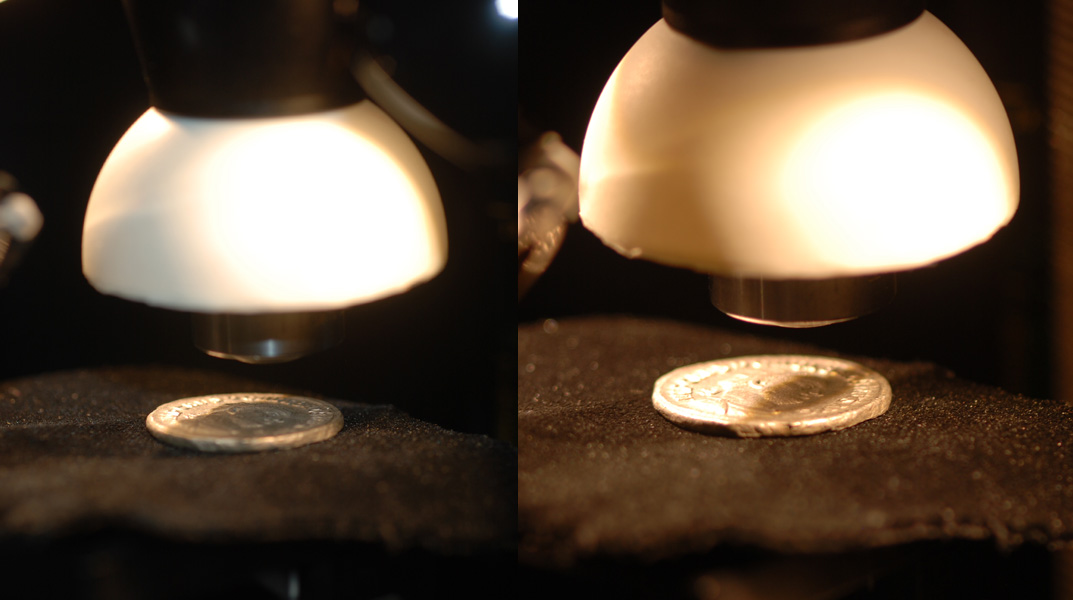 As you can see on the left image, the lens protrudes well below the base of the diffuser. But moving the lights up in order to keep the illumination on or above the diffuser, causes the lens to cast a shadow on the subject. When I try to lower the lights to eliminate the shadow (image on right), I exceed the lower limit of the diffuser, and the lighting of the subject goes completely haywire with a partial shadow, partial diffused light, and partial direct undiffused light. One obvious solution is to use something else for the diffuser, but somehow Ray is able to use a PPB with a 10x lens. What is the trick? 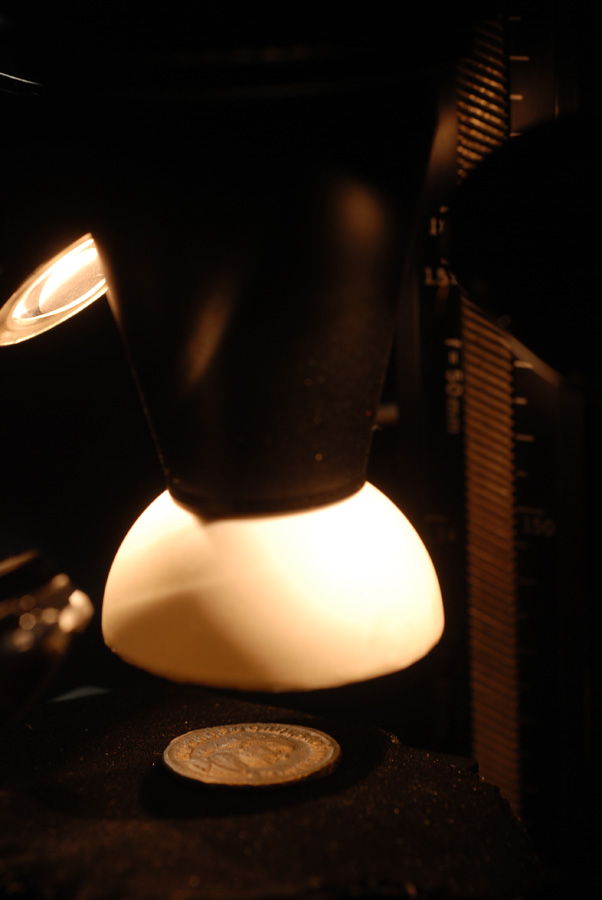 When I use a Plan4 lens with this setup, the shading of the subject is uniform. The barrel length of the lens fits the size of the PPB diffuser. Here is a shot of the test subject with a Nikon Plan4x in the setup illustrated, looking at the same region as before but now with PPB diffused lighting. This shot is composited from a 14 layer stack, and the edge anomalies have been left in. 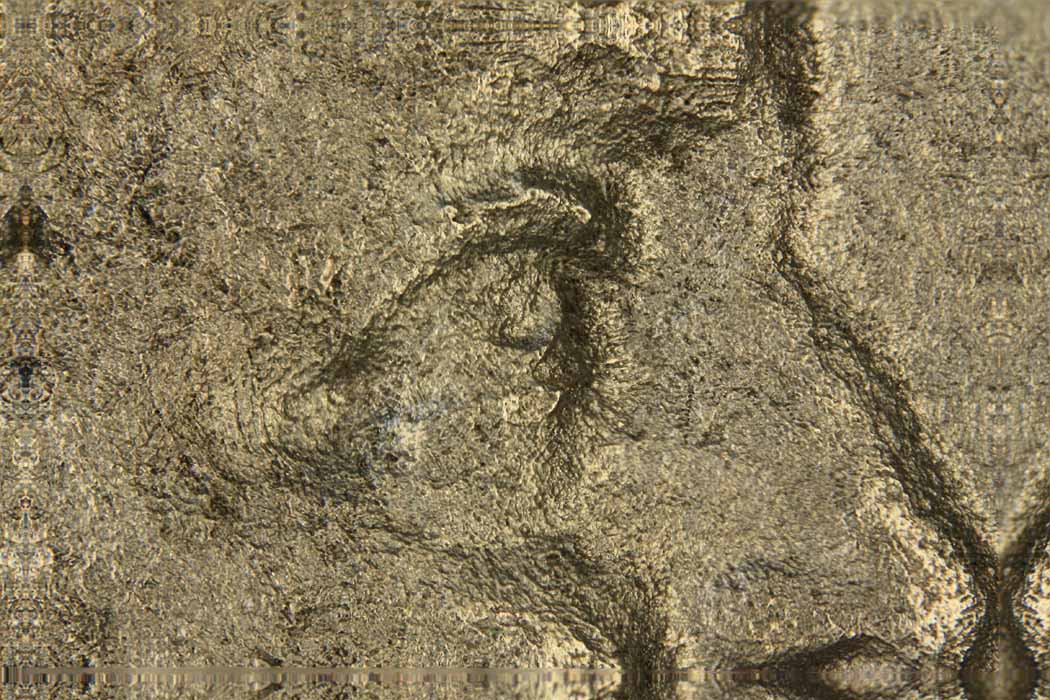 Here it is adjusted for color and tone. 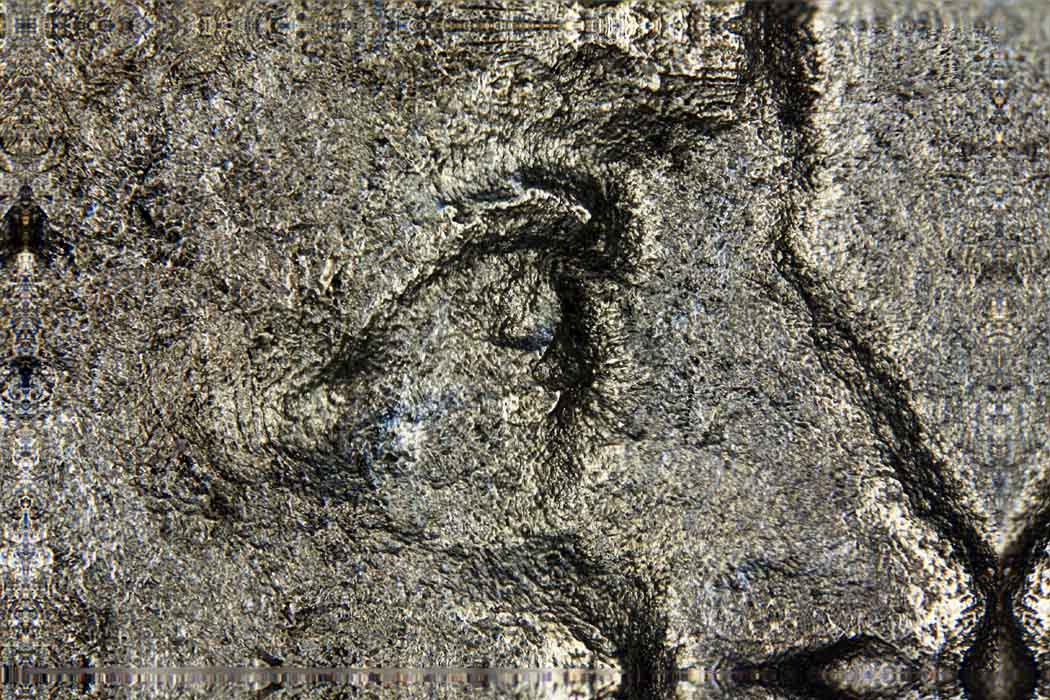 Note the granularity of the subject that was causing such a complicated image at 10x. This is a characteristic of this alloy and any high mag image comparisons need to take the alloy into account. Unfortunately these tests do not do direct comparisons of the original undiffused lighting with the Plan4 lens. Edited by lrbguy
07/20/2016 12:43 pm
|
|
Pillar of the Community
United States
4051 Posts |
Looks like you're mounting the PPB "above" the objective, ie holding the PPB in place with the objective. This is generally too high. I usually mount either PPB or flat diffuser "below" the objective, ie I attach the diffuser to the bottom of the objective, usually with double-stick tape. For lower mags, with longer working distance (WD), this works very well for PPB. But for high mag objectives that have short WD, I just use flat diffusers (masked outside a certain radius).
One thing that might help is to remove the front trim ring. This might reduce the diameter of the objective a little and allow more light.
|
|
Pillar of the Community
2087 Posts |
As rmpsrmps has pointed out there are different approaches. Here is the lighting and diffusion I used for the Axumite coin( letter T) I used a white light panel for back lighting as well as lights aimed at the Translucent half Sphere. The half sphere just sits on the light panel. I can get away with just the back lighting. I haven't tried out the masking technique rmpsrmps recommended 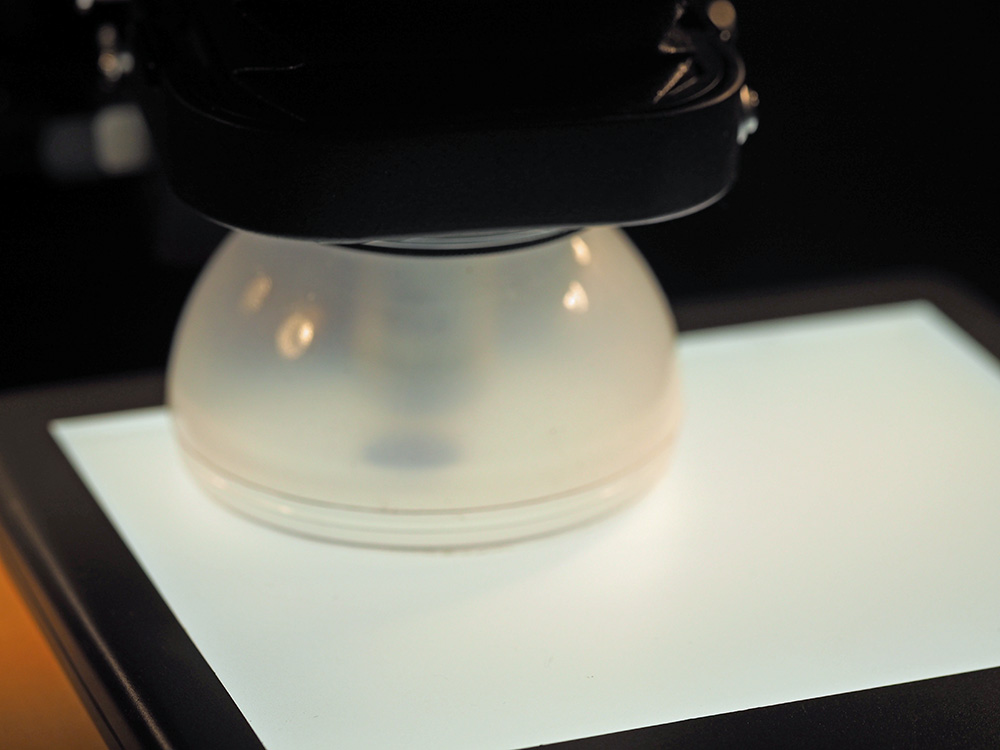 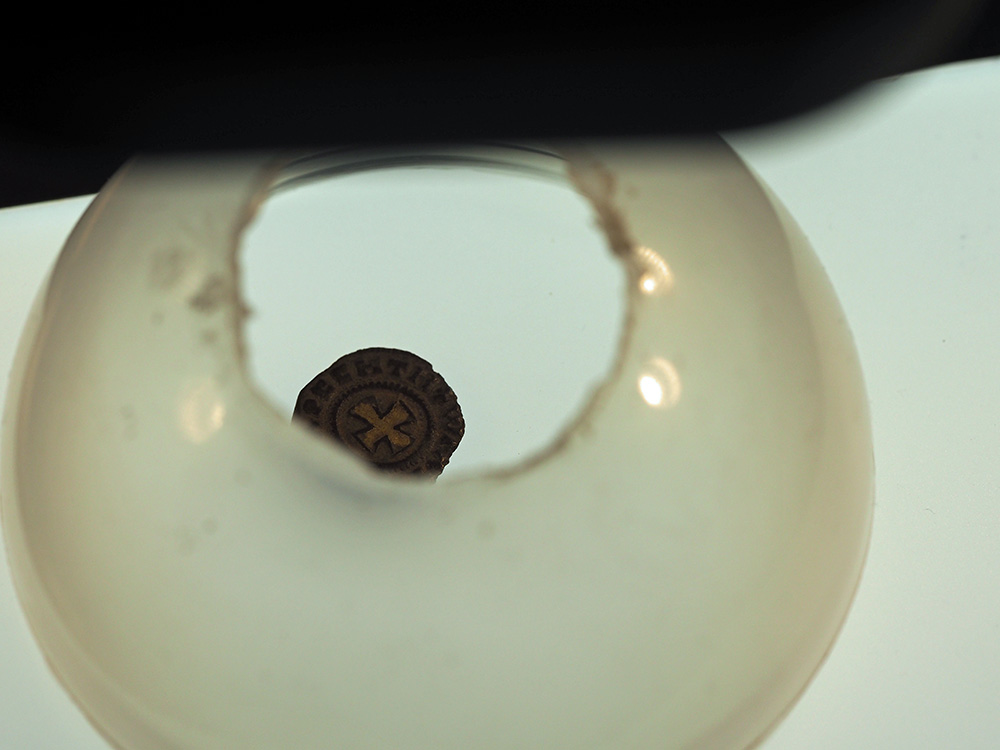 I have found that it pays to play around with multiple techniques until you find one that matches you work style and equipment Edited by austrokiwi
07/20/2016 1:39 pm
|
|
Pillar of the Community
2087 Posts |
Last night I redid the stack of the axumite coin at 10 X. I just only back lighting to illuminate the hemisphere I use. I believe a Ping pong ball half would be better as the translucent nature of the half sphere I used required a 2.5 second exposure for each shot. I masked off the lower part of the hemisphere. as below: 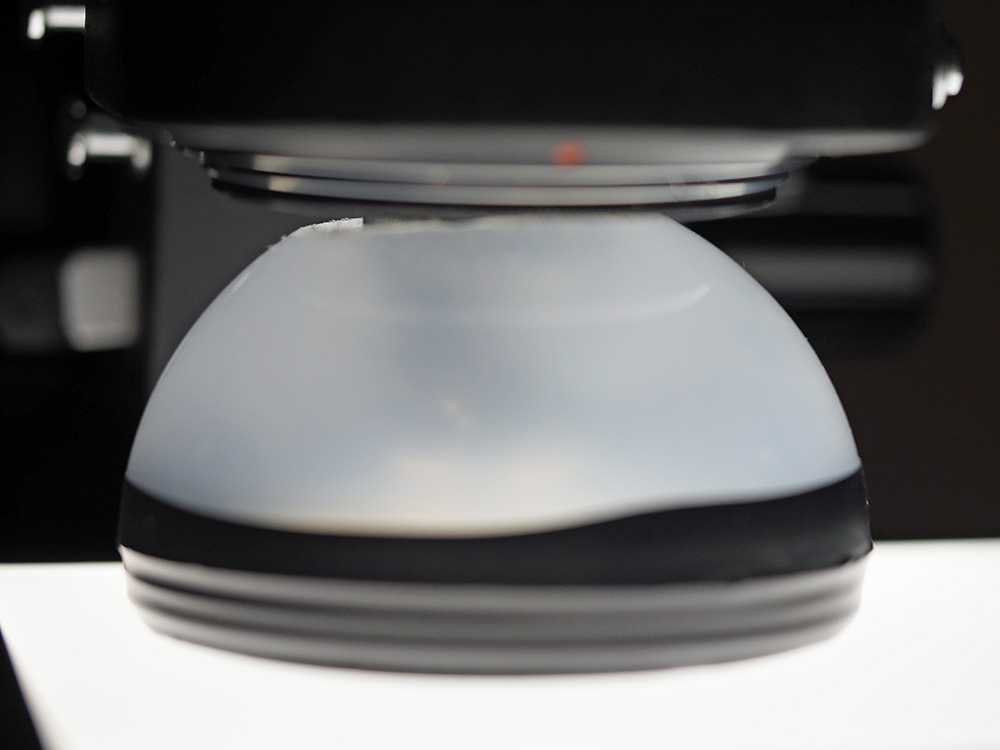 I tried to different methods for stacking the shots ( over 200) the pyramid method ws disappointing, as I had previously found the depth map method was best. I do have an issue now with Helicon Focus.... have a look at the bottom edge( the bar code like pattern) I believe this is a feature that is typical of trial versions of the software. Last night my stacks were getting trial version script superimposed on the pictures. I have had a number of similar issues with this software and it is annoying to contact the seller and ask how to fix it all the time. I will be emailing them again today asking what is going on. I am seriously thinking of switching to zerene stacker when my current license for helicon focus has expired. Here is the back lit and partially masked result: 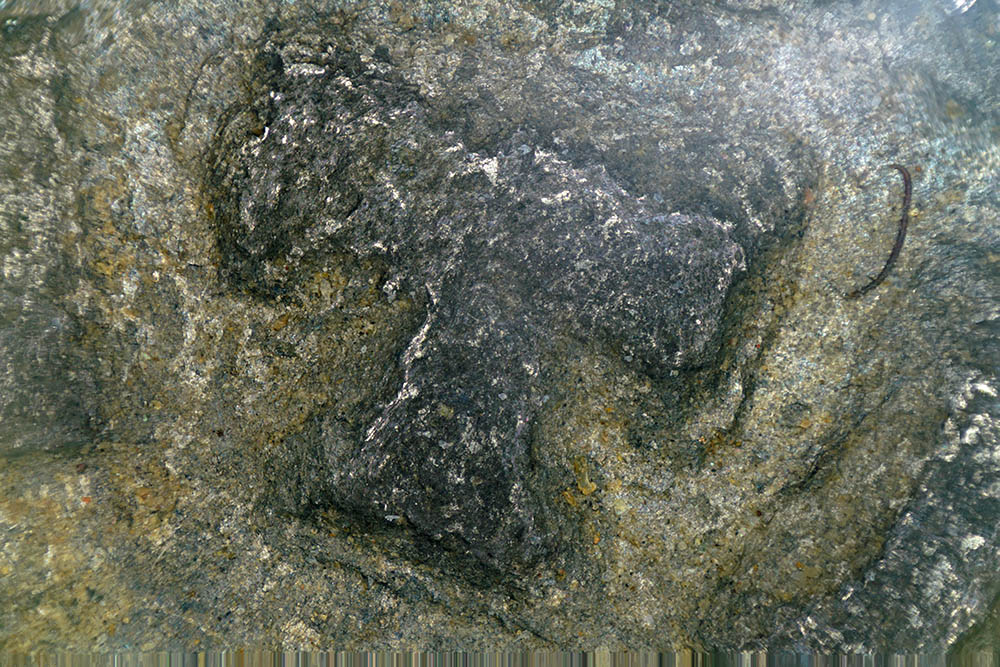 Edited by austrokiwi
07/21/2016 04:41 am
|
|
Pillar of the Community
United States
949 Posts |
Here are the results of a comparison test of images shot through a 10x objective, the first using direct lighting, undiffused, and the second under PPBdiffuse light. Here is the setup for the PPB diffusion. The coin was placed on the staging apparatus, and the ping pong ball diffuser was placed over it. The lens was lowered through its upper opening. (Note: The picture shows a goniometer as the top of the staging apparatus, but this was not used for the final images.) The same lighting arrangement was used for the image by direct lighting shown below, but without the ppb diffuser. 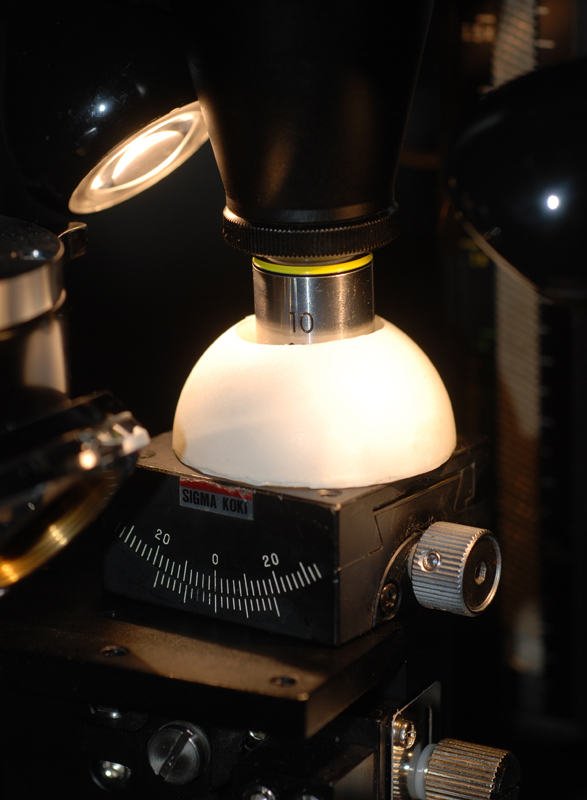 I found it a bit cumbersome to shoot with the diffuser loose and free to cover the coin. The problem came up when the coin needed to be repositioned. For the composite below, both images were composed from focus stacks rendered in the Pyramid Do mode. The upper image is derived from a twelve layer stack for the direct light image, and the lower from a 13 layer stack for the diffused light image. Neither has been adjusted in post. 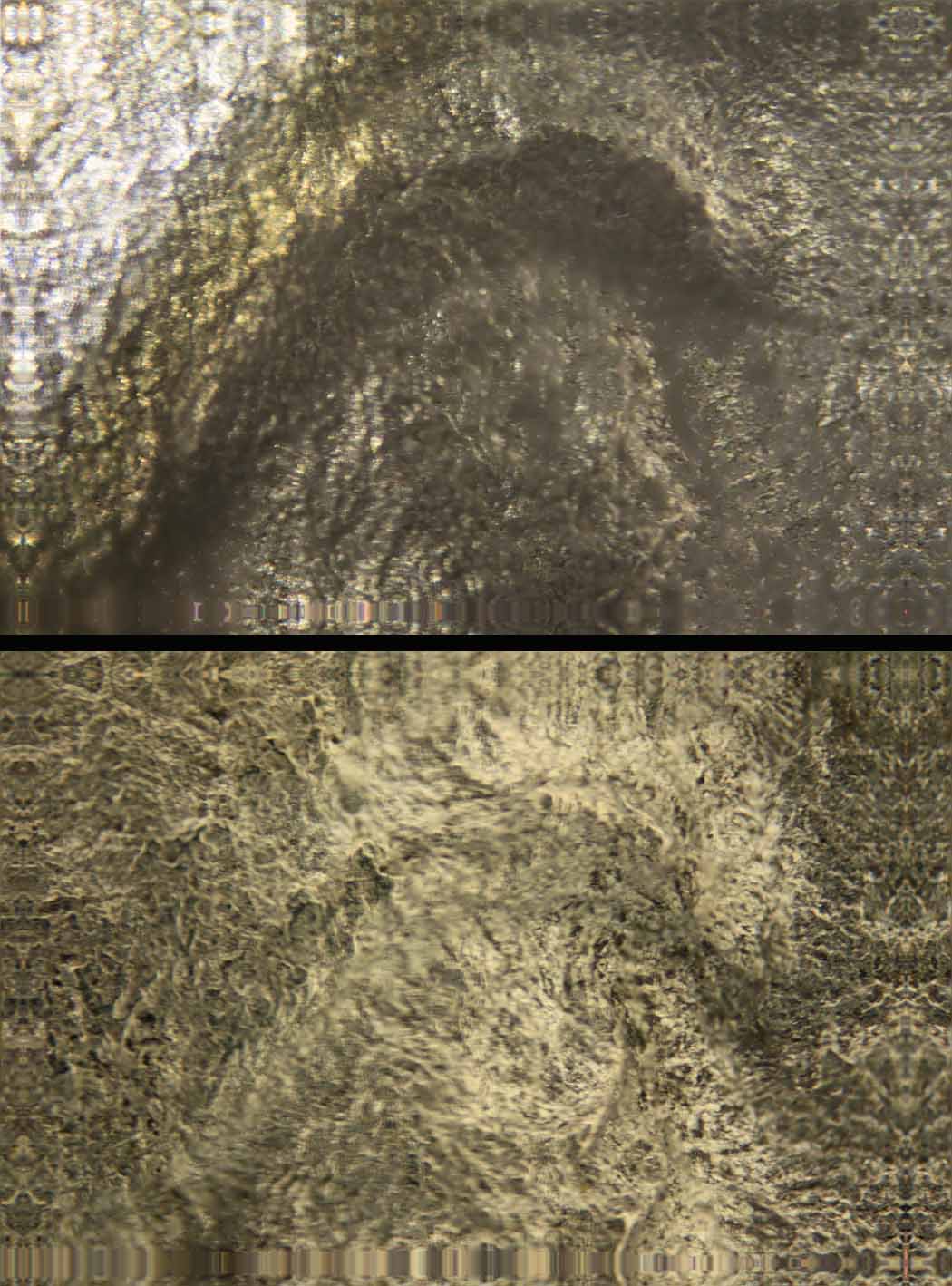 For the details I wish to expose I do not see an advantage in using the ppb diffuser. But I have only begun to explore its technique. |
|
Pillar of the Community
2087 Posts |
I have learnt that in photography there is never only one right way to do something. Often it takes the photographer time and experimentation to find the techniques that suit. I know from my own learning curve that what works well for some one else does not always work well for me. So perhaps you need to find another method However, I believe, your 12MP sensor should still be capable of shots of greater detail than I have seen so far. I do not believe in a single right way and I rankle when any one says "this is the only way", except when it comes to the laws of physics. This leads me to ask (rmpsrmps some time ago, gently, made this same point) What step are you making between photographs? At the 10X magnification you are using you should be using steps less than 0.050mm probably around 0.014mm(assuming you are using F4. Have a look at this link( if you haven't already) third table for microscope objectives: http://www.zerenesystems.com/cms/st...acromicrodof I was being very conservative and using 0.003 mm( massive over kill) and this required a stack of 273 photographs for that last photo(hence my annoyance with the Helicon focus software playing up. I have noted your claim its the surface of the coin that gives the soft effect your final images portray. However to my eye ( could well be wrong) it does look like you have been using too large a step. You may have already covered this so forgive me for asking: Are you using mirror lock up? ( if not you should as it reduces vibration) Does your camera have EFCS(Electronic front Curtain shutter)? At this level of magnification your 12MP sensor should still be capable of shots of greater detail than I have seen so far. If you do not have EFCS you may have to take longer exposures ( perhaps around 2-3 seconds) but rmpsrmps can advise you better Although my camera has some advantages over yours, with good technique you can equal or exceed my shots. Edited by austrokiwi
07/22/2016 04:04 am
|
| |
Replies: 65 / Views: 8,394 |
To participate in the forum you must log in or register.
Disclaimer: While a tremendous amount of effort goes into ensuring the accuracy of the information contained in this site, Coin Community assumes no liability for errors. Copyright 2005 - 2026 Coin Community Family- all rights reserved worldwide. Use of any images or content on this website without prior written permission of Coin Community or the original lender is strictly prohibited.
Contact Us | Advertise Here | Privacy Policy / Terms of Use
|
| Coin Community Forum |
© 2005 - 2026 Coin Community Forums |
| It took 0.42 seconds to rattle this change. |
 |
|
| |
| |






 First Page
 Previous Page


 Posted 07/19/2016 7:35 pm


