| Author |
 Replies: 28 / Views: 3,860 Replies: 28 / Views: 3,860 |
|
|
|
Pillar of the Community
Canada
5293 Posts |
A common Vickie in VG condition, undamaged, trends for at least $4, a G VI in VG trends for at least $1.
Of course damaged ones are quite a bit less. I have seen horribly mangled ones that I would be inclined to throw away.
However, ones with just honest wear have a good market. I have hundreds myself (this is not a purchase offer, by the way), because I like older, larger copper coins.
|
|
Pillar of the Community
 Canada
5654 Posts |
Without physical damage and just wear in F-12 & below ... $2-3. Eds & Geos in F-VF maybe $2 tops.
|
|
Pillar of the Community
 Canada
5420 Posts |
Vickies $3 , Eddies $2, Georges $1 hundreds to choose from at the market we attend. They are NOT super fast sellers even at these levels. Bought a thousand lot no culls from a US Dealer at 28 cents USD Each ,last summer. He was very glad to get rid of them.
Most people these days do not collect to fill albums like they used to.
Edited by Pacificoin
07/25/2016 3:13 pm
|
|
Pillar of the Community
 United States
4883 Posts |
Quote:
Bought a thousand lot no culls from a US Dealer at 28 cents USD Each ,last summer. Picked up this much smaller lot today, no Queen Victorias, but at about 20¢ apiece I wasn't about to complain. 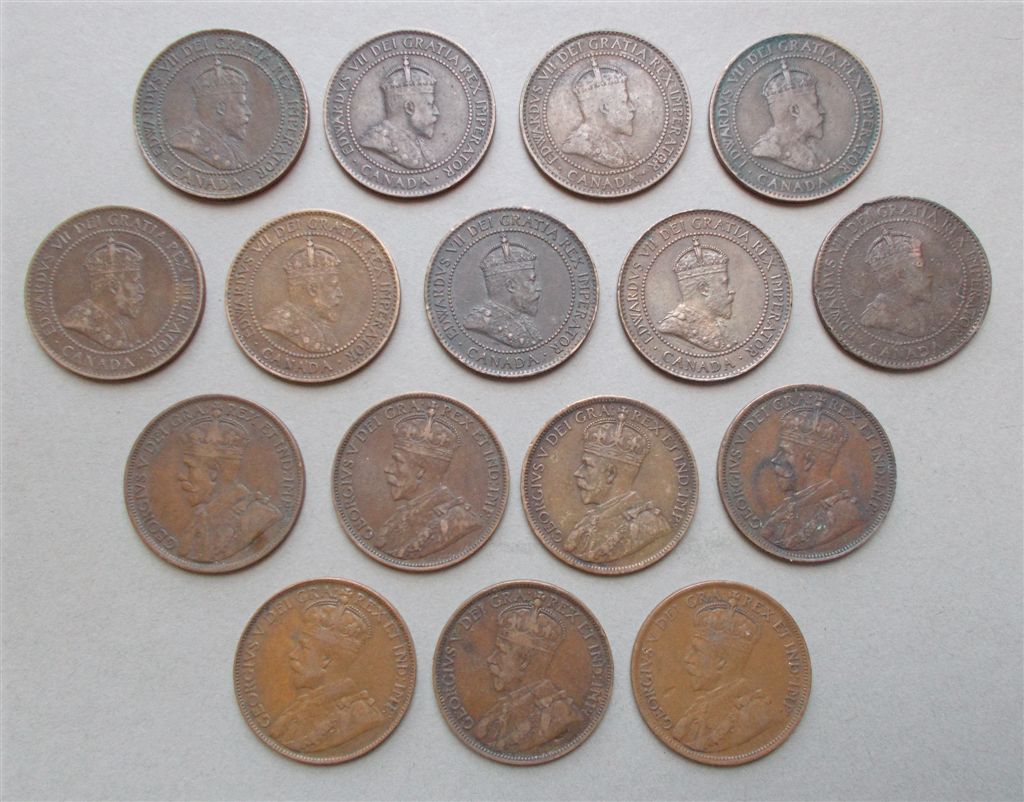 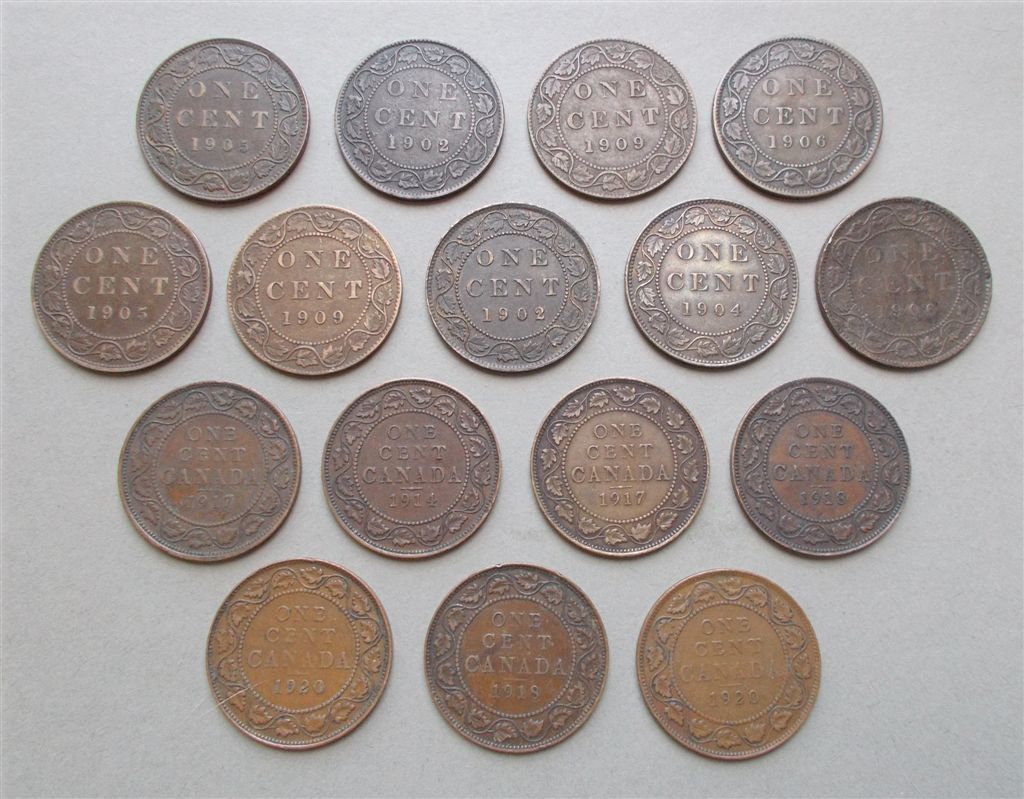 I'm still hoping somebody can shed some light on how the endgame that eliminated these being used in everyday commerce played out. Colligo ergo sum
|
|
Pillar of the Community
Canada
1571 Posts |
I thought $60 cdn for 100 was a good deal. 20 cents a piece is fantastic. I've found setting 10 out at a time during a garage sale usually can pull in $2-3 each. I grab them at coin shops when I'm picking up other stuff and give them to friends and coworkers who think they now have a super valuable 100+ year old coin. The rest get sold to fund my hobby while introducing the hobby to newcomers. They still usually think they're cool even after learning they're worth very little, since $2 will barely get you a coffee.
|
|
Pillar of the Community
Canada
2845 Posts |
Quote:
I'm still hoping somebody can shed some light on how the endgame that eliminated these being used in everyday commerce played out.
Not only the penny decreased in size in 1920, but another change took place in 1922 when the nickel changed from a silver, smaller than a dime, to a 21.21mm nickel made of...yes, nickel. However I don't know if there's any one answer to your question unless RCM releases large penny melt records. During that era I can imagine non-urban locations circulating "old" coin still years later because it cost too much money for shipping to exchange it for the new. The 20s and 30s -- era of the stock market crash and Great Depression plus US, NFLD coin also in circulation so maybe different sized coins were just another common variance? Almost a hundred years ago in Canada, society wasn't so properly organized and coin eventually became far more worn than would ever be acceptable by the general public today. It's also possible that the majority of the large pennies were simply stashed away for years on speculation that copper prices were set to skyrocket? If so, I'd bet even private banks retained sizeable holdings until a point in time when RCM quietly began buying them back to melt down and exchange for new smaller pennies. |
|
Pillar of the Community
Canada
5654 Posts |
I keep a stash of Ed's and Geo's to give to friends who have kids or grandkids with birth years 100 years from the coin's date. It's a little token that is almost universally accepted as "really neat".
|
|
Pillar of the Community
Canada
5293 Posts |
According to Charlton: Quote:
The large cents were not immediately withdrawn, but were allowed to circulate until the late 1930s. The implication is that after that they began to be withdrawn, but this is not proof. But I suspect that after 20 years of small cents, the large ones were largely stashed away as novelties. There seems to be no shortage of them. |
|
Pillar of the Community
Canada
3049 Posts |
|
|
Pillar of the Community
Canada
5293 Posts |
@AgCoinAu, that lot sold for 5 times the estimate of $200, which I would assume to be the approximate market value. So did someone overpay?
|
|
Pillar of the Community
Canada
1571 Posts |
For 800 of them in average circulated condition, I wouldn't pay more than $400 for them. And I think that's being generous. They aren't in "serious collector" condition so it'd take a long time to unload them a few at a time. I think it'd take the ones in poorest condition and make something cool out of them. I've seen some pretty sweet floors made out of pennies and grout.
|
|
Pillar of the Community
United States
4883 Posts |
Quote:
800 of 'em for under$2 few other listings after this one to ... just an indication as to market value With the buyer's premium, it worked out to just $1.40 Can each (roughly $1.12 US given the exchange rate at that time). Not sure what it cost to ship them, but that expense should've bumped those numbers up a tad. If they were shipped to a Canadian address, there also likely would've been 5% to 15% GST/HST (tax). So in the end the cost actually might well have approached $2 Can apiece. Quote:
For 800 of them in average circulated condition, I wouldn't pay more than $400 That's probably the sensible price point if making any money on them within your lifetime is the goal. Only if a substantial portion was in at least XF condition could a higher price point be justified, and while there was a bit of hyperbole in the listing to that effect, there was absolutely no guarantee. Quote:
There seems to be no shortage of them. And there shouldn't be, unless there was in fact at some point a concerted effort by the government to gather them up for recycling. Doing the math, just under 52 million Victorias were produced, over 30 million Edward VII's, and almost 78 million George V's. That's a grand total of right around 160 million. Colligo ergo sum
Edited by Lucky Cuss
07/26/2016 5:46 pm
|
|
Pillar of the Community
Canada
2845 Posts |
The Canada Currency Act stipulates it's illegal to melt coin, however the act was passed only in 1985. Was there an equivalent law prior to that, I have no idea. But one of the primary uses of copper has traditionally been electrical and plumbing pipes, likely beginning a steep rise in post WW2 years.. Perhaps private melters required copper supply in order to produce the same? Tools, weapons as well....the large pennies surely were a conveniently available source of raw material.
It's also commonly believed a huge amount of Canadian silver coins crossed into the US in the 60s when the value of silver increased higher than face. Copper has peaked at times creating the same situation. I think it would be highly unlikley the majority of large pennies are still kicking around considering decades ago the tripling or quadrupling of even one cent yielded actual spending power.
Edited by wildflowerAB
07/26/2016 6:42 pm
|
| |
Replies: 28 / Views: 3,860 |





 First Page


 Posted 07/25/2016 2:13 pm





