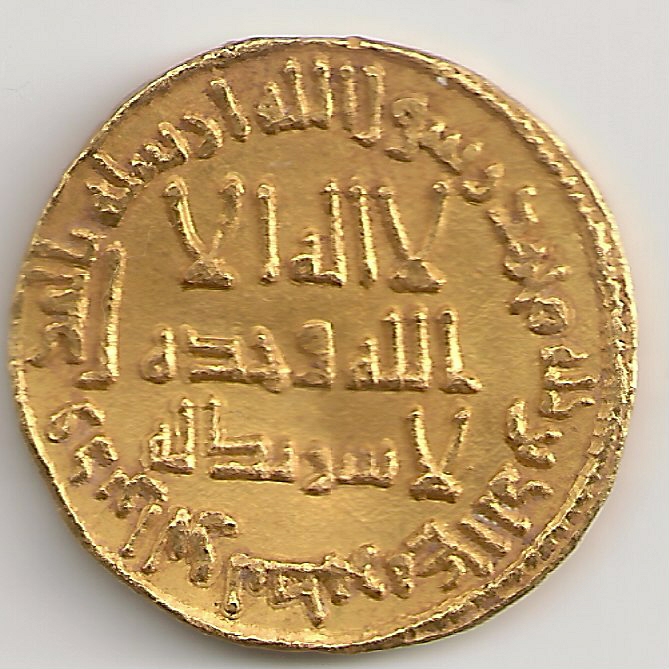
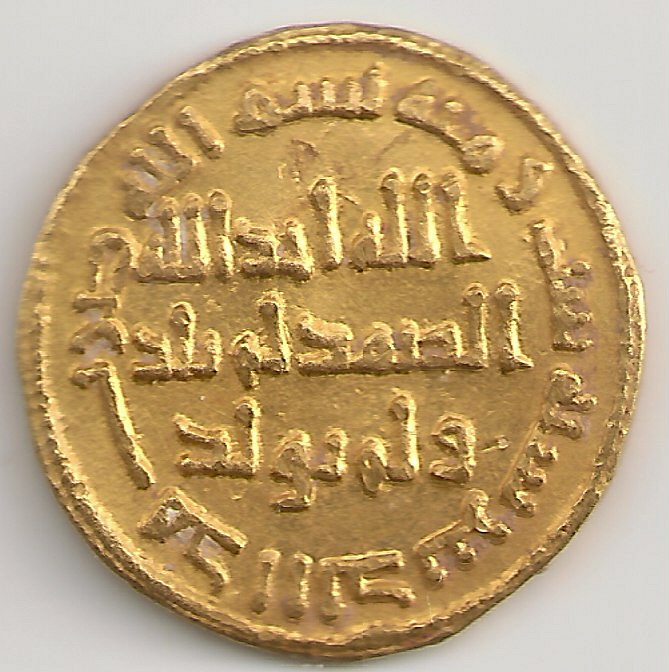
Added another coin to my early Islamic collection. Just in case you didn't know, among my other coin areas I am also acquiring coins from the early caliphates (Rashidun, Umayyad, Abbasid). I am not too picky with regards to which rulers or regions; as long the coin is early Islamic and doesn't look like it went through a blender, run over a few times, etc. then I will most likely be interested. This is my second dirham in my collection, and my first dirham of the Umayyad Caliphate. The small spots of hard sand/dirt on the obverse have since been removed.

Some basic info:
This particular example is a silver dirham of the Umayyad era (661-750 AD). It is 27 mm wide.
It does not make reference to the reigning caliph, but it does have a date, AH 102, dating approximately to 720-721 AD, the beginning of the reign of Yaz#299;d ibn Abd al-Malik (Yazid II). AH stands for Anno Hegirae, Latin for "in the year of the Hijra", the Hijra being the event in 622 AD when the Prophet Muhammad and his followers traveled to the city of Medina, a very important event in Islamic history.
Never eat with Yazid! According to a story, while eating with a slave girl of his, he threw a grape into her mouth, she choked on it and died. So, yeah....(
https://en.wikipedia.org/wiki/Yazid_II - short read I promise!)
Mint city is Wasit, in modern-day Iraq.
Islamic coins of this time period reflected the iconoclasm the Muslims practiced; no pictures or images were to be represented on Islamic coins (sorry @stevex6!). Before, the Muslims still struck their own coins but the styles were directly based on Byzantine and Sassanian coinage.
By the time this coin was struck, the caliphate had just completed its conquest of the Visigothic Kingdom in Hispania, and by then had stretched from the Iberian Peninsula to what is now Pakistan.
The Umayyad Caliphate was the largest empire in history up to that point.The Umayyad administration favored Arab Muslims over more recent, non-Arab converts to Islam. This contributed to dissatisfaction and tension in the caliphate, and eventually to open revolt in the form of the Abbasid Revolution which drove out the Umayyads (they stayed on in Hispania, however, ruling the Emirate of Cordoba).
In the obverse center it says: "There is no God but Allah. He has no equal."
Obverse margins: In the name of God. This Dirham was struck in Wasit in the year two and one hundred (AH 102)
Reverse center: God is One God. The eternal and indivisible, who has not begotten, and has not been begotten and never is there His equal
Reverse margins: Muhammad is the messenger of God. He sent him with guidance and the true religion to reveal it to all religions even if the polytheists abhor it
Umayyad Caliphate and its expansion:









 Posted 08/02/2016 4:27 pm




 )
)


