| Author |
 Replies: 18 / Views: 3,318 Replies: 18 / Views: 3,318 |
|
Pillar of the Community
United States
1101 Posts |
I just got my first St. George token. Reading previous posts from Doug, it looks like this token would be a Courteau variety between 190-207, because there are dots in the obverse rosettes. But that's all I can figure out so far. Here are the pictures. 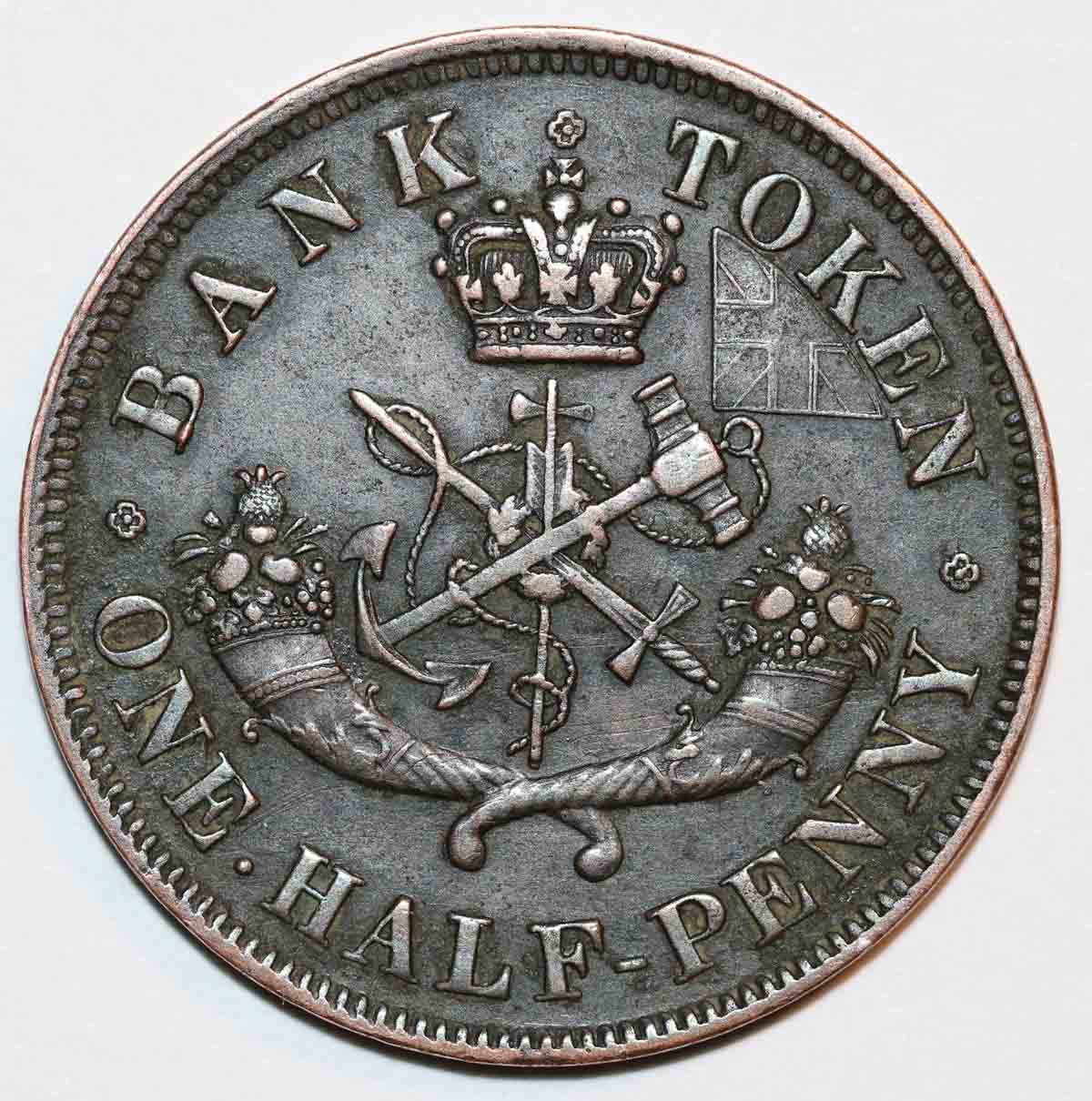 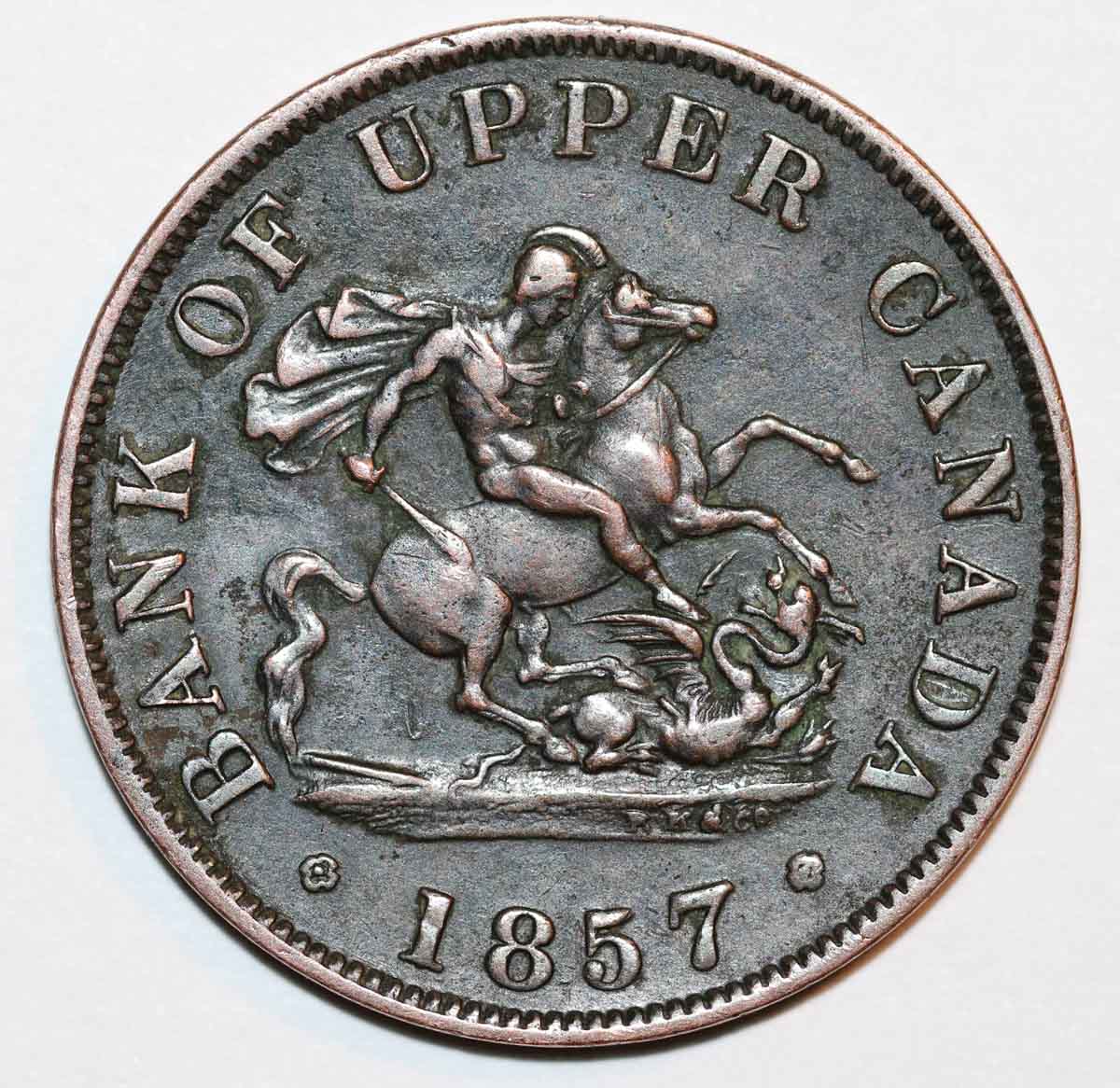 |
|
|
|
Pillar of the Community
United States
840 Posts |
Concerning th3 1857 HALF PENNY:
Phil310 is correct, this is a Doctor Courteau group II variety.
Group I varieties encompass varieties 159-189 inclusive. Group 1 varieties
shew no dots within the obverse rosettes.
Courteau group II encompass varieties 190-207 inclusive and shew dots within the
obverse rosettes.
Concerning the group II's, Dr. Courteau is concerned with the terminal anchor rope dots
(to the left of the lower section of the Battle Axe Handle). These terminate with either:
One Dot and a small line, (variety 190) or
Two small Dots, (variety 191) or
Two Dots of medium size, (varieties 192-199) or
Two large Dots, (varieties 199-204) or
Two and a half Dots, (variety 205) or
Three downward pointing Dots (varieties 206 or 207).
From the photo, we can eliminate varieties 190, 191, 199, 200, 201, 202, 203, 204, 205, 207, and 207.
The search is narrowed to one of seven possibilities. Now we must examine Dr. Courteau's specifics
concerning each of the seven.
more to follow...
doug
|
|
Pillar of the Community
United States
840 Posts |
For the aspiring student of Dr. Courteau varieties, the narrative are
somewhat perplexing. i.e., variety 192, "Fig. 7 away from and higher than 5".
Variety 193, "Fig. 7 still farther from 5." Variety 194, "Fig. 7 away from 5,
with its top higher than rosette". Variety 195, "Fig. 7 away from and higher
than 5." Variety 196, "Fig 7 still farther from 5". Variety 197, "top of 5 is
recut to the right". Variety 198, "Plain 5".
Oftentimes there is no base-line for reference. The student must positively
identify the variety using other die-markers and then study the placement of
the numeral 7 and compare the same numeral with other positively ascertained
varieties to determine specific parameters identified by Dr. Courteau.
In my work, I identify whether the 7 is on-line with the denticle or betwixt
the denticles. I further identify the 'cant' of the 7 by extending an imiginary
line across the top of the 7 to determine where it intersects the right rosette.
And much more...
I any event, the your token is Courteau variety 197:
"Obv. Man's L. foot half struck. Plain line below r. arm. Top of fig. t is recut
to the right.
Rev. The U.J. outline below letters ends in a small fork, St. Andrews cross frame
below E is broken in the middle. The four ornamental balls are well connected to
cornucopiae. Small speck before E of ONE. In some cases a die-crack between B and A.
R. 1."
Grade XF 45.
doug
|
|
Pillar of the Community
United States
840 Posts |
A few typos- ugh.
First response,
Change "Two Dots of medium size (varieties 192-199) or"
to read "Two Dots of medium size (varieties 192-198) or"
"From the photos, we can eliminate varieties 190, 191, 199, 200, 201, 202, 203, 204, 205, 207, and 207."
Chang the first 207 to read 206.
Second posting:
Delete "the" from the first line of the fourth paragraph.
sorry
doug
|
|
Pillar of the Community
 United States
1101 Posts |
Thanks Doug! It's always fascinating to follow your descriptions while attributing varieties. I think I figured out everything you describe except "the U.J. outline below letters ends in a small fork" What does the U.J. stand for?
|
|
Pillar of the Community
Canada
2786 Posts |
I'm surprised at XF45,
my limited understanding is that the lower band on the cornucopia must show individual beads in order to be in XF territory ?
|
|
Moderator
 Canada
10477 Posts |
Doug, within a reasonable amount of time (24 hours, I think) you have the ability to edit your own posts to correct typos and the like. Click on the little icon above your post with the "sheet of paper and the pencil" - that is the edit button.
cheers!
"Discovery follows discovery, each both raising and answering questions, each ending a long search, and each providing the new instruments for a new search." -- J. Robert OppenheimerContent of this post is licensed under a Creative Commons Attribution-NonCommercial 3.0 Unported License. See: http://creativecommons.org/licenses...0/deed.en_USMy eBay store
|
|
Pillar of the Community
United States
840 Posts |
Concerning the grade, over-all wear is clearly evident. I will not squabble
with a XF 40 though. Given the preponderance of other relative diagnostics,
the serriations of the Pineapples, shew wear, but are nearly complete. The
Anchor Rope Dots atop the Anchor Shaft and Battle Axe Handle shew wear, but are
discernible. The Mantle strap on the Chest nearly merges into the man's pectorials,
but a line of demarcation does exist. The initials below the ground are sharp.
The Bridle Strap and Rein are strong and do not merge into the body of the Horse.
The Hemispheres atop the Globe are present. The design elements of the Basket Weave
of the Cornucopiae are strong. The Helmet does not merge into the man's Face. The
double lines of the outlines of the three quadrants of the Union Jack have not yet
merged together.
Weighing all factors, I opted for a XF 45, but at least an AX 40.
p.s. SSP Ottawa
Thanks for the info; I was unaware of the edit feature.
doug
|
|
Pillar of the Community
United States
840 Posts |
U.J. is Doctor Courteau's nomenclature for Union Jack (some refer to this as the shield).
The U.J. is the outer edge.
Normally a second line is opposite the E in TOKEN. The inner line is referred to by Dr.
Courteau as the outer edge of the St. Andrew's Cross frame. On some varieties, this
outline extends below the K in TOKEN.
Some become perplexing. Is the "fork" actually a fork in the U.J., or is the left
branch actually the lower segment of the St. Andrew's Cross frame. Some are clearly
apparent, others...?
enough for now
doug
|
|
Pillar of the Community
 Canada
5654 Posts |
Doug ... And all this from a guy who rode a motorcycle from Fla to Toronto for a show or two and some show& tell. Your token research is top notch. Hope to see you sometime in near future.
|
|
Pillar of the Community
United States
1101 Posts |
U.J. for Union Jack. Thanks Doug. I think I've got it now.
These are very interesting tokens, and now that I've got one to look at, I'm probably going to want more.
Numismania seems to be an incurable disorder.
|
|
Bedrock of the Community
Canada
10743 Posts |
 ..very interesting, more info Doug, love it. Edited by SHAFTA9a
09/16/2016 08:47 am
|
|
Pillar of the Community
United States
1101 Posts |
This looks like the small fork described in Dr. Courteau's description, just under the right side of the E. 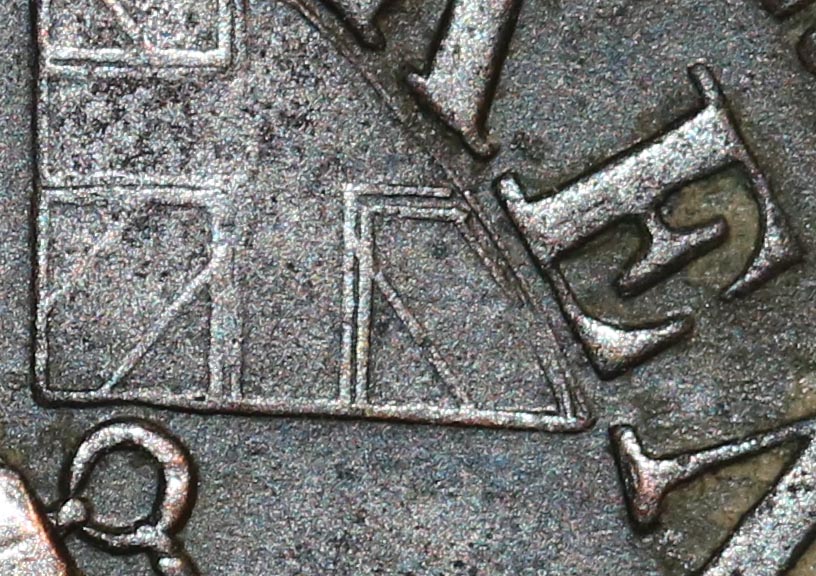 |
|
Pillar of the Community
United States
840 Posts |
Yes.
And it must be understood that the optics and magnifications used by Dr. Courteau were
not on par with what we have today. And numismatic photography was still in diapers.
This is where many enigmas arise when working Dr. Courteau's great tome.
Examine the segment of a line betwixt the outline of the Union Jack and the St. Andrew's
Cross frame below the right section of the upright of the E in TOKEN. On some varieties,
Dr. Courteau mentions the Union Jack being recut. On this variety, Dr. Courteau identified
this anomaly as being forked. As seen in your great photo, one can use some imagination
and see that this is actually a second line (also weak in the centre) betwixt the Union Jack
outline and the St. Andrew's Cross frame. On higher grade ensamples, this is more prominent.
And this is why careful crud removal is paramount. The crud has to be removed to discover what
lies below. And in my work, for the sake of clarity, when referencing right-side/left-side of
legend characters, I am basing the reference from the 6 o'clock position. When referencing the
right-side/left-side of Denticles, I am referencing the such from the 12 o'clock position.
Why? Denticles about the 9 o'clock and 3 o'clock position do not a right or left-side, but a
top and bottom. But one can not use top and bottom because the top is the rim and the bottom
is the curved base. Oh well, rambling too much.
doug
|
|
Pillar of the Community
Canada
2786 Posts |
I'm still having trouble getting past VF on this (but more than willing to learn) 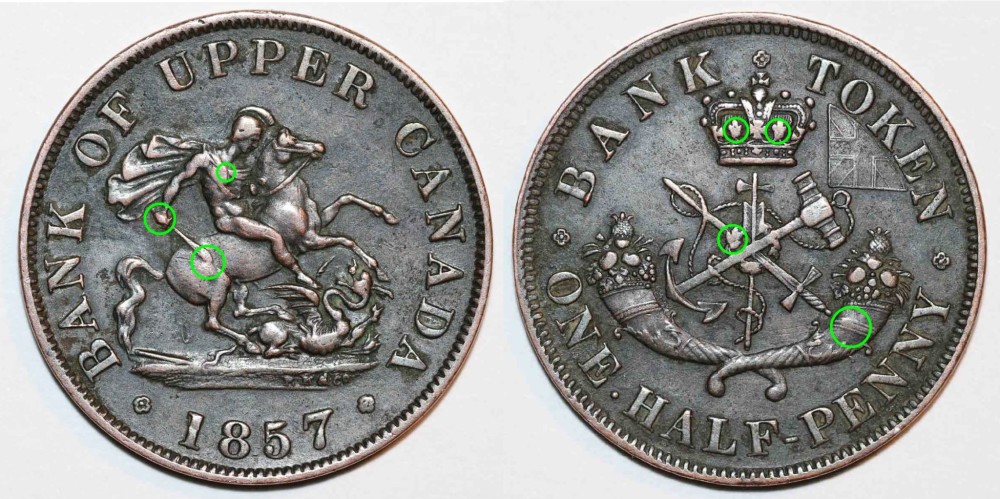 The fingers of the hand holding the sword are indiscernible, as is the clasp holding the cape. The sword tip blends into horse's thigh. The band that wraps the Fleur-dis-lis has blended away, as have the leafs of the wreath at the junction of the anchor and sword. As mentioned before the beads in the lower bands of the cornucopia have lost their individual shapes. Most tend to over grade this series, perhaps I tend to under grade? |
|
Pillar of the Community
United States
840 Posts |
Grading such tokens is often subjective.
This token exhibits sections which shew considerable wear
(as documented in your photo) which are characteristic of
a VF 30 or so.
In contrast, other sections of the token shew minimal wear
and are characteristic of a XF 40 grade.
The token does shew mild environmental damage (corrosion).
The corrosion should be noted, but is not sufficient to
detract from a technical grade.
Aside of the ding below the horse's Haunch, the fields shew
less dings than one would expect on many VF ensamples.
The rims do not appear to have any noticeable distractions (damage).
I suspect some of the cloudiness within the devices could be minimized
thus enhancing to appearance of the token.
Is the glass half full or half empty?
In this case, I opted to the higher grade, primarily because one would
expect wear to be more uniform throughout. How could the stronger
elements (mentioned in a previous narrative) not shew comparable wear.
This token shews no die-cracks indicating the lack of late state die fatigue.
What caused the weaker areas? Perhaps a slightly lighter weight planchet
contributed, perhaps the strike was not struck squarely. I do not know.
And yes, I am always learning and willing to change.
doug
|
| |
Replies: 18 / Views: 3,318 |










 Posted 09/15/2016 3:31 pm


